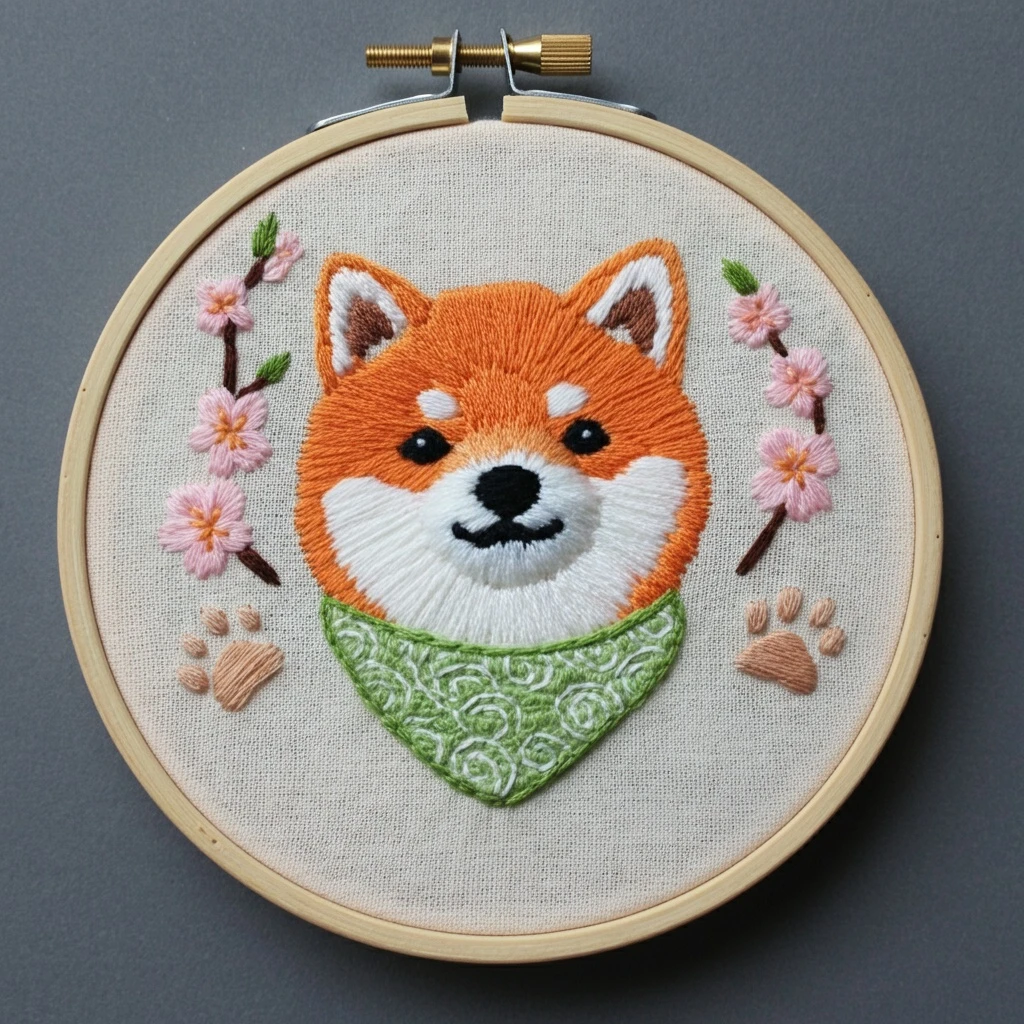

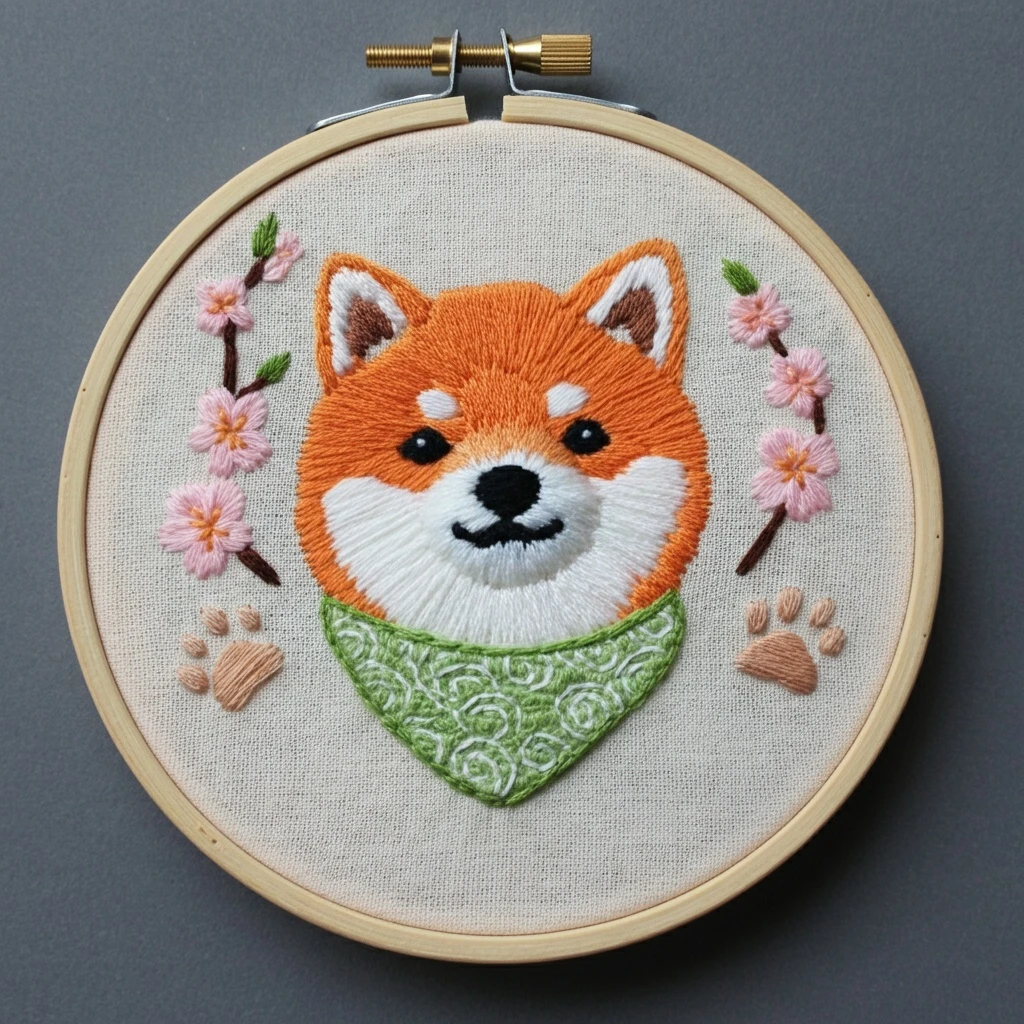
Shiba Inu Blossom Portrait
A polished floss and stitch plan for a warm Shiba portrait framed with delicate blossoms: cinnamon-orange fur, creamy muzzle highlights, expressive dark eyes, pink petals, and soft leafy accents.
Color story from the design
The artwork reads as a centered pet portrait with the Shiba Inu's face as the focal point. The dominant notes are toasted orange and russet fur, creamy white muzzle and cheek planes, charcoal facial accents, and a surrounding wreath of blush-pink blossoms with small green leaves. Keep the palette warm and natural so the dog remains soft rather than cartoon-flat.
Suggested DMC palette
Stitch map and practical technique notes
Blending and shading guide
| Area | Blend suggestion | Use note |
|---|---|---|
| Outer ears | 1 strand 919 + 1 strand 920 | Creates rich copper shadow without becoming black. |
| Cheek fur | 1 strand 920 + 1 strand 922 | Good all-purpose coat mix; feather strokes into cream areas. |
| Muzzle transition | 1 strand 3826 + 1 strand 739 | Softens the border between orange fur and pale muzzle. |
| White fur shadows | 1 strand 739 + 1 strand 3021 | Use lightly under the chin, around the nose, and beside cheeks. |
| Blossom petals | 1 strand 818 + 1 strand 335 | Balanced pink for mid petals; add 3865 at tips for sparkle. |
Thread-count guidance
For a 6-inch hoop
- Use 2 strands for most fur fill.
- Use 1 strand for eyes, nose shine, whisker dots, and petal veins.
- Use 3 strands only for foreground blossoms that need extra fullness.
For an 8-inch hoop
- Use 3 strands for broader coat areas if the fabric is open-weave.
- Blend 2 colors in the needle for smoother shaded cheeks.
- Keep all facial outlines at 1 strand to avoid a heavy cartoon edge.
Beginner-friendly order of stitching
1. Establish the face
- Outline the eyes, nose, and mouth with very light guide stitches first.
- Fill pale muzzle areas before the orange coat so darker threads do not fuzz into the cream.
- Work fur in short sections and rotate the hoop often to keep stitch direction comfortable.
2. Build warm coat layers
- Place DMC 920 as the middle value, then add 919 shadows and 922 highlights.
- Do not cover every gap; tiny fabric spaces can mimic natural fur texture.
- Blend transitions with scattered single stitches instead of hard stripes.
3. Add blossoms and leaves
- Stitch flowers from back to front so overlapping petals make sense.
- Use satin stitch for large petals and lazy daisy for small buds.
- Add a few French knots last so they stay raised and clean.
4. Finish with expression
- Add catchlights with one tiny stitch of DMC 3865.
- Use black brown only where needed; too much dark thread can flatten the portrait.
- Steam from the back after finishing, avoiding pressure on knots.
Texture suggestions
For the Shiba's fur, vary stitch length between 3-8 mm so the coat looks layered. Around the cheeks, let cream stitches overlap orange stitches by a few millimeters to imitate fluffy fur. For the nose, use tight satin stitch or padded satin stitch with 1 strand of DMC 3371 and a final tiny white highlight. For blossoms, combine satin petals with French-knot centers and a few detached chain leaves to keep the floral frame light, sweet, and dimensional.