
DMC color palette & stitching guide
Autumn Roots Tree
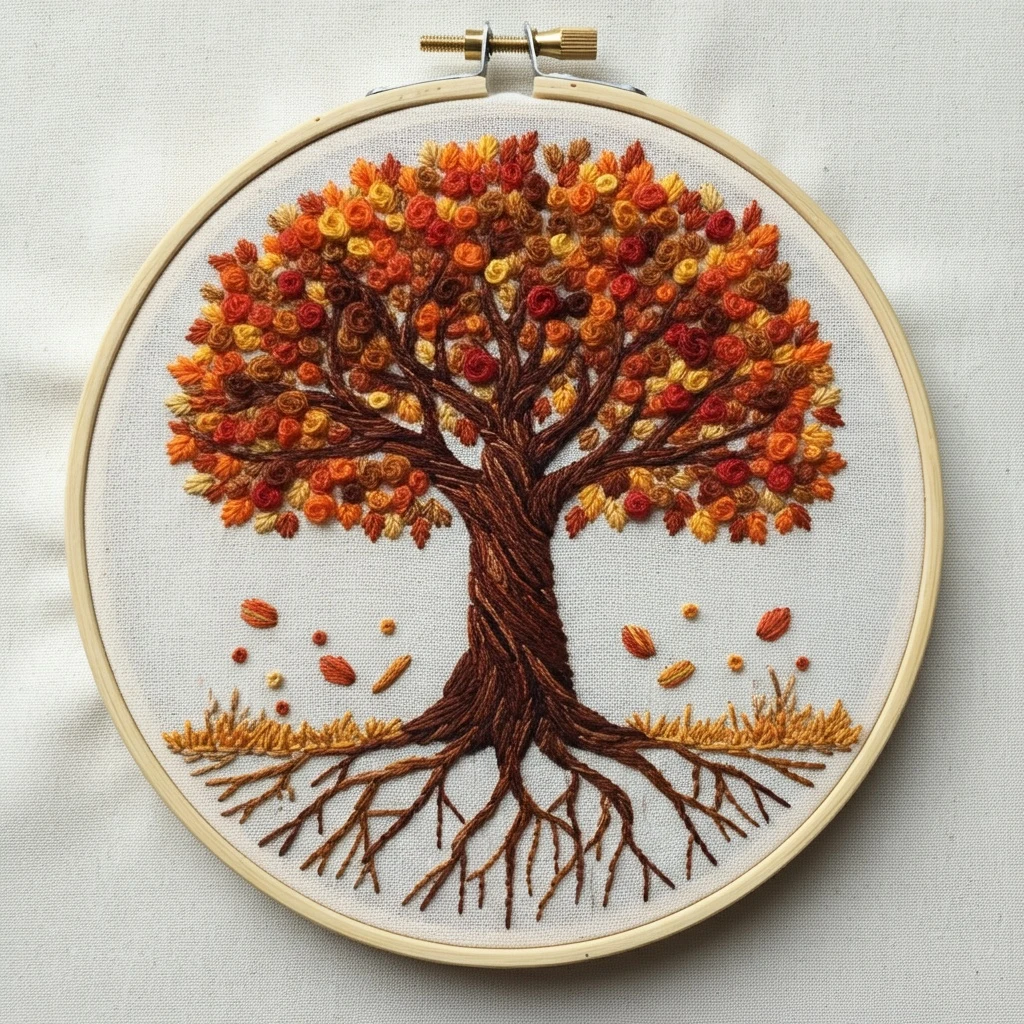
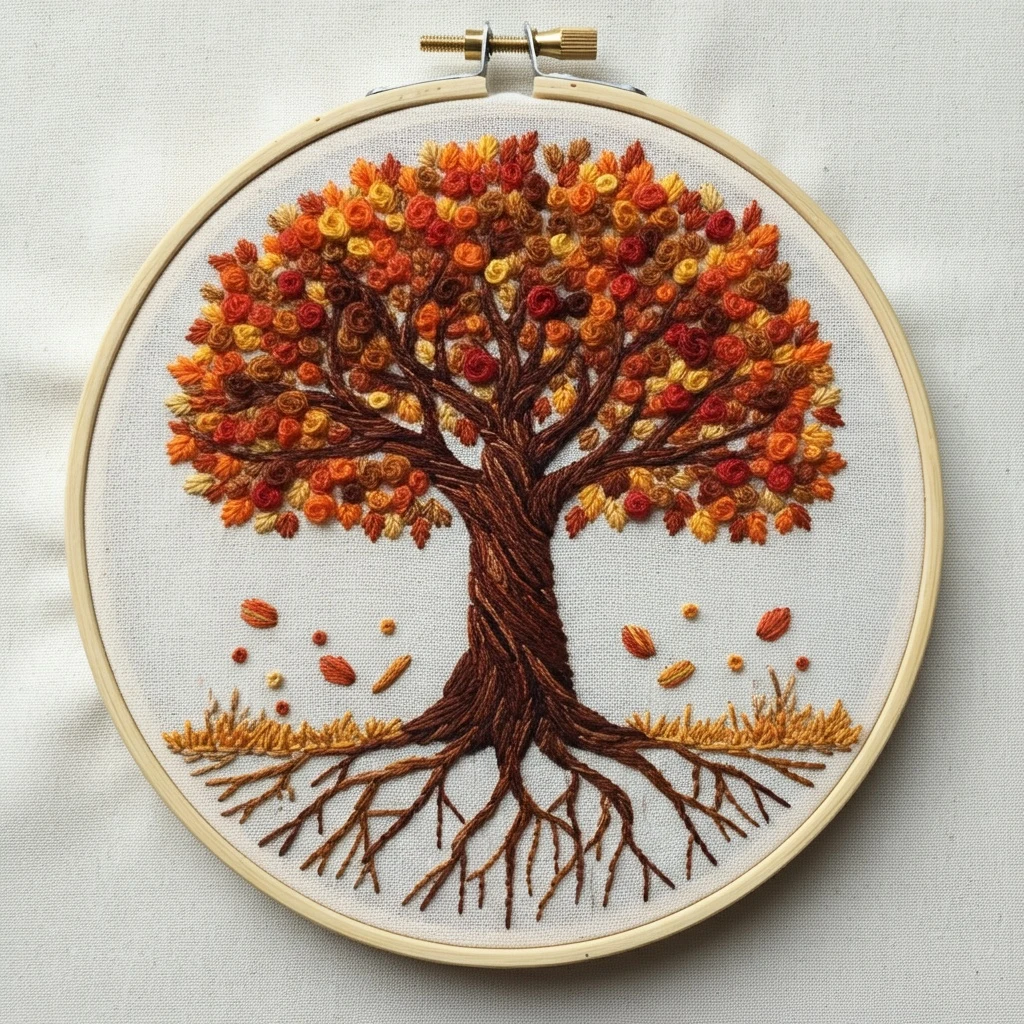
A warm embroidery guide for a symbolic autumn tree design: twisting roots, textured bark, falling leaves, and a grounded harvest-season palette of ochre, rust, umber, moss, and deep shadow.
Suggested DMC palette
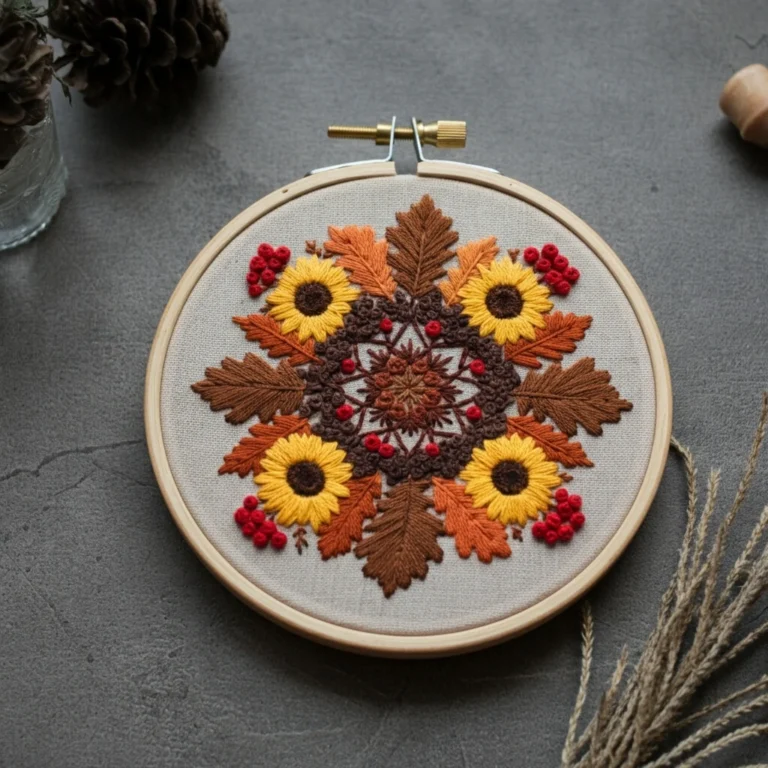
The design reference reads as an earthy autumn tree composition: a sturdy trunk and exposed roots in layered browns, leaves in gold and burnt orange, and darker accents to define the root channels and inner bark. Use the brighter tones sparingly so the tree keeps a natural, woodland feel.
Stitch suggestions by area
| Area | Recommended stitches | Practical notes |
|---|---|---|
| Tree trunk | Long and short stitch, stem stitch, split stitch | Work vertical and slightly curved strokes. Alternate DMC 975, 433, and 3826 to create bark grain. |
| Exposed roots | Stem stitch, whipped back stitch, couching | Use 2 strands for main roots and 1 strand for small root hairs. Add 3371 only after the shape is filled. |
| Leaf clusters | Lazy daisy, fishbone stitch, satin stitch | Mix 783, 976, 921, and 920 leaf by leaf rather than stitching one color block at a time. |
| Tiny falling leaves | Detached chain, straight stitch, seed stitch | Use single stitches in 783 and 921 for movement around the tree canopy. |
| Moss or ground | Seed stitch, small French knots, short straight stitches | Blend 732, 832, and 898 to anchor the roots without creating a heavy base. |
| Outlines | Back stitch, split back stitch | Outline selectively. Too much dark line can flatten the organic root shapes. |
Thread-count guidance
Blending ideas
For a soft bark transition, thread one strand of DMC 975 with one strand of DMC 433. For sunlit root ridges, blend DMC 3826 with DMC 3822. For coppery leaves, combine one strand of DMC 921 with one strand of DMC 976, then finish a few edges with DMC 920.
Shading and texture plan
Outlining details
Use dark outline sparingly around the trunk silhouette, lower roots, and a few major branches. For natural depth, make the lower and inner lines darker than the upper edges. A split back stitch in 1 strand gives a softer botanical line than a heavy back stitch.
Beginner-friendly workflow
- Stitch from the center trunk outward so your hand does not disturb finished leaf clusters.
- Complete the largest root shapes before adding tiny root hairs or moss knots.
- Use short lengths of floss, about 14–16 inches, because browns and copper tones can fuzz when repeatedly pulled through fabric.
- Step back after every few leaf clusters to check color balance. Add more gold near the top and more dark brown near the roots.
- Press only from the back on a padded towel so French knots and textured root stitches stay raised.
Leaf shading recipe
Base with DMC 976, shade the base with DMC 920, add a side highlight in DMC 783, and place one tiny vein in DMC 3822. Rotate the direction of each leaf to keep the canopy lively.
Bark recipe
Lay irregular long-and-short stitches in DMC 975. Add DMC 433 beside it, deepen cracks with DMC 898, then use occasional DMC 3826 strokes for warm bark ridges.
Root recipe
Stitch each root as a curved stem line, then whip or couch the largest roots for thickness. Shade the lower side with DMC 3371 and leave the top edge warmer.