
Pastel Rose Garden
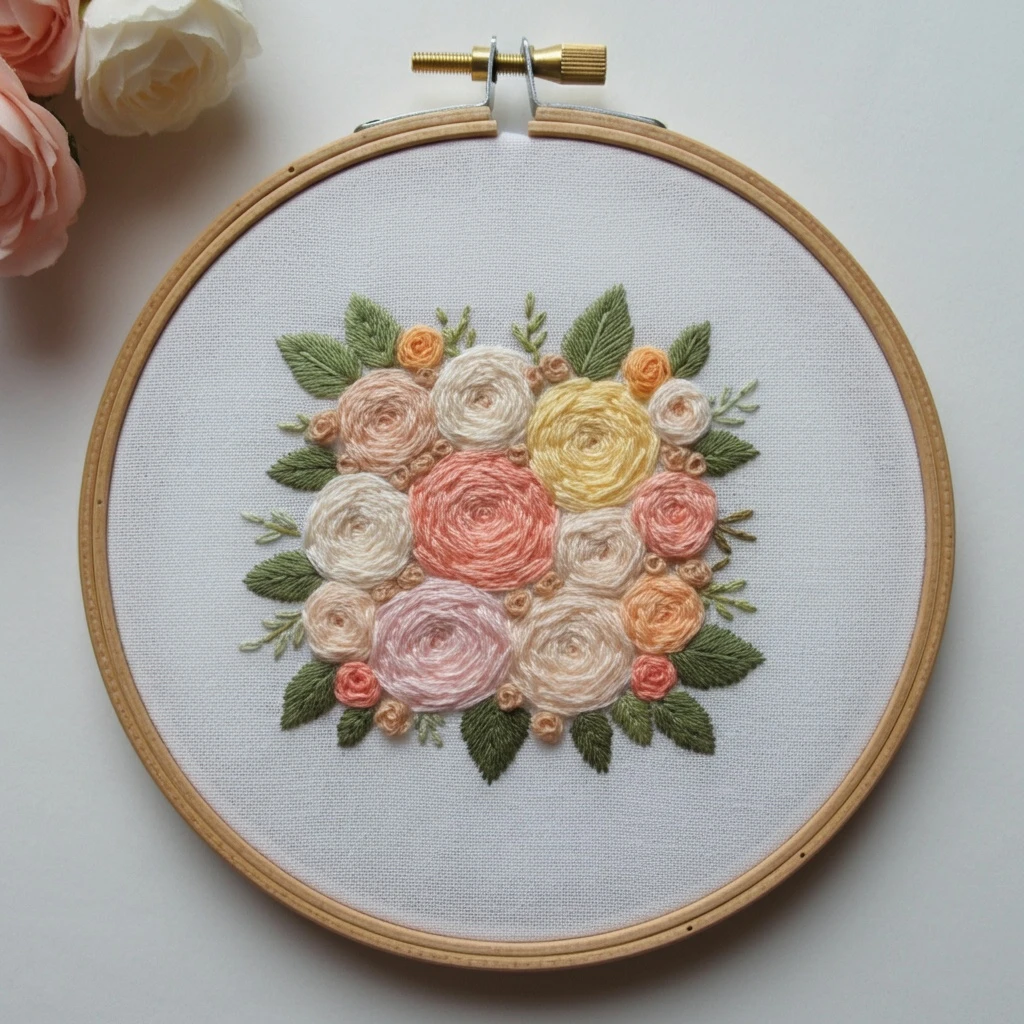
A soft hoop bouquet filled with layered rosette blooms, creamy garden roses, peach buds, butter-yellow highlights, and textured sage foliage. This guide translates the pastel floral embroidery into practical DMC floss choices and beginner-friendly stitch planning.
Suggested DMC Color Palette
Use the softer colors as the main body of the flowers, then reserve the deeper shades for petal shadows, centers, and small accent buds. For a hand-dyed look, blend one strand of a light tone with one strand of a mid tone inside the same rose.
Tiny highlights on ivory roses and the brightest petal ridges. Use sparingly so the cream roses stay soft.
Primary color for the large cream and white blooms. Works beautifully in 2-strand woven wheel roses.
Underlayer for cream flowers, tan bud spirals, and soft shadow between overlapping roses.
Main blush tone for the lower pink bloom and soft edge petals. Blend with 3865 for a milky pastel.
Gentle middle tone for circular petal movement. Use after the lightest shade to keep the rose dimensional.
For the central coral flower and small red-pink buds. Excellent as a blended partner with 352.
Inner spiral, shadowed petals, and accent knots. Keep it near centers rather than across the whole bloom.
Small orange-peach rosettes at the upper and lower right. Pair with 3825 for bright petal tips.
Warm highlights on peach buds and outer loops. Use 1 strand with 3865 for a softer pastel apricot.
Main color for the pale yellow rose. Keep stitch direction circular so the yellow flower reads as a rose, not a flat disk.
Add to the center and lower arcs of the yellow bloom. A few short stitches are enough.
For the lavender-pink lower rose and muted petal shadows. Blend with 151 for a faded garden-rose effect.
Use only in the center spiral or tucked underside of the pink flower to avoid making the palette too dark.
Light-to-mid leaf sections and young sprigs. Works well for detached chain leaves and lazy daisy foliage.
Primary shade for the larger leaves behind the roses. Stitch from center vein outward for natural leaf texture.
Use under rose edges, at leaf bases, and on one side of the central vein to create depth and separation.
Stitch Map & Texture Suggestions
The design relies on soft circular flower texture contrasted with directional leaves. Keep the roses plush and rounded, then make the foliage flatter and sharper so the bouquet feels balanced.
Woven Wheel Rose
Lay 5 or 7 spokes, then weave 2 strands around the spokes. Start with the deeper shade in the center, switch to the mid tone, and finish with a light edge color.
Loose Spiral / Stem Stitch Rose
For the big coral and blush blooms, use curved stem stitch or split stitch spirals. Keep each ring slightly uneven for the handmade garden-rose look.
Bullion Knots & French Knots
Use 2 strands for tiny tan and peach buds. Bullion knots make rolled petals; French knots create seed-like centers and filler texture.
Fishbone Stitch
For the large sage leaves, stitch from the center vein outward with alternating diagonal stitches. Change from 3052 to 3362 near the base.
Stem Stitch + Lazy Daisy
Use 1 strand for slim stems and 1-2 strands for small detached-chain leaves. Keep sprigs airy so the roses remain the focal point.
Split Stitch Shadows
A fine split-stitch line in a neighboring shade can define petal edges without a harsh outline. Use only where flowers overlap.
Thread Count, Blending & Shading Guide
Recommended strand counts
- Large woven roses: 2 strands for most weaving; 3 strands only if you want a fuller, raised bloom.
- Petal spirals: 2 strands for visible texture; 1 strand for delicate inner rings and final highlight arcs.
- Small buds: 2 strands for French knots or bullions; use 1 strand when placing tiny filler dots close to a flower edge.
- Leaves: 2 strands for fishbone stitch; 1 strand for the center vein and fine outlining.
- Stems and airy sprigs: 1 strand in 522 or 3052 to avoid heavy lines.
Blending combinations
- Cream rose: 1 strand 3865 + 1 strand 738 for warm shadow, then 3865 + B5200 for petal tips.
- Coral rose: 1 strand 353 + 1 strand 352 for the inner spiral; finish with 353 alone or 353 + 225.
- Blush rose: 151 + 225 for the main body, with 224 tucked into the lowest petals.
- Yellow rose: 745 as the base, 744 at the center, and a final strand of 3865 for creamy highlights.
- Sage foliage: 522 + 3052 for soft leaves; 3052 + 3362 for dark leaves behind blooms.
Practical Stitching Order
Working from background to foreground keeps the bouquet tidy and prevents green stitches from crossing over finished roses.
Beginner-Friendly Tips
Keep the roses soft
- Use short lengths of floss, about 14-16 inches, to reduce fuzzing in pale colors.
- Do not pull woven-wheel stitches too tight; a slightly raised surface looks more like layered petals.
- When changing color inside a rose, tuck the tail under nearby stitches on the back rather than knotting repeatedly.
- Rotate the hoop while stitching circular petals so your hand angle stays comfortable.
Make the bouquet readable
- Place darker greens behind the blooms and lighter greens on outer sprigs to create depth.
- Use one fine shadow line where cream flowers touch blush flowers; avoid outlining every petal.
- Repeat each accent color at least twice in the bouquet so no single flower looks isolated.
- Press the finished piece from the back on a towel to preserve raised rosettes.
Quick Substitution Notes
If your stash is limited, keep the value relationships rather than exact numbers: one ivory, one blush, one coral, one peach, one pale yellow, one light sage, one medium sage, and one deep green are enough for a convincing version.
- For a cooler bouquet: replace 738 with 822 and use more 224 in the blush flower.
- For a warmer vintage look: add DMC 3770 or 407 to the tan buds and shadowed rose centers.
- For extra sparkle without changing the mood: add a single strand of metallic blending filament only to the lightest petal ridges.
- For linen fabric: test pale pinks first; 151 and 3865 can disappear on warm beige cloth, so add a little 225 or 738 for contrast.