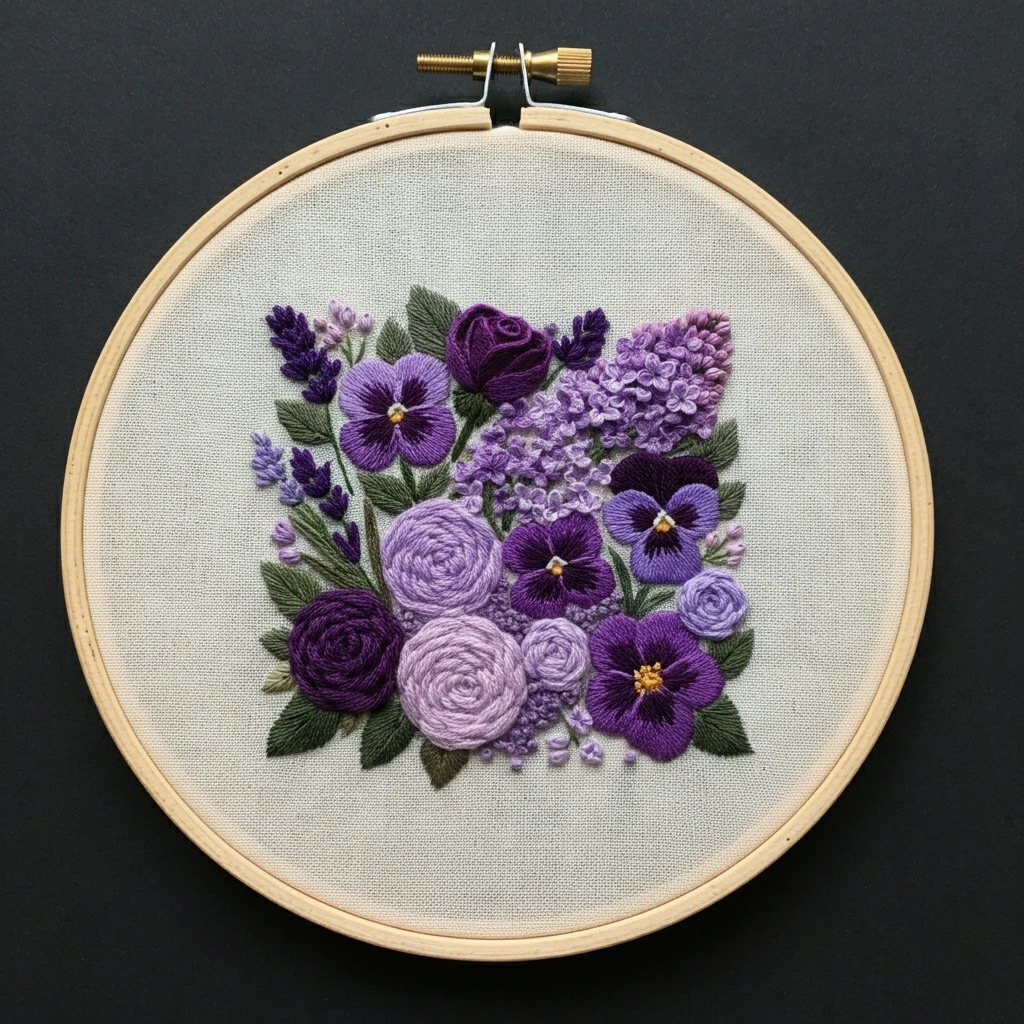

Lavender Violet Bouquet
A soft linen-hoop bouquet filled with violet pansies, tightly curled lavender roses, deep plum blooms, lavender sprigs, clustered lilac petals, sage leaves, and tiny golden centers. The design works best when the deepest purples are reserved for shadow pockets and the light lavenders are layered over them in airy, directional stitches.

Recommended DMC palette
Use the palette as a practical stitching map: dark grape shades anchor the center shadows, mid-violets build the flowers, pale lavenders create raised highlights, and muted greens keep the leaves natural rather than neon.
Stitch plan by design area
- Spiral roses: Work a woven wheel or whipped spider-web rose with 4–6 strands. Start with DMC 154 or 550 near the center, then wrap outward with 552, 554, and a few 211 highlights on the top edges.
- Pansy-style violet flowers: Use long-and-short stitch in 2 strands. Angle stitches from the petal rim toward the yellow center, leaving a dark 154/550 wedge at the throat for depth.
- Lilac cluster: Build texture with French knots, colonial knots, or tiny detached chain petals in 2–3 strands. Mix 209, 554, 211, and 3042 randomly for a natural cluster.
- Lavender sprigs: Stem stitch the stalks in 3363. Add lazy daisy petals or small straight stitches in 550, 552, and 554, alternating sides of the stem.
- Leaves: Satin stitch or fishbone stitch with 2 strands. Use 3363 at the base and vein, 3051 for the body, and 3052 along the lit outer edge.
- Fine outlines: Use one strand of 154 or 550 only where separation is needed; too much outlining can flatten the soft bouquet.
Thread-count guidance
| Area | Strands | Why it works |
|---|---|---|
| Rose wraps | 4–6 | Creates the plush, raised coils visible in the bouquet. |
| Pansy petals | 2 | Allows smooth long-and-short shading without bulky ridges. |
| Lilac knots | 2–3 | Gives small bead-like blossoms with enough texture to stand out. |
| Stems and veins | 1–2 | Keeps greenery crisp and prevents stems from overpowering flowers. |
| Highlight strokes | 1 | Adds delicate shine on pale lavender petals and leaf tips. |
Blending, shading & texture suggestions
Soft violet gradients
Blend one strand of DMC 552 with one strand of 554 for mid-petal areas. For darker flower throats, blend 154 + 550, then soften the edge with 550 + 552.
Raised floral dimension
Use padded satin stitch under the largest pansy petals or a woven wheel for the roses. Padding should stay just inside the shape so the final layer keeps a clean edge.
Natural lilac scatter
Avoid stitching the lilac cluster in straight rows. Place knots unevenly, with darker knots tucked underneath and pale 211 knots on the upper-right highlight zones.
Leaf movement
Work fishbone stitch from the center vein outward, changing angle with the leaf shape. This makes the leaf look folded rather than flat.
Golden centers
Use 2 strands of DMC 783 for French knots, then add one or two tiny straight stitches in a lighter yellow if you want extra sparkle.
Background control
On natural linen, keep jump threads short and trim dark purple tails carefully; deep grape floss can shadow through pale fabric.
Beginner-friendly workflow
- Transfer the design lightly so pale lavender stitches do not have to cover heavy lines.
- Stitch stems and leaf veins first; they act like a map for the bouquet.
- Complete the large roses next, because their raised texture can crowd nearby small flowers.
- Fill pansies with long-and-short stitch, saving the yellow centers until the petals are finished.
- Add lilac knots and lavender sprigs last so their small textured stitches sit visibly on top.
- Finish with one-strand accents: dark separations, pale glints, and a few loose buds around the bouquet edge.
Practical hoop tips
- Use a sharp crewel needle for woven roses and a smaller embroidery needle for one-strand outlines.
- Condition or separate floss before stitching dark purples; they can twist and look ropey.
- Work with fabric drum-tight in the hoop to keep satin petals smooth.
- Step back often: the bouquet should read as light lavender, mid-violet, deep plum, sage green, and tiny gold.