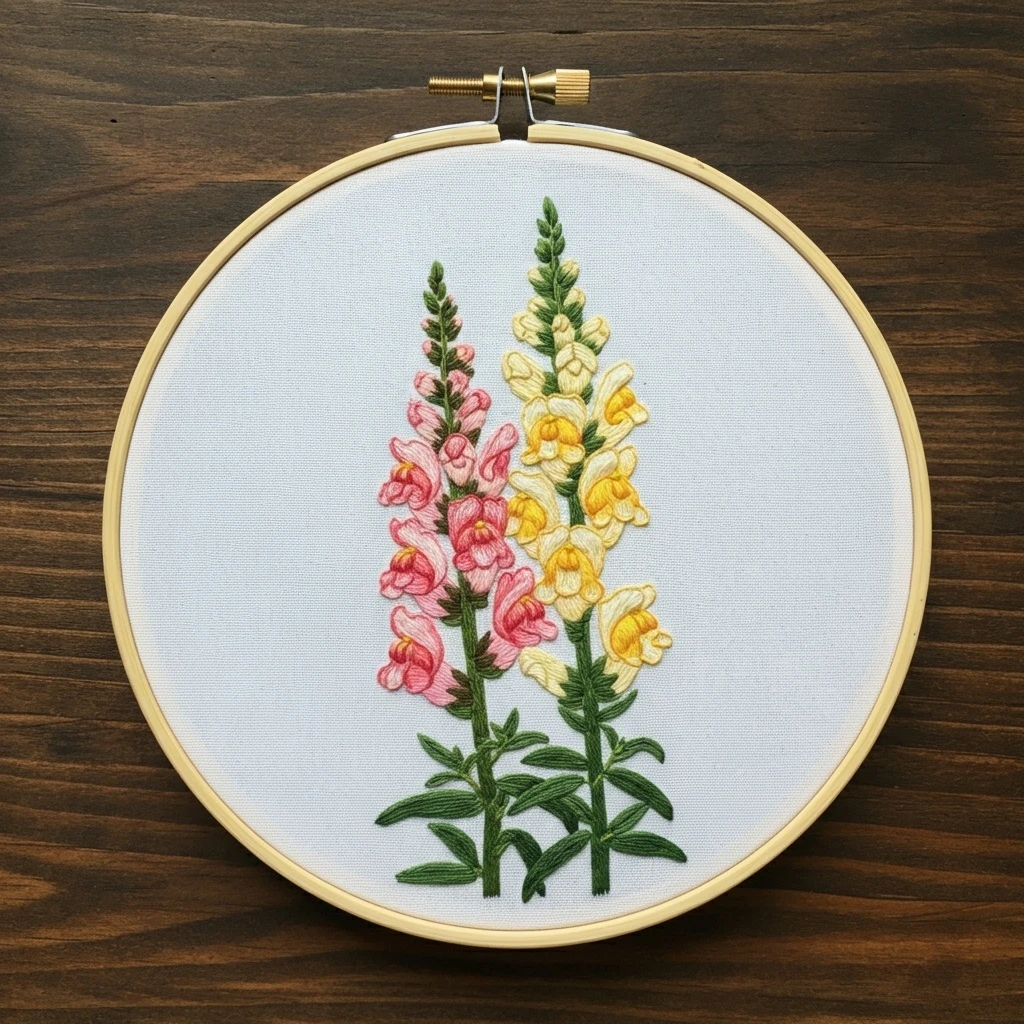

Pink Yellow Snapdragons
A cheerful botanical hoop with two upright snapdragon stems: rosy-pink blooms on the left, buttery yellow blooms on the right, deep green stems, pointed leaves, and small stacked buds. The guide below keeps the look light, dimensional, and beginner friendly while giving enough shading structure for a polished finish.

Design read
The composition is vertical and airy, with most of the visual weight in the flower spikes. Petals are rounded and cupped, so the embroidery should emphasize soft curved outlines, darker folds near the throat of each bloom, and lighter highlights on the outer petal edges.
The foliage is more structured than the flowers: long, narrow leaves radiate from the stems and should be stitched with clean center veins and directional satin or fishbone stitches. Keep the stems slim and strong so the blooms feel supported without becoming heavy.
Quick stitch map
Split stitch outlinesLong & short petalsFishbone leavesStem stitch stalksFrench knot centers1-strand fold linesThread-count overview
- 1 strand: petal fold lines, bud tips, fine veins, delicate outlines.
- 2 strands: most petals, leaves, stems, and shaded fill work.
- 3 strands: occasional base stems only, if the design is enlarged.
Suggested DMC floss palette
Use the pink family for the left spike, the yellow family for the right spike, and the greens to separate buds, leaf clusters, and the central stems. The palette is intentionally soft but includes a few darker accents for definition.
Flower stitching
- Outline first: use 1 strand split stitch in a matching mid-tone: DMC 335 for pink petals and DMC 3078 or 972 for yellow petals.
- Fill petals: work long-and-short stitch with 2 strands. Start from the petal rim and angle stitches toward the throat so each blossom looks cupped.
- Petal folds: add curved 1-strand lines in DMC 326 on pink blooms and DMC 783 on yellow blooms. Keep these broken and light, not continuous heavy outlines.
- Centers: use tiny satin stitches or a single French knot in DMC 972/783 for yellow centers and DMC 326 with a touch of 972 for pink centers.
Leaves, stems & buds
- Stems: stitch the tall stalks in stem stitch with 2 strands of DMC 3363; add a narrow shadow line with DMC 895 on one side.
- Leaves: use fishbone stitch or slanted satin stitch, blending DMC 469 into DMC 3363. Add center veins with 1 strand of DMC 895.
- Buds: make stacked buds with short lazy daisy stitches or small satin ovals. Highlight tops with DMC 470 and shade bases with DMC 3363.
- Sepals: use small straight stitches that point upward into each bloom to create the snapdragon spike texture.
Recommended stitching order
Blending ideas
For the pink blossoms, thread one strand of DMC 3716 with one strand of DMC 335 for soft mid-petal areas. For yellow blossoms, blend DMC 745 with DMC 3078 near the outer edges and DMC 3078 with DMC 972 near the throats.
Shading guidance
Place the deepest colors where petals tuck under each other and where blooms meet the green stalk. Leave the outer rims lighter. A few small dark accents are more convincing than heavy shading everywhere.
Texture tips
Vary stitch direction blossom by blossom. Use smoother satin-style stitches for open petals and shorter, bumpier stitches for upper buds. This contrast helps the snapdragons feel layered and lively.
Beginner-friendly practical notes
- Use a sharp embroidery needle for clean petal curves; switch to a slightly larger needle only when using 3 strands on stems.
- Keep thread lengths around 14-18 inches to reduce fuzzing, especially with pale yellow and pale pink floss.
- Do not pull satin stitches too tightly. Snapdragon petals should sit softly on the fabric rather than pucker.
- When two flowers touch, outline the front petal after filling the back petal. This creates a crisp overlap without needing extra dark thread.
- Press from the back over a folded towel when finished to protect French knots, raised centers, and padded petal areas.