
DMC palette & hand embroidery notes
Golden Aspen Forest
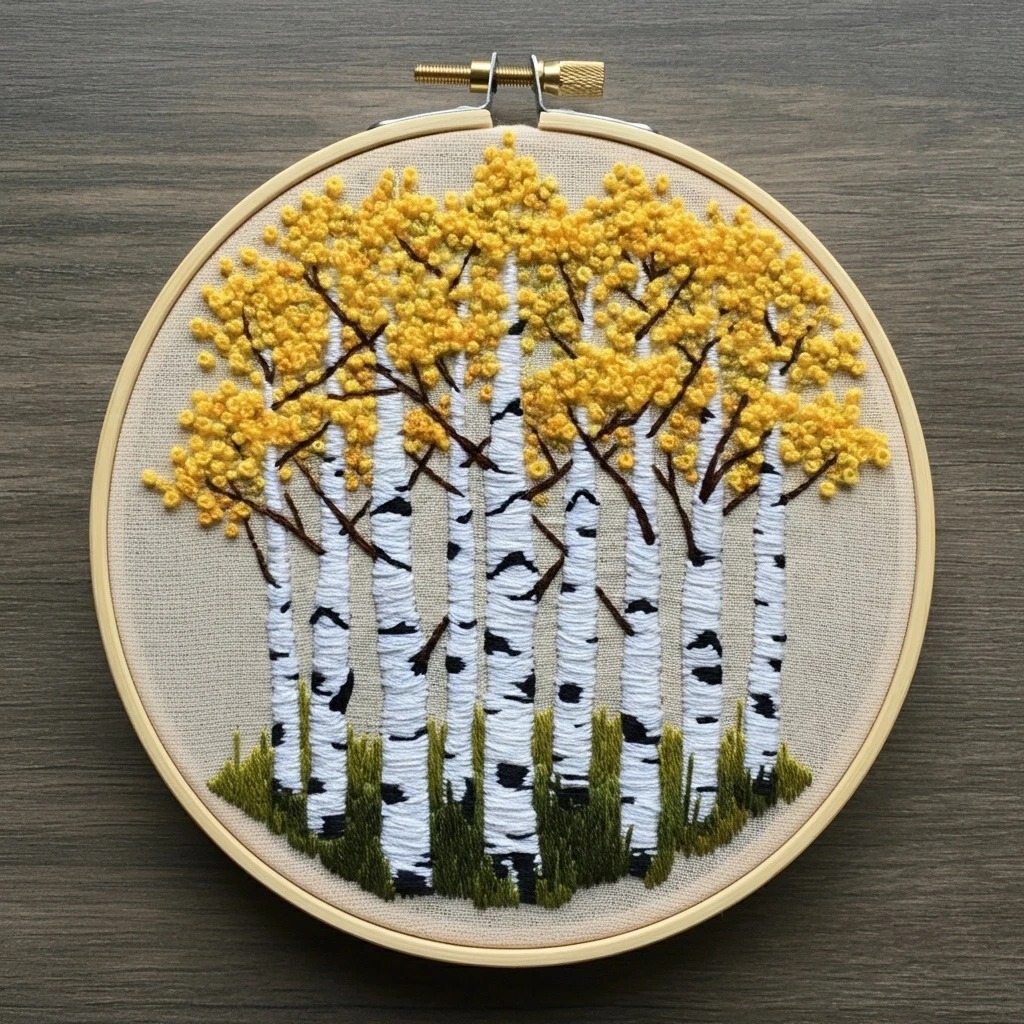
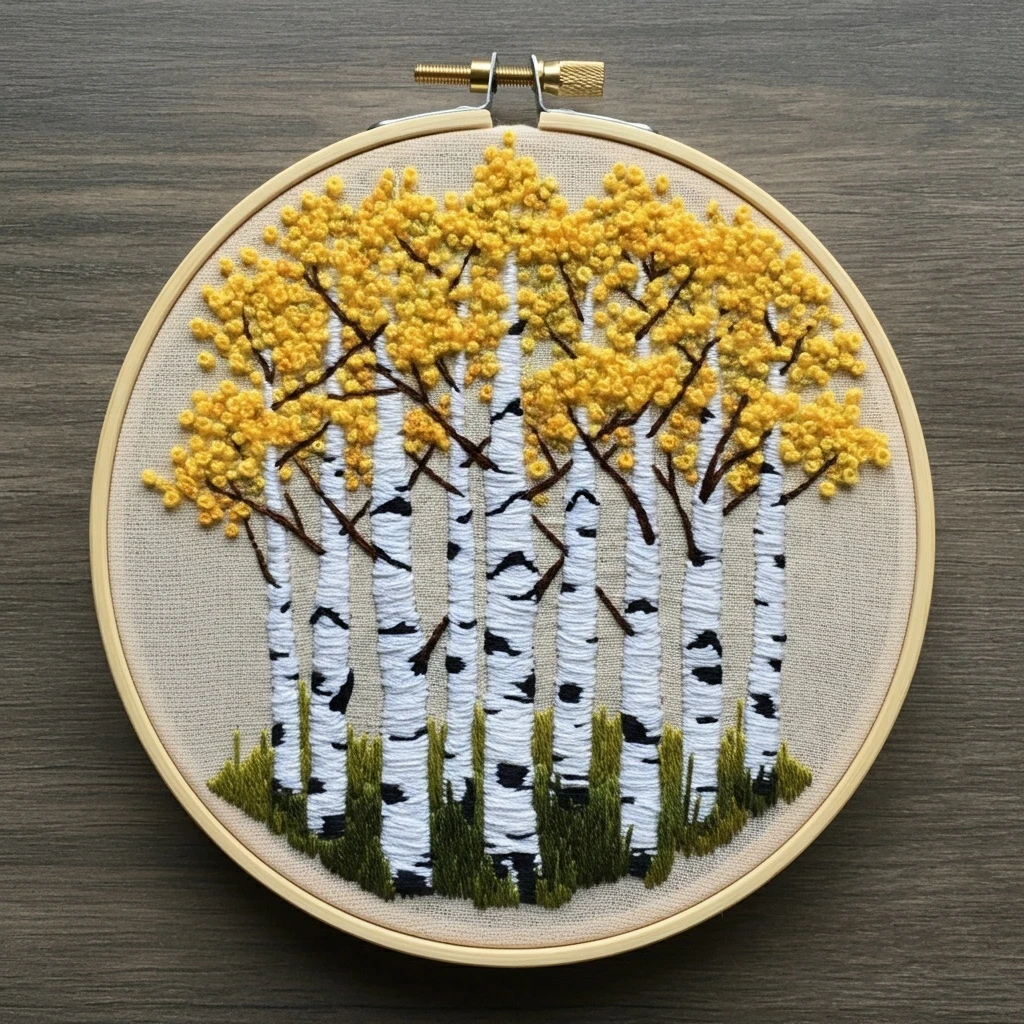
A warm woodland hoop built around white aspen trunks, dark bark markings, olive grasses, slim brown branches, and a dense crown of golden French-knot leaves. Use the guide below as a practical stitching plan for keeping the design crisp, dimensional, and beginner friendly.
Color reading from the design
The artwork is dominated by round golden foliage over a grove of pale birch/aspen trunks. The highest contrast comes from clean white trunks against black bark scars, while warm browns carry the branch structure and deep olive greens anchor the forest floor. Keep the background fabric neutral so the yellow canopy feels luminous rather than flat.
DMC 972
Deep Canary
Brightest leaf knots and sunlit canopy tips.
DMC 783
Topaz Medium
Main golden aspen foliage; use generously.
DMC 782
Topaz Dark
Shadowed leaf clusters and lower canopy depth.
DMC B5200
Snow White
Clean highlights on the aspen trunks.
DMC 762
Pearl Gray Very Light
Cool trunk shadows and spacing between white bands.
DMC 310
Black
Birch bark slashes, tiny bird silhouettes, deepest bases.
DMC 801
Coffee Brown Dark
Main branches and strongest twig lines.
DMC 975
Golden Brown Dark
Secondary branch highlights and warmer twig edges.
DMC 730
Olive Green Very Dark
Deep grass shadows and lower forest base.
DMC 732
Olive Green
Mid grass blades and mossy vertical stitches.
DMC 611
Drab Brown
Subtle ground shadows on beige linen.
DMC 822
Beige Gray Light
Optional softening stitch where trunks meet fabric.
Suggested stitch map
| Area | Best stitches | Practical notes |
|---|---|---|
| Golden canopy | French knots, colonial knots, scattered seed stitch | Use 2 strands for most knots; wrap twice for compact leaves. Mix DMC 972, 783, and 782 in irregular clusters so the crown looks natural. |
| Aspen trunks | Long-and-short stitch, satin stitch, split stitch edges | Work vertical stitches with B5200 and 762. Keep stitch direction vertical, then add bark marks after the trunk fill is complete. |
| Black bark marks | Short satin stitch, tiny fishbone shapes, straight stitch | Use 1 strand of 310 for small scars and 2 strands only for bold lower marks. Avoid making every mark the same length. |
| Branches | Stem stitch, back stitch, whipped back stitch | Use DMC 801 for dark limbs and add a few 975 highlights on upper-facing sections. Let some branches disappear behind knots. |
| Grass and moss | Straight stitch, fly stitch, detached chain, turkey work sparingly | Use vertical strokes in 730 and 732. Vary height and angle at the base to avoid a comb-like edge. |
| Tiny birds | Single-strand back stitch or small satin shapes | Place birds after the trunks are stitched; they should remain crisp and minimal, not heavily filled. |
Thread-count, blending & shading guidance
Thread counts
- Canopy knots: 2 strands for standard knots; 3 strands only for the largest foreground leaf dots.
- Trunks: 2 strands for smooth fills, 1 strand for narrow highlight/shadow corrections.
- Branches: 2 strands for major limbs, 1 strand for fine twigs and distant branch tips.
- Grass: 2 strands for visible blades; 1 strand for thin background grasses.
Blending ideas
- Blend one strand DMC 972 with one strand DMC 783 for glowing leaf knots near the top and outer edge.
- Blend one strand DMC B5200 with one strand DMC 762 to soften the gray shadow on white trunks.
- Blend DMC 730 and 732 in the needle for richer mossy grass without changing colors constantly.
Outlining details
- Use a very fine split-stitch line in 762 on one side of each trunk before filling if you need clean boundaries.
- Branches can be stitched first, but keep long branch ends free from heavy foliage until the knots are added.
- Add black bark marks last so they sit sharply on top of the white trunks.
Texture suggestions
- Make the canopy tactile by varying knot size: small two-wrap knots in the background, slightly larger knots near the front.
- Use broken vertical trunk stitches rather than perfectly smooth satin if you want a bark-like hand texture.
- For grass, layer short dark stitches first, then taller olive blades over them.
Beginner-friendly stitching order
1. Transfer lightly. Mark trunk outlines, main branches, canopy boundary, and the base grass line. Keep leaf dots loose rather than tracing every knot.
2. Stitch the trunks. Fill each aspen trunk with vertical B5200/762 stitches, leaving a little breathing room between trunks so the fabric still shows.
3. Add branches. Work brown stem stitch and back stitch over and between trunks. Taper the tips with single-strand stitches.
4. Build the foliage. Start with medium gold DMC 783 knots, add DMC 972 highlights, then place DMC 782 in shadow pockets under branches and dense clusters.
5. Finish contrast details. Add black bark marks, small birds, and deep base accents after the larger areas are complete.
6. Refine the ground. Layer olive grasses upward from the bottom edge, mixing heights and leaving a few gaps so the scene stays airy.
Practical tips for a clean hoop
Keep the canopy dimensional but not bulky: dense French knots can distort fabric if the hoop tension is loose. Tighten the fabric before knotting, avoid pulling knots too hard, and rotate colors frequently so each golden shade appears naturally scattered.
- Use a sharp embroidery needle for the trunk fill and a slightly larger needle for 3-strand knots.
- Work with 14–18 inch thread lengths to prevent fuzzing in the pale trunk colors.
- When stitching on beige linen, test white floss coverage; add a second pass only where the fabric shows too strongly.
- Press from the back on a towel after finishing so the knots and grasses remain raised.