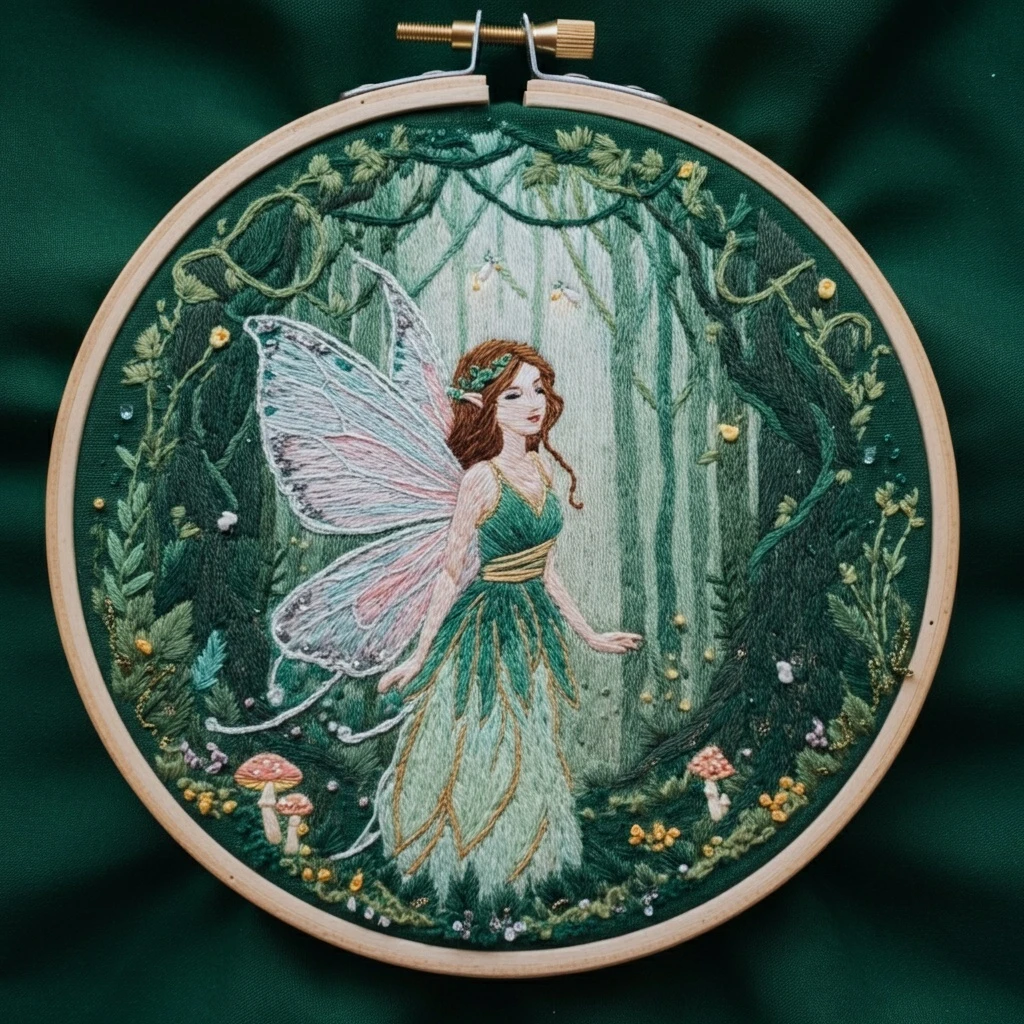

Enchanted Forest Fairy
A practical thread and stitch guide for the hoop preview: a fairy in a teal-green dress, translucent pink-and-mint wings, auburn hair, pale skin, golden belt and dress accents, deep forest trunks, leafy vines, tiny flowers, mushrooms, and scattered sparkle-like knots.
Design read
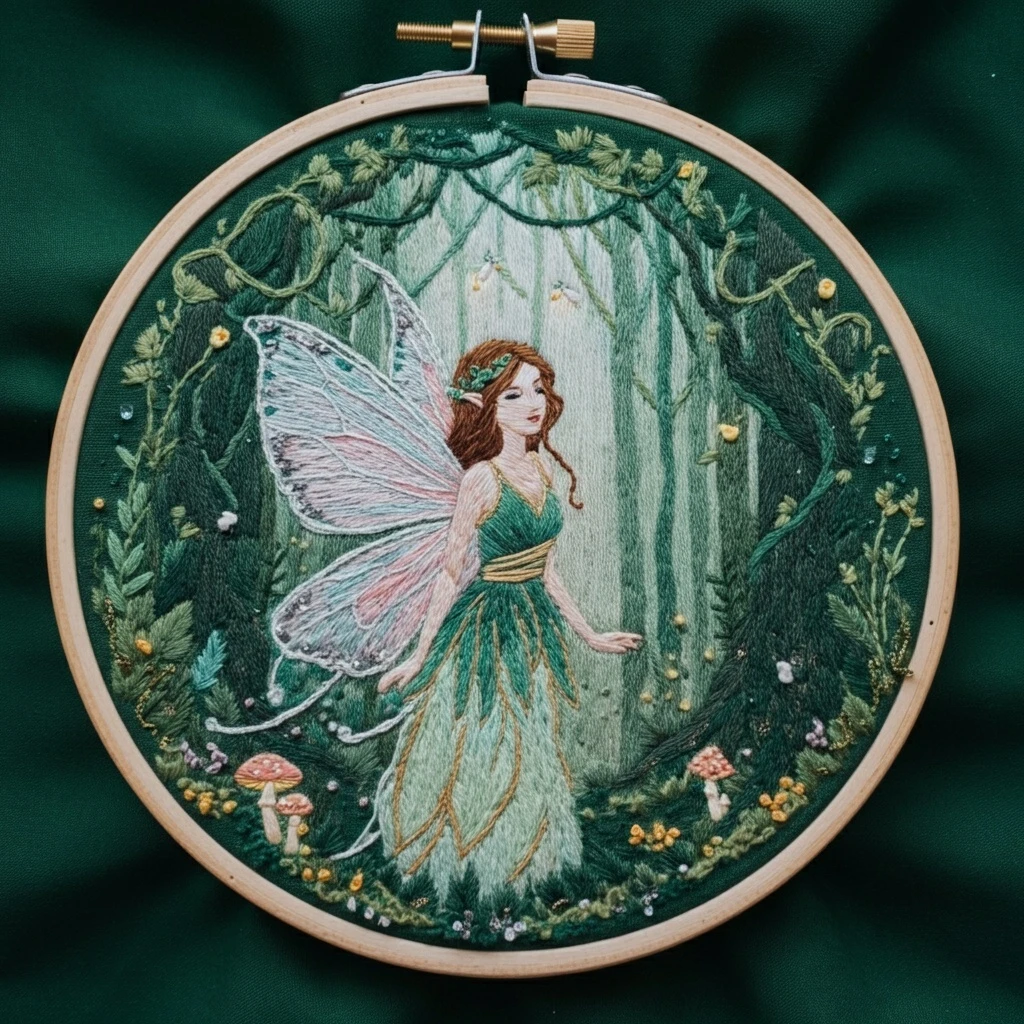
The design depends on layered contrast: a dark green woodland border frames a pale misty clearing, while the fairy’s wings and dress add delicate color. The wings should stay airy and translucent, the forest should feel textured and shadowed, and the golden waist and skirt veins should be added last as crisp accents.
Work from background to foreground: forest trunks first, then vines and foliage, then the fairy body, dress, wings, and finally the tiny flowers, French knots, sparkle dots, and outlining refinements.
Likely DMC Color Palette
These shades are selected to match the visible fairy, woodland clearing, transparent wings, mushrooms, floral details, and warm gold accents.
Stitching Suggestions
| Design area | Recommended stitch | Practical notes |
|---|---|---|
| Misty forest background | Long-and-short stitch, vertical straight stitch, split stitch | Use pale greens in the center and darker greens at the edges. Keep strokes vertical and uneven so they resemble distant tree trunks and shafts of light. |
| Dark tree trunks | Stem stitch, split stitch, long-and-short stitch | Layer 500 and 501 first, then add 3363 or 502 highlights along one side. Let stitches follow the curve of the trunks and roots. |
| Vines and leafy arch | Stem stitch, whipped backstitch, detached chain | Use 1–2 strands for curling vines. Add detached-chain leaves after the vine line so each leaf sits neatly on the curve. |
| Fairy wings | Long-and-short stitch, single-strand backstitch, couching | Keep the wing fill thin with 3813, 772, and 225. Outline veins with one strand only; too many strands will make the wings look heavy. |
| Wing sparkle and dots | French knots, seed stitch, tiny straight stitch | Use B5200, 3816, and tiny touches of 725. Vary knot size and spacing for a natural fairy-dust effect. |
| Dress bodice and skirt | Satin stitch, long-and-short stitch, split-stitch outline | Fill the bodice with smooth teal satin stitches. Work the skirt downward in directional sections so the darker teal blends into pale mint near the hem. |
| Gold waist and skirt veins | Couching, stem stitch, backstitch | Add 729 after the green dress is complete. Couch longer gold lines if you want smooth curves without snagging or distortion. |
| Hair | Stem stitch, split stitch, long directional stitch | Start with 801 in the shadow curls, add 433 as the main auburn, then place a few 434 highlights along the outer curls. |
| Face and arms | Fine split stitch, backstitch, tiny satin stitch | Use one strand for facial features. Keep peach shading minimal and avoid carrying dark threads behind pale skin areas. |
| Mushrooms and flowers | Satin stitch, French knots, detached chain | Use warm browns and pinks for mushroom caps, cream or peach for stems, and 725/729 knots for small flower centers. |
| Forest floor texture | French knots, seed stitch, fly stitch | Cluster mossy greens around the base. A mixture of knots, tiny straight stitches, and fly stitches creates the lush woodland edge. |
Thread Count, Blending & Shading Guidance
Best strand counts
Use 2 strands for most foliage, dress fill, and trunks. Use 1 strand for facial features, wing veins, fine vines, and tiny highlights. Use 3 strands only for dense dark forest areas.
Wing transparency
Use long, spaced stitches rather than full heavy fill. Blend one strand of 3813 with one strand of 225 for a soft pink-mint shimmer, then add B5200 sparingly.
Dress blending
Blend 501 into 502 for bodice shadows, 502 into 3816 for the upper skirt, and 3816 into 3813 near the hem to match the pale glowing lower dress.
Forest depth
Place darkest greens around the outer hoop and lighter greens behind the fairy. This keeps the center luminous and frames the figure clearly.
Hair texture
Use short curved stem stitches around the face and longer directional stitches through the loose curls. Add hair highlights only after the face is complete.
Gold control
Gold details should be crisp and thin. Use 1 strand for skirt vein lines or couch 2 strands with tiny anchor stitches for a raised belt effect.
Outlining, Shading & Texture Suggestions
Outlining details
- Outline the dress with 501 or 502 before filling.
- Use pale gray-green or mint for wing edges instead of dark thread.
- Keep the face outline very light and avoid heavy black lines.
Shading guidance
- Shade trunks from dark outer edges toward lighter center clearing.
- Place pink wing blush near the lower wing sections, then soften with mint stitches over it.
- Use golden accents only after the dress shape is established.
Texture ideas
- French knots make excellent tiny flowers, berries, and dew dots.
- Detached chain stitches create leafy sprays along the border.
- Seed stitch adds moss without filling the entire ground solidly.
Beginner shortcuts
- Use simple satin sections for the dress if long-and-short feels difficult.
- Reduce the palette to dark green, mid teal, mint, peach, brown, pink, gold, and white for an easier version.
- Practice wing veins on scrap fabric before stitching the final piece.
Beginner-Friendly Work Order
Final finishing notes
This hoop will look best when the fairy stays delicate and the forest remains textural. Use short thread lengths to prevent fuzzing in the wings, re-tighten the hoop before dense tree stitching, and press from the back over a towel so French knots and raised gold details stay dimensional.