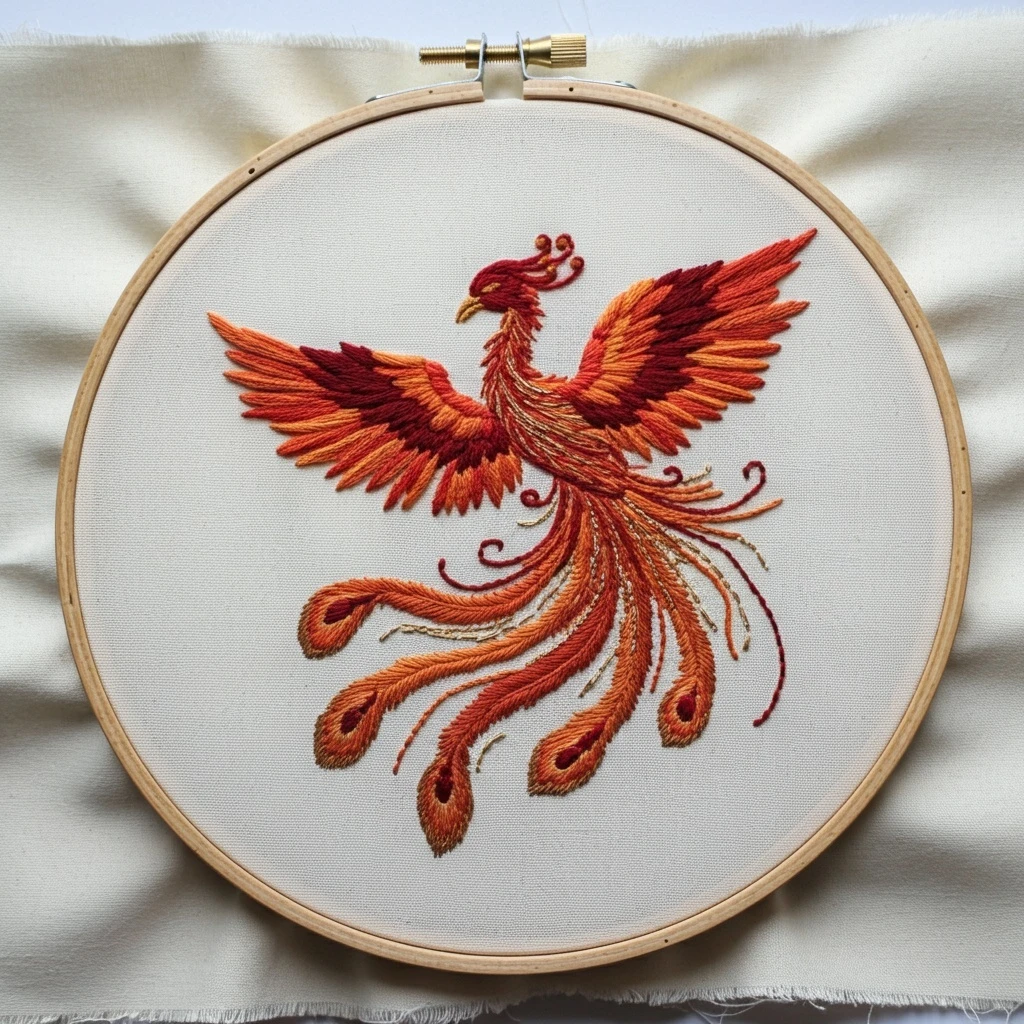

Fiery Phoenix Rebirth
Colors estimated from the visible phoenix preview and matched to close DMC embroidery floss shades. The design reads as a rising firebird with sweeping feather plumes, flame-like wings, a glowing golden body, dark ember accents, and rebirth energy radiating upward from warm ashes.
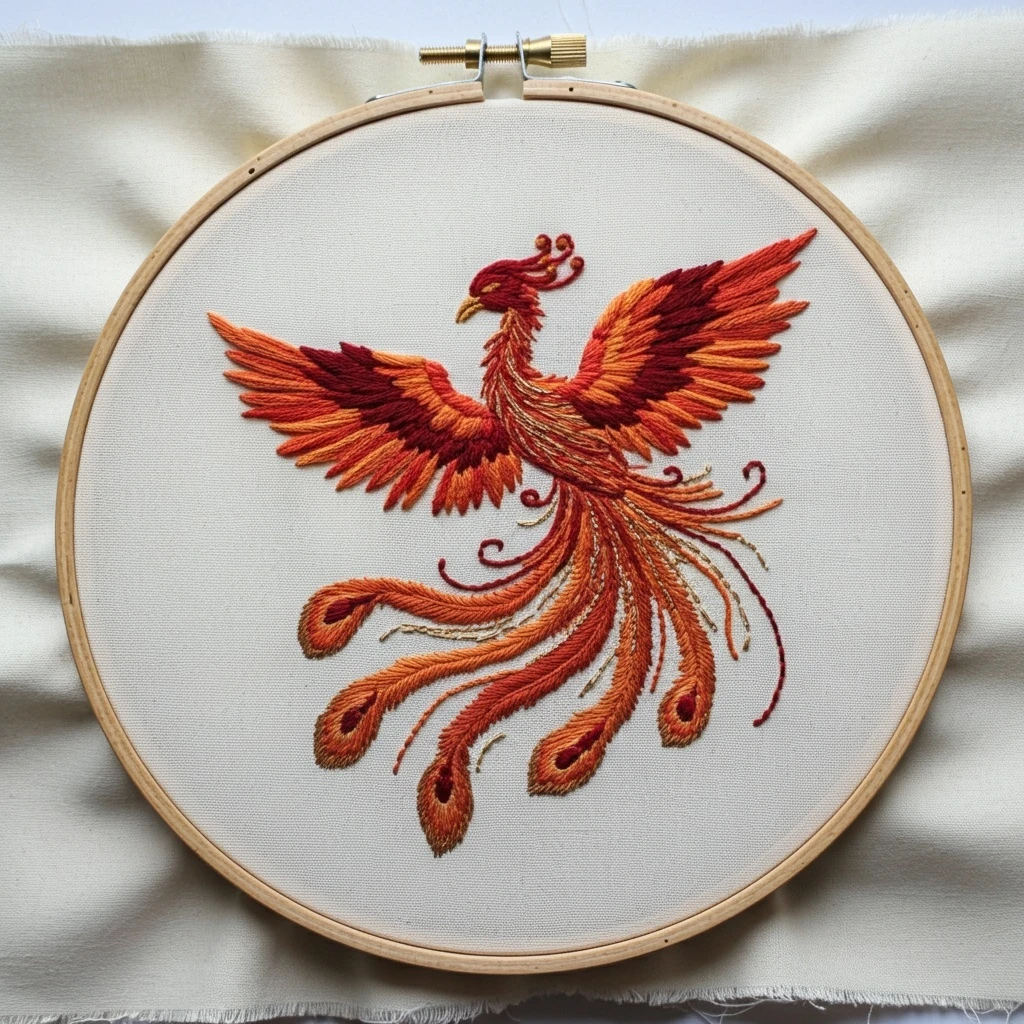
Preview & Color Impression
The artwork is dominated by hot oranges, flame reds, glowing yellows, and deeper burgundy shadows. The phoenix body and wing centers should feel luminous, while the outer feather tips and underside curves need darker red-brown contrast so the bird keeps its dramatic shape.
Palette approach
Use a warm gradient: pale yellow highlights at the hottest flame points, golden orange through the body and feathers, scarlet and crimson in the wing shadows, and dark brown-black for the eye, beak separation, deepest feather cuts, and ember base.
Likely DMC Color Palette
Palette based on the phoenix body, flame-shaped wings, red-orange feather plumes, golden highlights, smoky ember shadows, and crisp dark outlining. Coverage percentages are visual estimates, not exact thread usage.
Stitching Suggestions
| Element | Stitch Type | Notes |
|---|---|---|
| Phoenix body and chest | Long and short stitch | Shade from DMC 725 and 742 at the center into 741 and 900 near the edges. Keep stitches curved with the body so it looks rounded and glowing. |
| Sweeping wings | Directional satin stitch plus long and short stitch | Work each feather plume separately. Start with the darkest red at the base, then blend through orange toward yellow at the flame tips. |
| Tail flames | Split stitch rows or fishbone stitch | Follow the S-curves of the tail. Alternate 816, 900, 741, and 740 so the tail has movement rather than one flat orange area. |
| Feather veins | Stem stitch or split backstitch | Use one strand of 814 or 3371 for inner veins; switch to 666 or 740 on brighter feather ridges. |
| Outer silhouette | Whipped backstitch | Outline only after the fills are finished. Use 3371 for shadowed areas and 816 for red flame contours to avoid a harsh cartoon edge. |
| Head, eye, and beak | Tiny satin stitch, straight stitch, French knot | Use 310 for the smallest eye point, 3865 for a glint, and gold/orange satin stitches around the head for a focal glow. |
| Rising sparks | French knots and seed stitch | Scatter knots in 444, 725, and 740. Keep the sparks uneven so they feel like embers lifting from the phoenix. |
| Ash and rebirth base | Short straight stitch and couching | Use dark brown with small orange highlights. A few loose stitches are enough; do not let the base overpower the bird. |
Thread-Count, Blending & Shading Guidance
Thread counts
- 2 strands for most wing, tail, and body filling.
- 1 strand for eye details, feather veins, inner flame cuts, and final outlines.
- 3 strands only for bold lower flames or areas that need extra raised texture.
Blending ideas
- Blend one strand 816 + one strand 741 for red-orange feather transitions.
- Blend one strand 740 + one strand 725 for bright golden fire edges.
- Blend one strand 3371 + one strand 814 for soft ember shadows instead of black-heavy outlining.
Shading direction
- Keep stitches radiating outward from the phoenix chest and wing roots.
- Place the darkest colors underneath feather overlaps and at curled flame bases.
- Reserve 444 and 3865 for tiny accents so the glow remains believable.
Texture suggestions
- Use slightly staggered long-and-short stitches for feather softness.
- Add French knots last for sparks and ember texture.
- Whip selected outlines with a brighter orange to create a heated rim-light effect.
Where to Start
Build the phoenix from the strongest central shapes outward, then add the tiny fire details last.
Stitch the chest and head first with gold and orange tones so the focal point is established.
Work one plume at a time, following the feather direction and blending red into orange.
Use curved stitch paths so the tail appears to rise and twist like fire.
Add one-strand dark red or brown details where feathers cross, curl, or disappear into shadow.
Place French knots, tiny highlights, and final outlines only after all fills are complete.
Beginner-Friendly Practical Tips
- Transfer only the main outlines and the largest feather divisions; too many tiny guide lines can make the design confusing.
- Use a sharp embroidery needle and keep thread lengths around 35–45 cm to reduce fraying in the bright reds and oranges.
- Do not pull satin stitches too tight, especially in wide wing areas; firm tension can pucker the fabric.
- Stitch from light to dark in the glowing body, but from dark to light on flame tips when you want dramatic feather separation.
- Step back often. Fiery designs look best when the overall gradient reads clearly from a short distance.
- Save the black and winter-white accents for the final pass; they are powerful and should remain tiny.