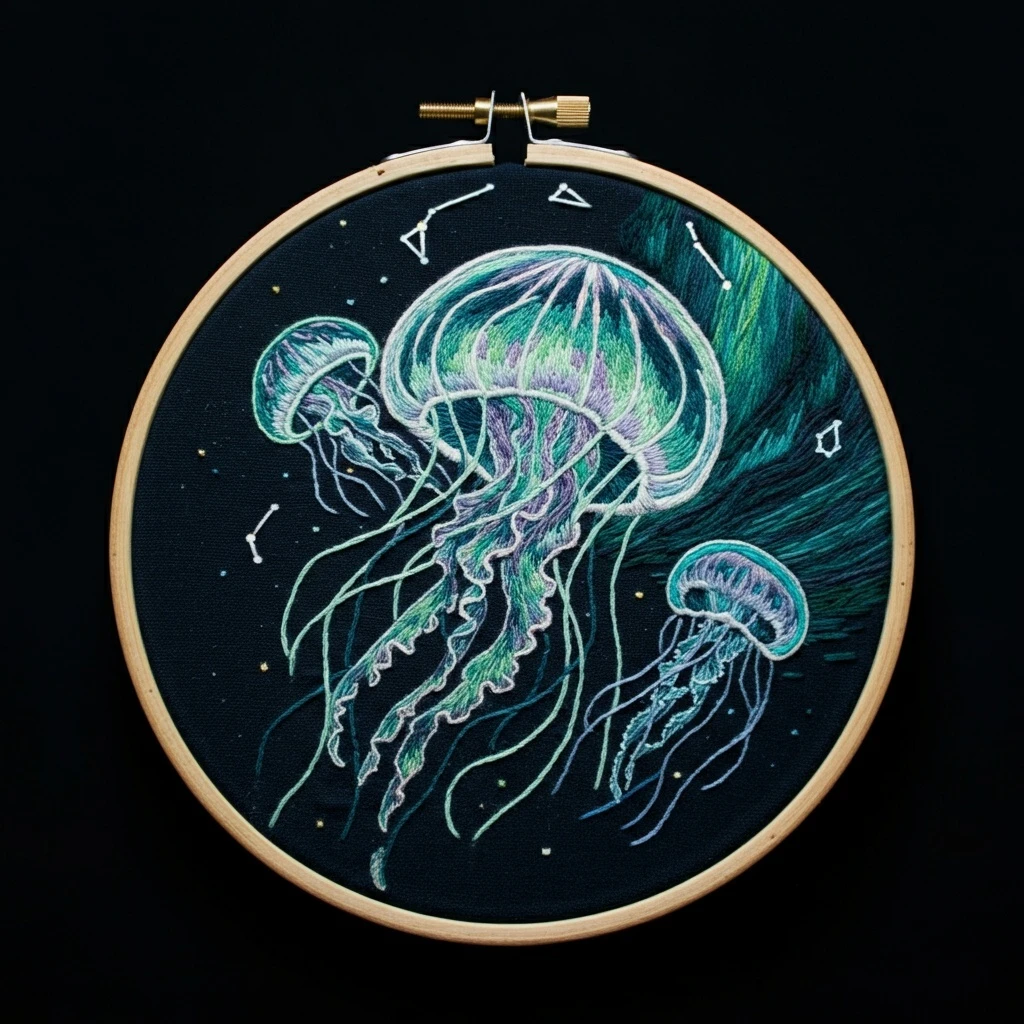

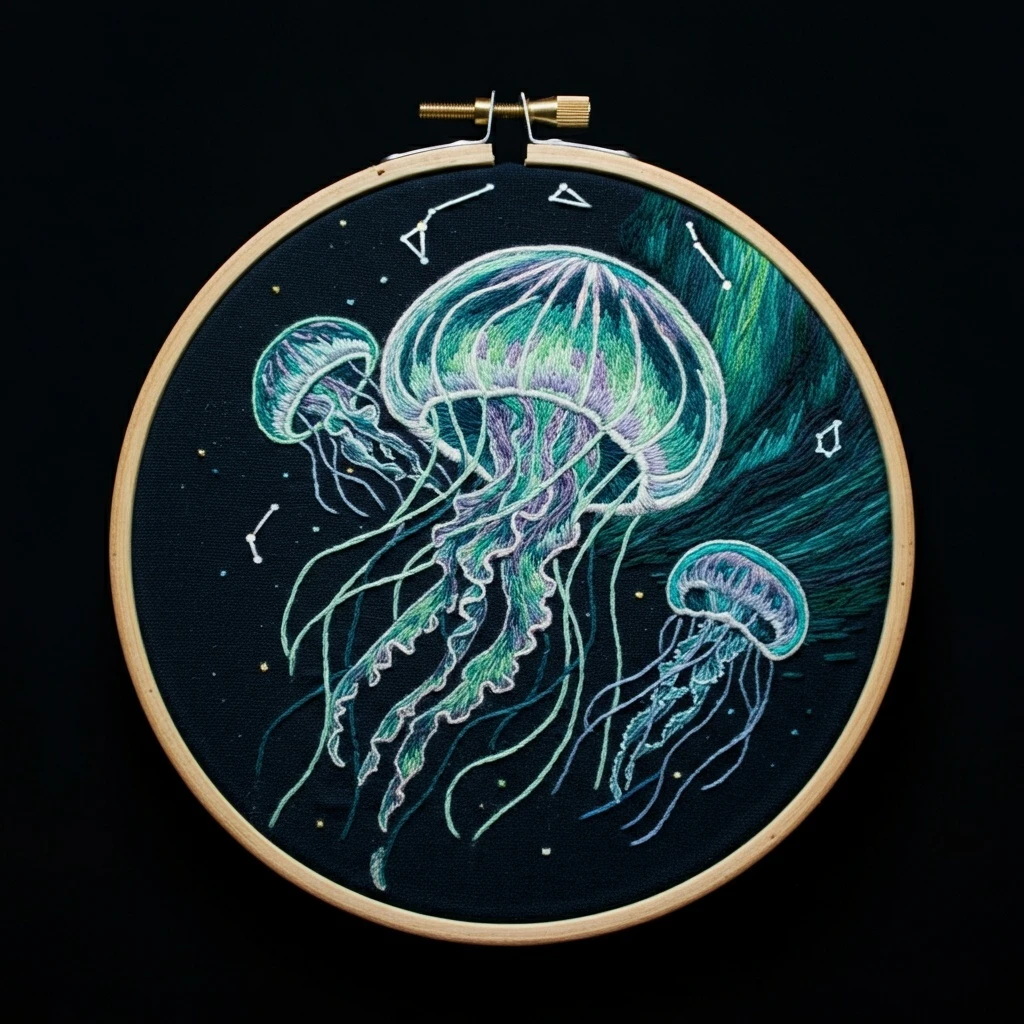
Cosmic Jellyfish Galaxy
This cosmic jellyfish design blends an ethereal sea creature with galaxy color, glowing tendrils, starry dots, and deep ocean-night shading. The stitched version should feel weightless and luminous: a translucent bell with violet-blue shading, aqua highlights along the rim, long flowing tentacles, soft pink and lavender glow, tiny gold-white stars, and delicate thread movement that suggests the jellyfish drifting through space.
Polished DMC Color Palette
This palette combines ocean glow with celestial depth: midnight purple and navy for the background contrast, lavender and pink for the translucent bell, aqua and teal for luminous edges and tentacles, and gold-white for starlight.
Stitch Map by Design Element
Thread Count & Blending Guide
Fine tendrils and stars
Use 1 strand for hairlike tendrils, tiny stars, rim glints, small dots, and final highlights. One strand keeps the jellyfish delicate and floating.
Main bell and ribbons
Use 2 strands for the bell fill, thicker tentacles, larger glow shapes, and major color blends. Two strands gives enough color while preserving translucency.
Raised sparkle
Use 2–3 strands for selected French-knot stars or brighter bubble dots. Use three strands sparingly so the cosmic dust does not overpower the jellyfish silhouette.
Shading, Outlining & Texture Suggestions
Translucent bell shading
- Keep the darkest color at the lower bell edge and inner folds.
- Blend upward into lavender, pale blue, aqua, or cream for a glowing dome.
- Use curved stitch direction so the bell feels rounded and soft.
- Avoid heavy outlines around the entire bell; use broken highlights and shadows instead.
Flowing tentacles
- Stitch tentacles after the bell so they emerge naturally from the underside.
- Vary thickness: a few stronger ribbons plus many fine tendrils.
- Keep thread tension gentle on long lines to avoid puckering.
- Couch extra-long tendrils with tiny matching stitches if they need control.
Galaxy sparkle
- Add stars and dots after the jellyfish is complete so they sit cleanly on top.
- Mix white, aqua, lavender, and gold dots for a layered cosmic effect.
- Make a few stars larger and many dots tiny for natural scale.
- Leave open space between star clusters so the design stays airy.
Outlining approach
- Use deep violet, navy, or teal for selected separations instead of black.
- Use split stitch for the bell rim and stem stitch for flowing tentacles.
- Break outlines where light should pass through the jellyfish.
- Add final dark accents before the last white and gold sparkles.
Beginner-Friendly Stitching Order
- Transfer lightly: mark the bell outline, underside rim, main tentacles, a few tendril paths, and major star clusters. Save tiny galaxy dots for the end.
- Stitch the bell base: work the lower shadows first, then blend upward into lavender, blue, aqua, and pale highlights.
- Add the rim: stitch scalloped or glowing rim details with pale blue, aqua, cream, and white.
- Stitch main tentacles: add the thicker flowing lines first, curving them naturally downward.
- Add fine tendrils: place one-strand drifting lines and taper them carefully.
- Finish with stars: add galaxy dots, French knots, gold-white sparkle, aqua glints, and final correction stitches last.
Practical Tips for a Clean Finish
Fabric & hoop
Soft black, navy, deep purple, pale aqua, or warm cream fabric all work. Dark fabric makes the jellyfish glow more dramatically; pale fabric gives a dreamy watercolor feel. Keep the hoop drum-tight for long tentacles.
Needle choice
Use a sharp embroidery needle size 7–9 for one- and two-strand stitching. For raised stars with three strands, use a slightly larger needle so knots pull through cleanly.
Keeping it weightless
Do not fill every area solidly. Let fabric show through between tentacles and around the bell so the jellyfish keeps its translucent, floating quality.
Avoiding tangled tendrils
Stitch long tentacles one at a time from top to bottom, then add fine tendrils between them. This keeps the linework readable and prevents thread snags.