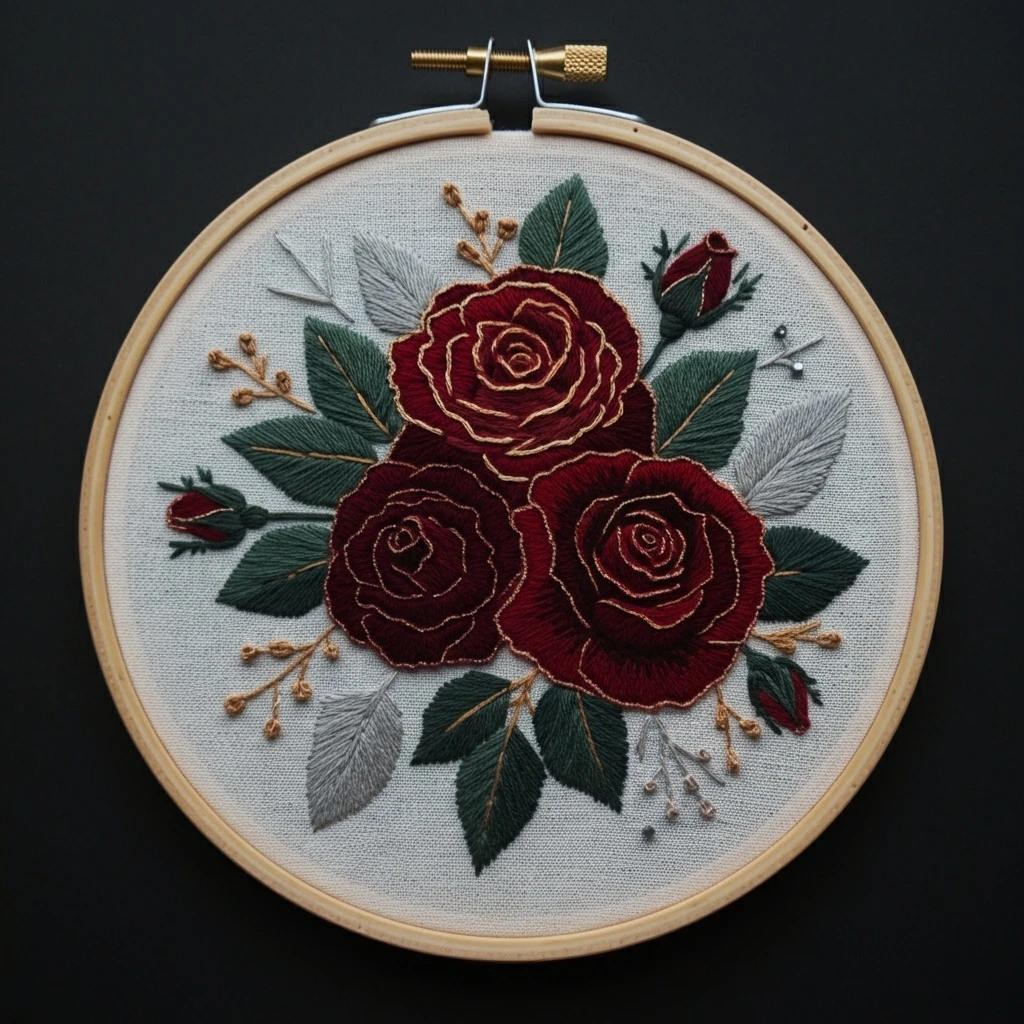

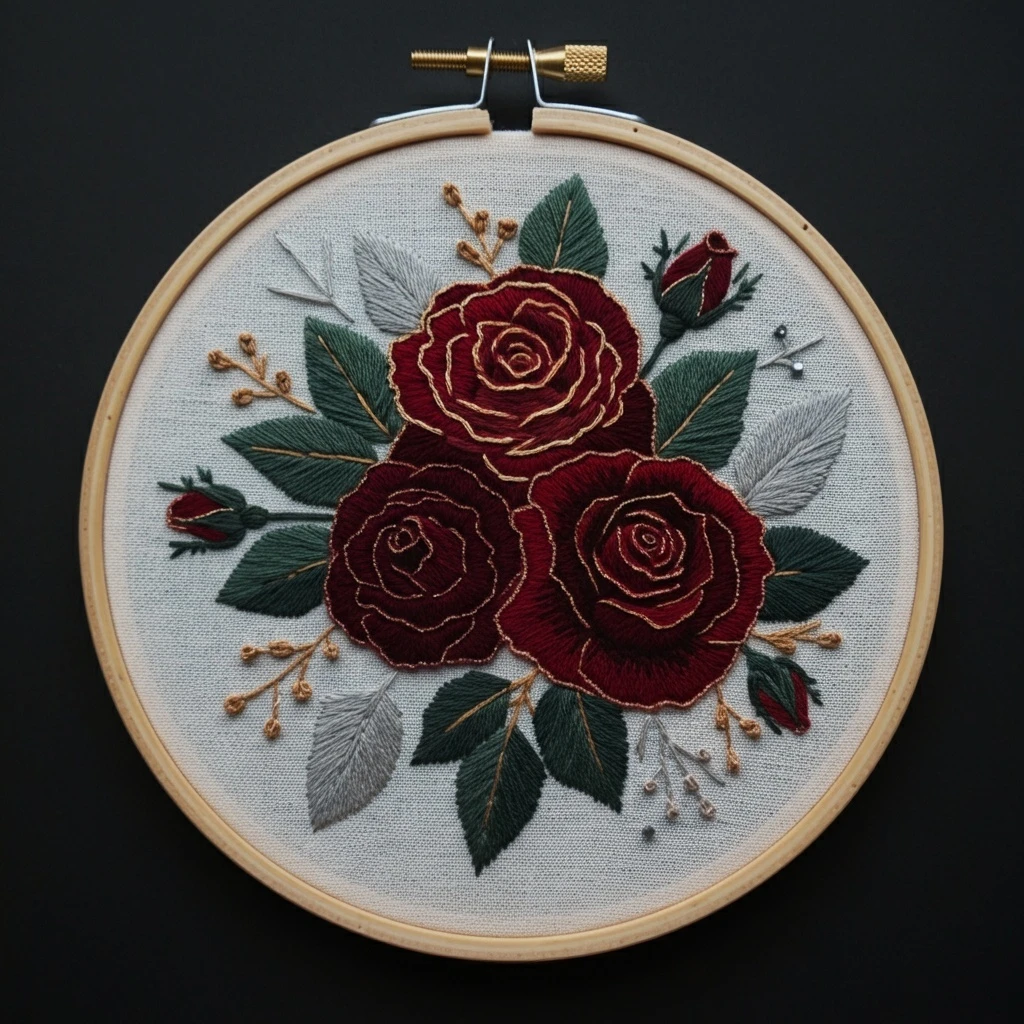
Deep Crimson Rose Bouquet
A dramatic rose-hoop palette built around velvety crimson petals, antique gold outlines, dark evergreen leaves, soft silver foliage, and warm linen. Use the deeper tones to keep the bouquet rich and dimensional while letting the metallic-looking ochre accents define the rose spirals.
Design character
This design features three large roses with dense burgundy centers and brighter crimson outer petals, surrounded by sharply stitched dark green leaves, muted gray leaves, small berry sprays, and fine golden vein lines. The strongest contrast comes from the pale linen ground against the wine-red flowers and almost black-green foliage.
The original look depends on clean outlines and controlled direction: petals curve in nested spiral shapes, leaves radiate outward with long satin-like stitches, and the small buds and berry stems add airy movement around the heavy rose cluster.
Suggested DMC palette
The colors below are chosen to match the photographed design: saturated crimson roses, deep burgundy shadows, dark teal-green leaves, cool gray foliage, wheat-gold detailing, and a natural linen base.
Blending ideas
Blend one strand of 814 with one strand of 816 for the lower petals, especially beneath overlapping edges. This keeps the roses dark without becoming flat black.
Use 816 with 815 for most highlights; reserve 902 for only a few short stitches on bud lips or upper petal rims.
Alternate 500 and 501 along leaf halves rather than mixing randomly; directional contrast is what gives the leaves their woven texture.
Shading guidance
- Rose centers: stitch the spiral center in 814, then outline with one strand of 783 so the curled shape remains visible.
- Outer petals: place 816 in long curved rows, feathering 815 toward the petal lip. Keep stitch direction radial, following the petal curve.
- Leaf groups: work from the center vein outward with fishbone stitch. Use 500 close to the bouquet and 501/503 on the outer tips.
- Gray leaves: keep them cooler and quieter than the roses. Use 414 as the base with 318 as fine top stitches, leaving slight fabric gaps for airiness.
- Gold details: add them last. A single strand of 783 gives elegant linework; two strands make bolder folk-art outlines.
Stitch suggestions by design area
| Area | Recommended stitches | Practical notes |
|---|---|---|
| Large crimson roses | Long-and-short stitch, padded satin stitch, split stitch outline | Outline petal sections first with split stitch in a matching red, then fill inward. Use shorter stitches near the spiral center to avoid bulky knots. |
| Gold petal edging | Stem stitch, couching, whipped backstitch | For the photographed antique-gold effect, use 1 strand 783 over the finished petals. Whip with 782 if you want a raised, luminous rim. |
| Dark leaves | Fishbone stitch, satin stitch, split stitch vein | Keep stitches smooth and parallel. Change the angle at the center vein so each leaf reads as two folded halves. |
| Gray side leaves | Straight stitch, fishbone stitch, feather stitch | Use light thread counts and visible direction lines to make them softer than the dark leaves. |
| Buds and sepals | Satin stitch, detached chain, fly stitch | Fill buds with 816/815, then cup them with 500 sepals. A narrow gold line on the bud lip ties them to the large roses. |
| Berry sprays | Stem stitch, French knots, colonial knots | Work the stems in 783 with small knots in 782 or 783. Vary knot size by wrapping once or twice. |
| Tiny pale berries | French knots, seed stitch | Use 318 or a 318/414 blend. Keep spacing irregular so the sprays feel natural rather than dotted. |
Texture plan
- Pad the main rose centers with a base layer of split stitch before adding satin or long-and-short fill.
- Use slightly raised gold outlines to separate petals cleanly.
- Keep gray leaves flatter so the red bouquet remains the focal point.
- Add berry knots last to avoid snagging while working larger fills.
Beginner-friendly workflow
Outlining details
Use stem stitch for rose outlines when you want a soft rope-like edge, or backstitch if you prefer crisp graphic lines. Around the tight inner rose spirals, reduce to one strand so the line does not overpower the petals. For the outermost rose edges, a two-strand whipped backstitch in 783 can mimic the raised golden contour seen in the reference image.
Fabric and finishing tips
A natural linen or linen-cotton blend in oatmeal, flax, or warm gray will support the dramatic red-and-green palette. Use a stabilizer if your fabric is loose-weave, especially under the dense roses. Press from the back on a towel after stitching to protect raised knots and gold outlines.