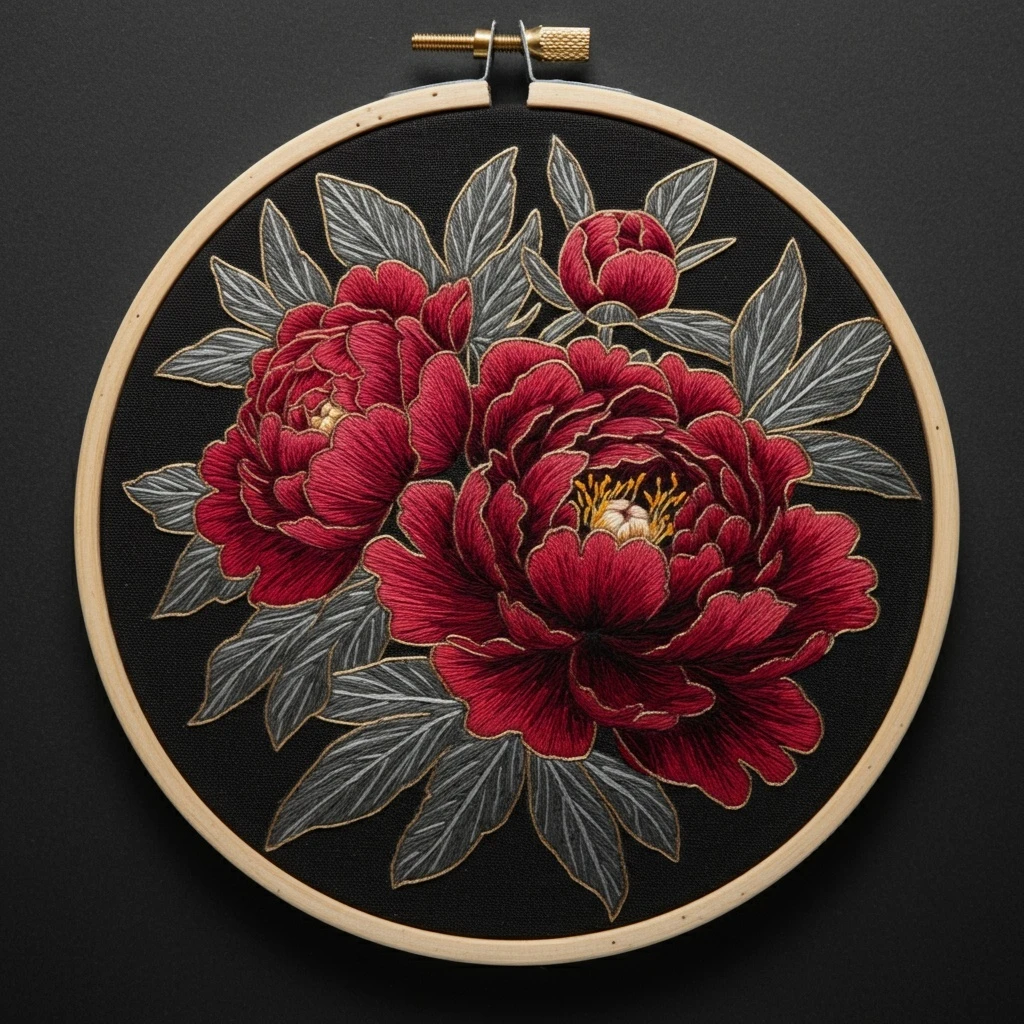

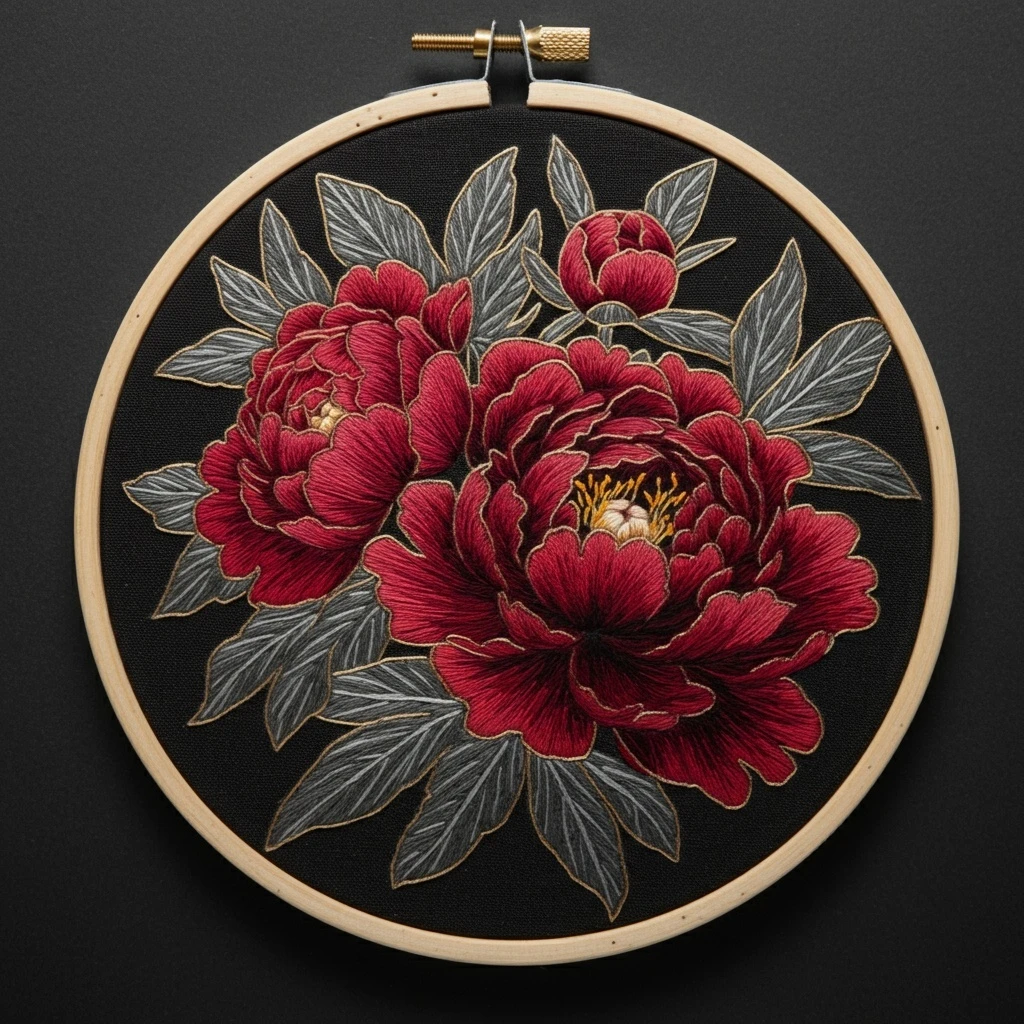
Scarlet Peony Elegance
A dramatic floral embroidery built around a full scarlet peony bloom: layered red petals, wine-dark folds, soft coral highlights, golden stamens, and deep green foliage. The best approach is painterly long-and-short shading for the petals, crisp split-stitch outlines, and small raised knots in the flower center for a polished botanical finish.
scarlet petalssoft shadinggold stamensleaf textureImage-based color story
The design reads as a refined scarlet peony with luminous red petal planes, darker burgundy creases, warm pink-coral edges, olive and forest green leaves, and a small golden center. Use a controlled palette so the flower keeps its elegant, high-contrast look rather than becoming overly busy.
Stitch map by design element
| Area | Recommended stitches | Thread guidance |
|---|---|---|
| Large outer petals | Long-and-short stitch following each petal from base to rim; use split stitch as a neat boundary before filling. | Work mostly with 1 strand for soft shading; add 2 strands only on broad, simple petal sections. |
| Inner folded petals | Short satin stitches, fishbone-style directional stitches, and tiny split stitches along curled edges. | Blend 321 with 815, then deepen creases with one strand of 814. |
| Petal highlights | Feathered long-and-short stitches or single straight stitches placed along the upper rim. | Use 350, 352, and touches of 353. Keep highlights broken, not solid blocks. |
| Flower center | French knots, colonial knots, short straight stitches, and small seed stitches. | Use 725 for knot tips, 3821 for stamen stems, and a few 815 shadows behind them. |
| Leaves | Fishbone stitch for individual leaves, stem stitch for veins, split stitch for serrated outlines. | Base with 469, shade with 895, and add thin 471 highlight veins. |
| Stems & outlines | Stem stitch for graceful curves, whipped back stitch for raised stems, split stitch for crisp floral edges. | Use 898 for warm stems and 938 only where the design needs strong contrast. |
Blending & shading plan
Petal gradient
Begin each petal with 815 or 814 at the base, transition through 321, then feather 666, 350, and 352 toward the rim. Keep each stitch direction aligned with the petal curve: vertical for upright petals, diagonal for folded side petals, and short crescent strokes for curled tips.
Natural red depth
A scarlet flower becomes dimensional when the darks are narrow and deliberate. Place 814 only in the tightest folds and under overlapping petals. Use 321 as the visual anchor so the whole bloom still reads bright and elegant.
Outlining details
Keep outlines refined
- Use split stitch around petals before filling if you want clean, raised edges.
- Choose 815 instead of black for most flower outlines; it looks softer and more botanical.
- Add a single strand of 938 only where leaves tuck under petals or stems overlap.
- For curled rims, whip the split-stitch outline with 352 or 350 to create a soft highlight.
Beginner-friendly stitching order
Thread-count cheat sheet
- 1 strand: petal shading, fine veins, small center details.
- 2 strands: petal outlines, stem stitch, most leaf edges.
- 3 strands: bold satin fills on simple outer petals.
- 4 strands: optional padded center knots or raised decorative accents.
Texture suggestions
- Use French knots in two sizes for a clustered pollen center.
- Mix satin and long-and-short stitches so some petals look smooth and some look softly brushed.
- Add a few seed stitches in 815 near the flower throat for extra depth.
- Keep leaf fishbone stitches slightly open for a hand-rendered botanical texture.
Finishing tips
- Press from the back on a towel to protect knots and raised outlines.
- Trim jump threads behind pale highlights so no dark red shadows show through.
- Back the hoop with cream felt or linen for an elegant gallery-style finish.
- Use a deep burgundy or olive ribbon hanger to echo the palette.
Practical embroidery notes
The visual success of this design depends on controlled contrast. Let the scarlet bloom be the focus, keep the foliage muted, and use the golden center as a small bright accent rather than a competing color field.
Needle movement
Bring the needle up just inside the outline and take it down toward the petal center. This hides the transfer line and makes the petal rim look clean.
Color blending
For the smoothest transitions, thread the needle with one strand 321 and one strand 350 in the same needle, then place mixed stitches between pure red and coral areas.
Common fix
If a petal looks too striped, add a few short 321 stitches across the transition zone. Random lengths soften the boundary quickly.