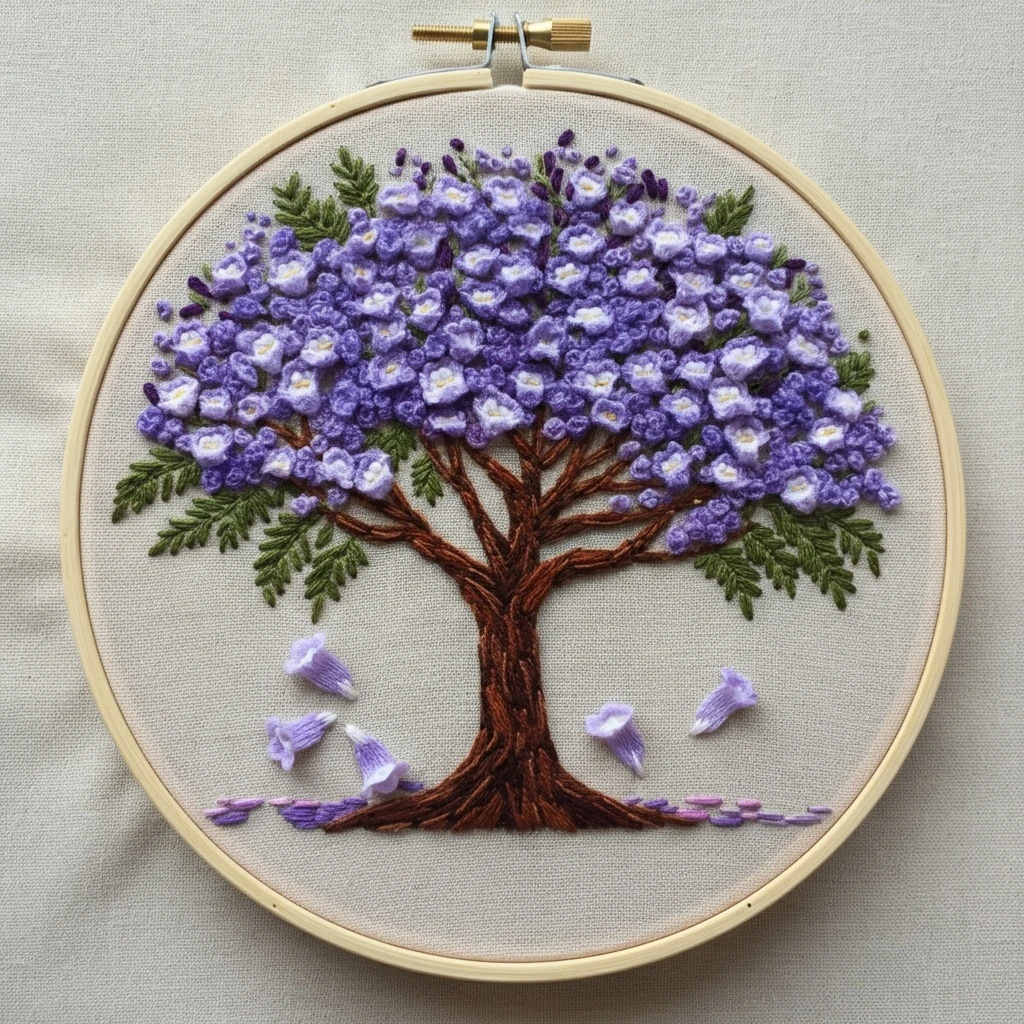

Blooming Jacaranda Tree
A polished stitching plan for a graceful jacaranda in full bloom: airy violet flower clusters, warm twisting bark, fresh green ground, and soft shadows that keep the design delicate and beginner-friendly.
Design color reading
The design is led by a blooming jacaranda canopy, so the main impression should be cool violet and lavender with small darker purple pockets for depth. The trunk and branches need enough warm brown contrast to anchor the tree, while muted greens and soft earth tones keep the base natural without competing with the blossoms.
Suggested stitch map
- Canopy: detached chain, lazy daisy, small French knots, and scattered seed stitches.
- Trunk and branches: split stitch outlines, stem stitch curves, and short-long texture strokes.
- Ground foliage: fly stitch, straight stitch tufts, and small seed stitches.
- Fine outlines: one strand of dark plum or brown-black only where definition is needed.
Thread-count guidance
- 1 strand: fine twig tips, blossom speckles, delicate outlines, and facial-small detail if present.
- 2 strands: most petals, leaves, branch lines, and general fill stitching.
- 3 strands: bold blossom clusters or foreground leaves where extra texture is wanted.
- 6 strands: avoid for most areas; reserve only for chunky practice knots on a separate sampler.
Recommended DMC palette
Blending & shading ideas
- Canopy blend: use 1 strand DMC 340 + 1 strand DMC 341 for soft middle flower clusters.
- Shadow blend: combine 1 strand DMC 333 + 1 strand DMC 340 for darker blossom undersides.
- Bark blend: combine DMC 898 and 975 in short staggered stitches for natural ridges.
- Sunlit tips: place DMC 3747 sparingly at the top and outer edges of the canopy.
Outlining details
Outline the trunk and main branches before filling, but keep flower edges broken and soft. A jacaranda canopy should feel airy; avoid tracing every blossom. Use single-strand dark violet only in small gaps to suggest depth.
- Use split stitch for clean branch outlines.
- Use couching for long sweeping branch curves if the line is hard to keep even.
- Leave small fabric gaps between flower clusters to avoid a heavy purple block.
Texture suggestions by area
Mix lazy daisy petals with French knots and seed stitch. Rotate stitch direction so the clusters feel organic.
Layer stem stitch lines with tiny straight stitches in two browns. Add darker strokes at branch forks.
Use fly stitches for leafy sprigs and short straight stitches for grass. Keep greens muted so the purple canopy stays focal.
Beginner-friendly stitching order
- Transfer the design lightly and mark the main branch direction.
- Stitch trunk and branch outlines with 1-2 strands of DMC 898.
- Fill bark with DMC 975, then add DMC 977 highlight strokes.
- Add medium lavender flower groups with DMC 340 and 341.
- Place darker DMC 333/550 accents under the canopy and near branch intersections.
- Finish with grasses, tiny leaves, and final pale lavender highlight knots.