
Cyclamen
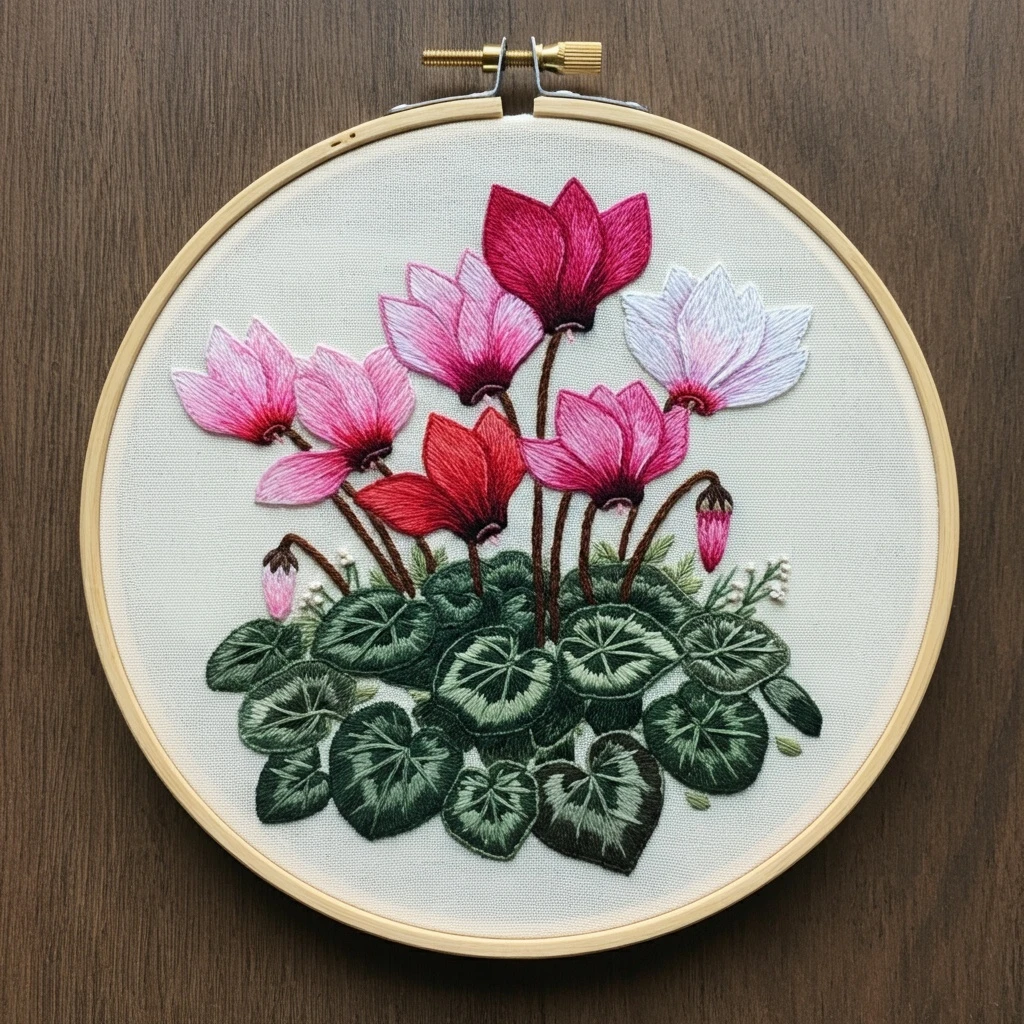
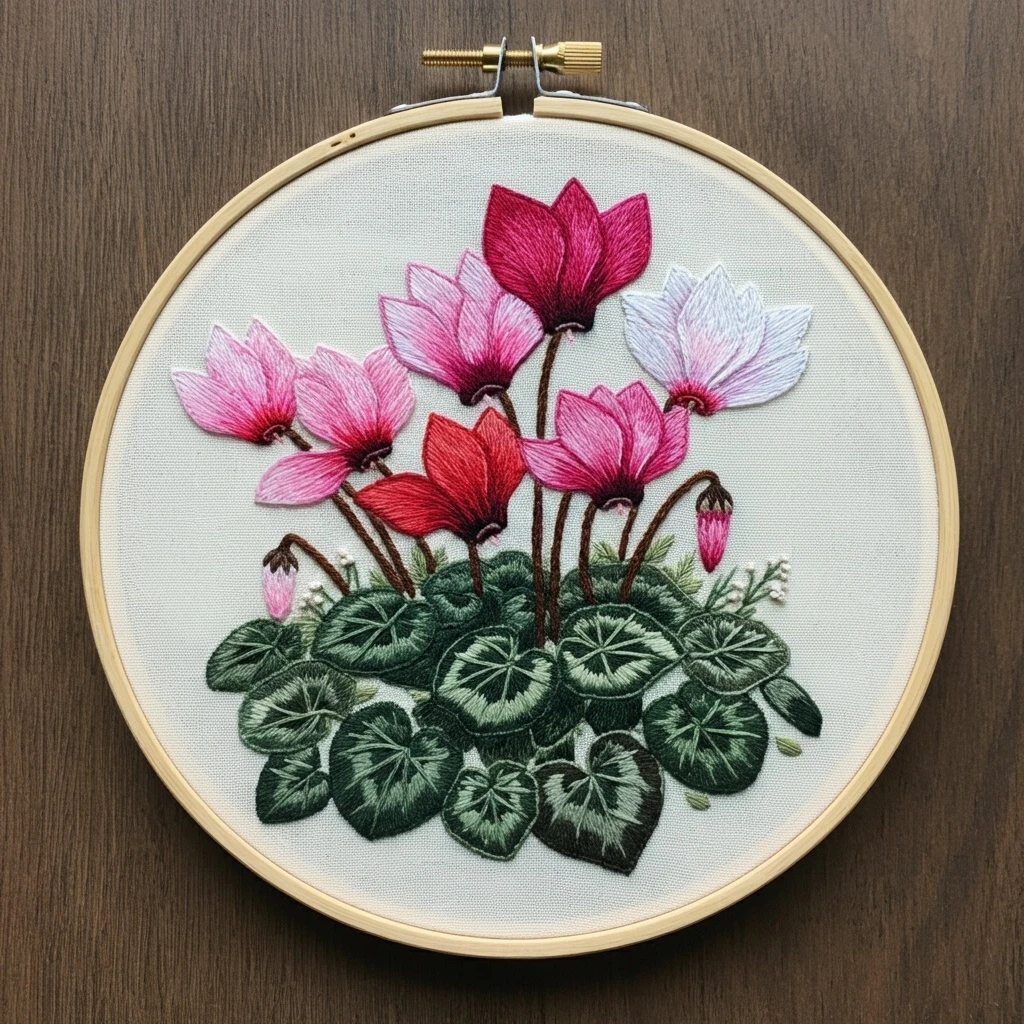
A graceful hoop design with upright cyclamen blooms, magenta-to-pale-pink petals, dark chocolate stems, rounded green leaves with silvery veining, and tiny white filler buds. The key is soft botanical shading: saturated petal throats, feathered highlights, and dimensional leafy texture.
Design color read
The reference image is built around cool pink cyclamen petals, deeper crimson centers, nearly black green foliage, pale sage leaf veins, slim brown stems, and a natural cream linen ground. Keep the flower heads airy and directional, while making the leaf cluster denser and slightly glossy.
Suggested DMC floss palette
Stitch map by area
| Area | Recommended stitches | Practical use notes |
|---|---|---|
| Cyclamen petals | Long and short stitch, satin stitch accents, split stitch edge | Follow the petal direction from dark throat to pointed tip. Start with 1 strand for the top feathering, then add 2-strand satin strokes only where you want a fuller petal surface. |
| Petal throats | Dense short satin, tiny straight stitches, seed stitch | Use DMC 600 and 938 sparingly where petals meet the stem. Feather DMC 601 outward so the dark center does not become a harsh spot. |
| Rounded leaves | Fishbone stitch, long and short stitch, split back stitch outline | Work each leaf from the central vein outward. Alternate DMC 500 and 501 for depth, then skim DMC 502 along raised areas. |
| Leaf veins | Single-strand straight stitch, fly stitch, couching for main veins | Use DMC 3053 with a light hand. Keep veins slightly broken rather than perfectly solid to mimic the natural mottled leaf pattern. |
| Stems | Stem stitch, whipped back stitch | Use 1 strand of DMC 938 or a blend of 938 + 433 for thinner stems. Curve each stitch with the stem so the lines stay graceful. |
| Small buds and white sprays | Detached chain, French knots, colonial knots | Use 1-2 wraps for small white buds. Add a darker brown cap at the top of the pink buds to tie them into the stems. |
Thread-count guidance
- Petal shading: 1 strand for delicate long-and-short gradients; 2 strands only for bold foreground petals.
- Leaf fill: 2 strands for coverage on medium linen; switch to 1 strand for final veins and light edge strokes.
- Stems: 1 strand keeps the stems fine and elegant. Use whipped back stitch if you need a smoother raised line.
- Knots and tiny buds: 1 strand for small white buds, 2 strands for larger pink unopened buds.
Blending ideas
- Crimson petal blend: one strand DMC 600 + one strand DMC 601 for deep, velvety petal bases.
- Rosy transition: one strand DMC 602 + one strand DMC 604 for soft mid-petal passages.
- Pale flower blend: one strand DMC 818 + one strand DMC 211 for cool pink-lavender tips.
- Leaf depth blend: one strand DMC 500 + one strand DMC 501 for shadowed foliage that still reads green.
Shading, outline, and texture suggestions
Petal shading
Place the darkest floss at the base of each flower, then stagger progressively lighter stitches toward the tips. Do not make every petal identical; vary the length and angle of your stitches for a natural flower shape.
Foliage texture
Use darker green around overlaps and under the flowers. Add pale veins last so they sit visibly on top, and let a few veins stop before the leaf edge for a softer botanical look.
Outlining details
Outline only selected edges: petal throats, lower leaf overlaps, and stems. Leaving some petal tips unoutlined keeps the piece light and watercolor-like.
Beginner-friendly stitching order
Practical embroidery tips
Fabric and hoop
Use a firmly tightened hoop and a light cream or natural linen/cotton blend. The pale ground makes the pink petals glow and helps the dark green leaves stand out.
Needle choice
A size 7 or 8 embroidery needle works well for most 1-2 strand sections. Switch to a sharper needle if your long-and-short stitches need to pierce between existing threads.
Avoid bulk
Keep knots small on the back, especially behind the pale flowers. Too much thread behind the right-side white bloom can shadow through light fabric.
Clean finishing
Trim jump threads between dark leaves and pale petals. Deep greens and browns can show through the light fabric if carried too far across the back.