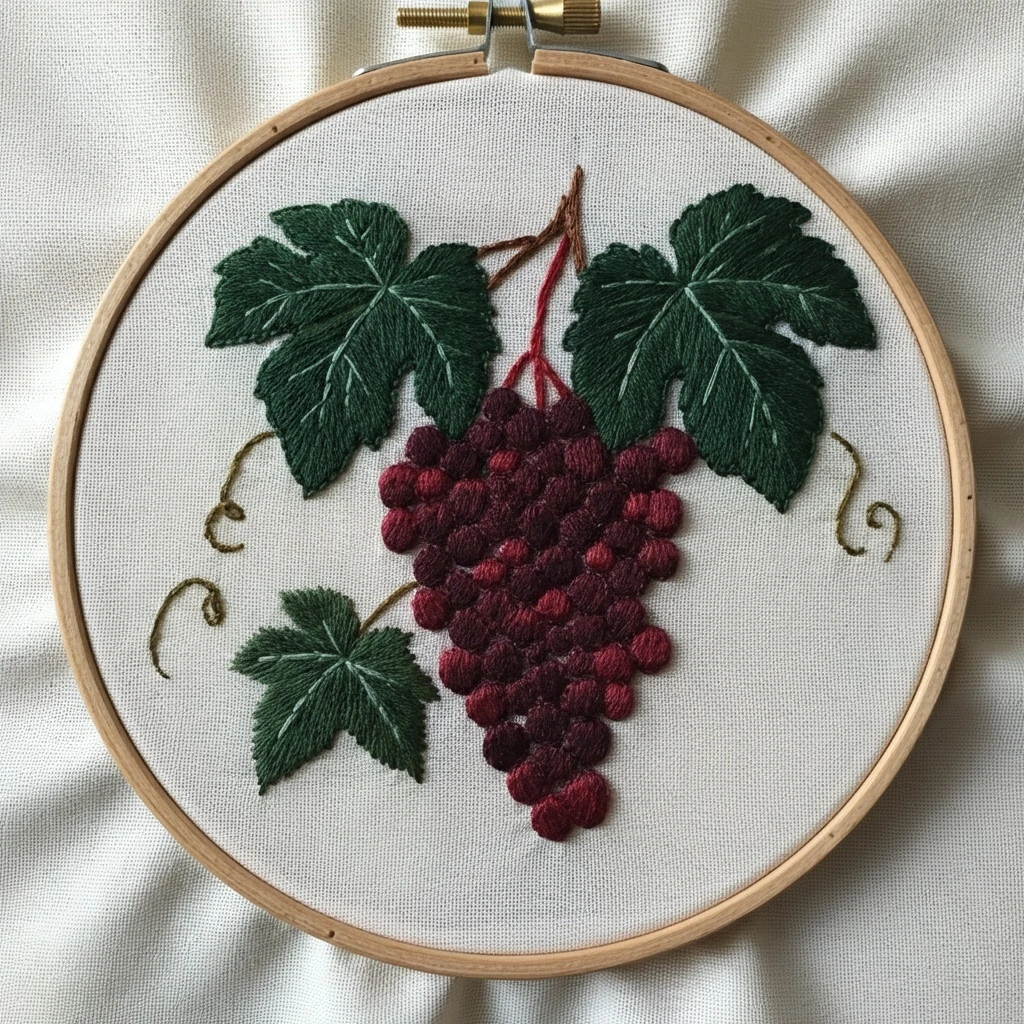

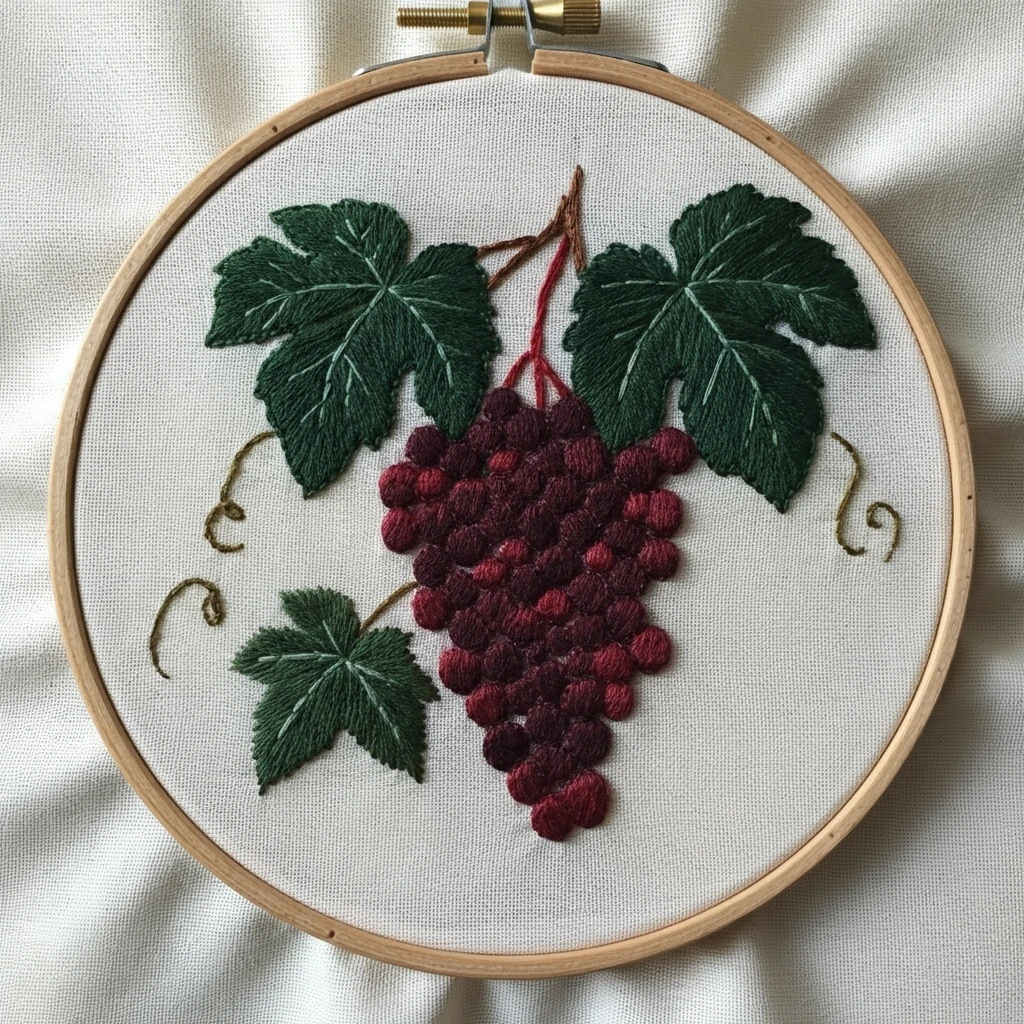
Grapes Embroidery
A polished color and stitching plan for a grape-cluster embroidery design: rounded purple fruit, warm highlights, curling stems, and fresh green leaves. The palette leans into wine-plum shadows, violet midtones, pale lavender shine, olive leaf veins, and woody vine accents so the finished hoop feels dimensional rather than flat.
Design color read
The artwork is built around a clustered bunch of grapes, where each berry needs its own small highlight and shadow to keep the bunch lively. Use darker plums at the undersides and where grapes overlap, brighter violets at the centers, and a tiny pale lavender or off-white accent on the upper-left edge of selected grapes.
Leaves and tendrils should contrast the fruit: muted olive and fresh green for leaf bodies, darker green for veins and shadow cuts, and tan-brown for vine stems. Keep outlines refined so the design remains elegant and botanical.
Thread-count snapshot
- Grapes: 2 strands for satin/long-and-short fill; 1 strand for highlight crescents.
- Deep grape separations: 1 strand split stitch, back stitch, or tiny couching lines.
- Leaves: 2 strands for fishbone or satin stitch; 1 strand for veins.
- Vines/tendrils: 1–2 strands stem stitch; 1 strand for delicate curls.
- Optional sparkle: one short stitch in Ecru or B5200 on only a few berries.
Suggested DMC floss palette
These DMC colors are chosen for a grape-themed hoop with natural purple fruit, green leaves, and warm vine details. Substitute one step lighter or darker depending on your fabric color and desired contrast.
Stitch map
Transfer and anchor the shapes
Mark each grape lightly so the cluster does not become a single blob. Add the vine and leaf outlines first with 1 strand in a muted brown or green.
Fill grapes one at a time
Use satin stitch for small berries or long-and-short stitch for larger ones. Start with DMC 550/552, add DMC 154 at the overlap edge, then feather in DMC 554 or 3042 toward the highlight.
Shape the leaves
Work fishbone stitch from the center vein outward, alternating DMC 469 and 472. Add DMC 3362 beside folds or behind fruit to push the leaves into the background.
Finish vines and tendrils
Use stem stitch or whipped back stitch with DMC 839, then add a few DMC 977 stitches along the top of the vine for warmth.
Blending & shading
- Round grapes: blend 1 strand DMC 550 + 1 strand DMC 552 for middle-dark grapes; blend 1 strand DMC 552 + 1 strand DMC 554 for front grapes.
- Soft bloom: add a few short DMC 3042 stitches over violet areas to mimic the powdery bloom on grape skins.
- Deep gaps: use DMC 154 with tiny split stitches between overlapping grapes; avoid heavy black outlines.
- Leaf dimension: shade the lower side of each leaf with DMC 3362 and keep DMC 472 near tips and vein ridges.
- Consistent light: place highlights on the same side of every berry, usually upper left or upper center.
Recommended stitches by area
| Area | Stitches | Practical guidance |
|---|---|---|
| Grape bodies | Satin stitch, padded satin, long-and-short | For plump grapes, first lay a few padding stitches in the center, then satin over them with 2 strands. Keep stitches curved with the berry shape. |
| Grape shadows | Split stitch, short straight stitches | Use 1 strand of DMC 154 or 550 in tight creases. Place shadow only where berries touch or tuck under leaves. |
| Highlights | Tiny straight stitch, seed stitch | A single 1-strand stitch in DMC 3042 or 3865 is enough. Too many white stitches will make the grapes look dotted. |
| Leaves | Fishbone stitch, satin stitch, split back stitch | Fishbone creates a natural vein structure. Work from center outward and change greens gradually at the edges. |
| Vines and tendrils | Stem stitch, whipped back stitch, couching | Use 1 strand for curls so they stay graceful. For thicker stems, whip a brown back stitch with a lighter golden brown. |
| Fine outlines | Back stitch, split stitch | Outline selectively: around the outer cluster and the underside of key grapes, not every single shape. |
Texture ideas
Add grape skin texture with scattered 1-strand stitches in DMC 3042 over DMC 552. For leaves, mix straight stitches with fishbone direction changes so the leaf surface looks slightly veined and organic.
Beginner-friendly tips
Work from back grapes to front grapes. This lets you tuck darker stitches under lighter foreground berries. Use shorter satin stitches on round fruit to prevent snagging and keep edges smooth.
Clean finishing
After stitching, gently steam from the back over a towel. Avoid pressing the grape padding flat. If the design is hoop-framed, trim and lace the fabric instead of gluing for a neater archival finish.
Simple order of work
Start with stems and the deepest hidden grapes, move forward through the grape cluster, then stitch leaves and tendrils. Add highlights and final outline details last. This order keeps the purple fruit crisp while allowing the greenery to frame the cluster naturally.