
DMC palette & hand embroidery notes
Tulip Garden
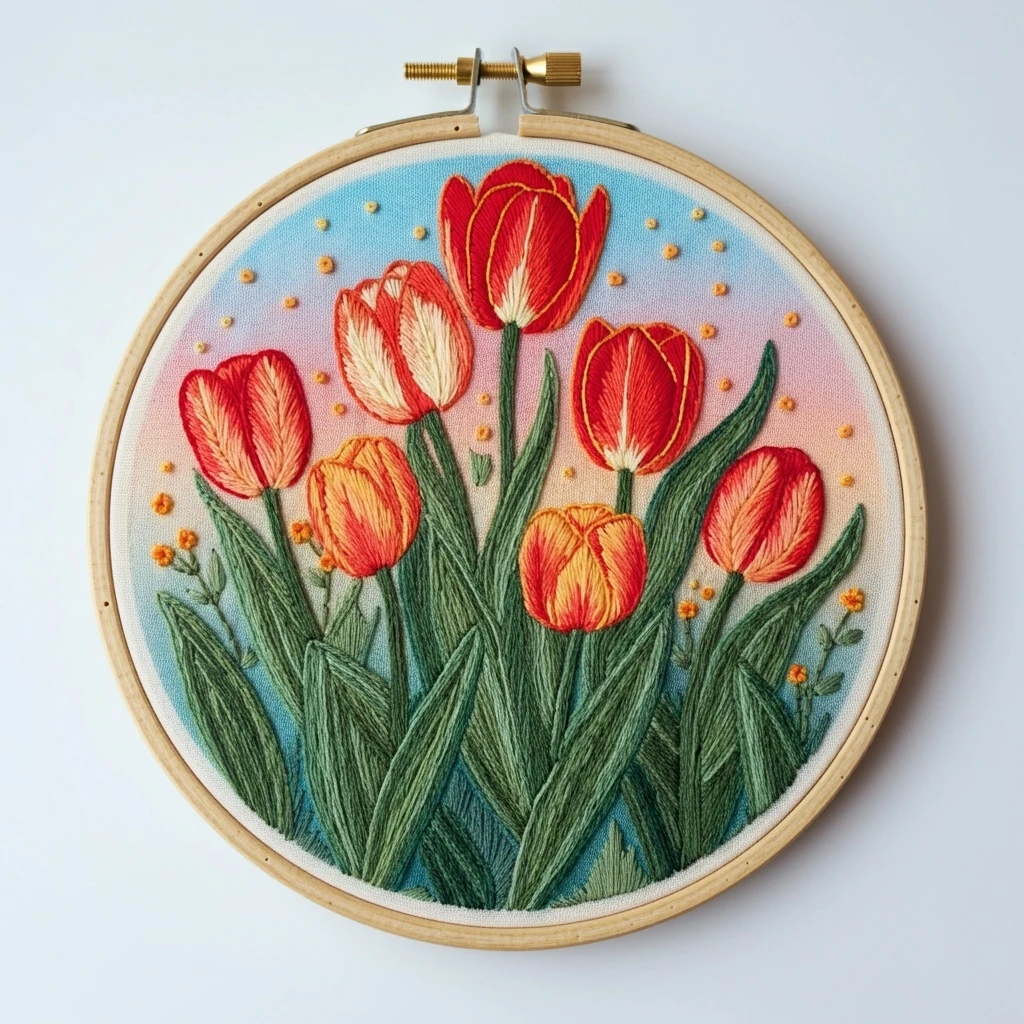
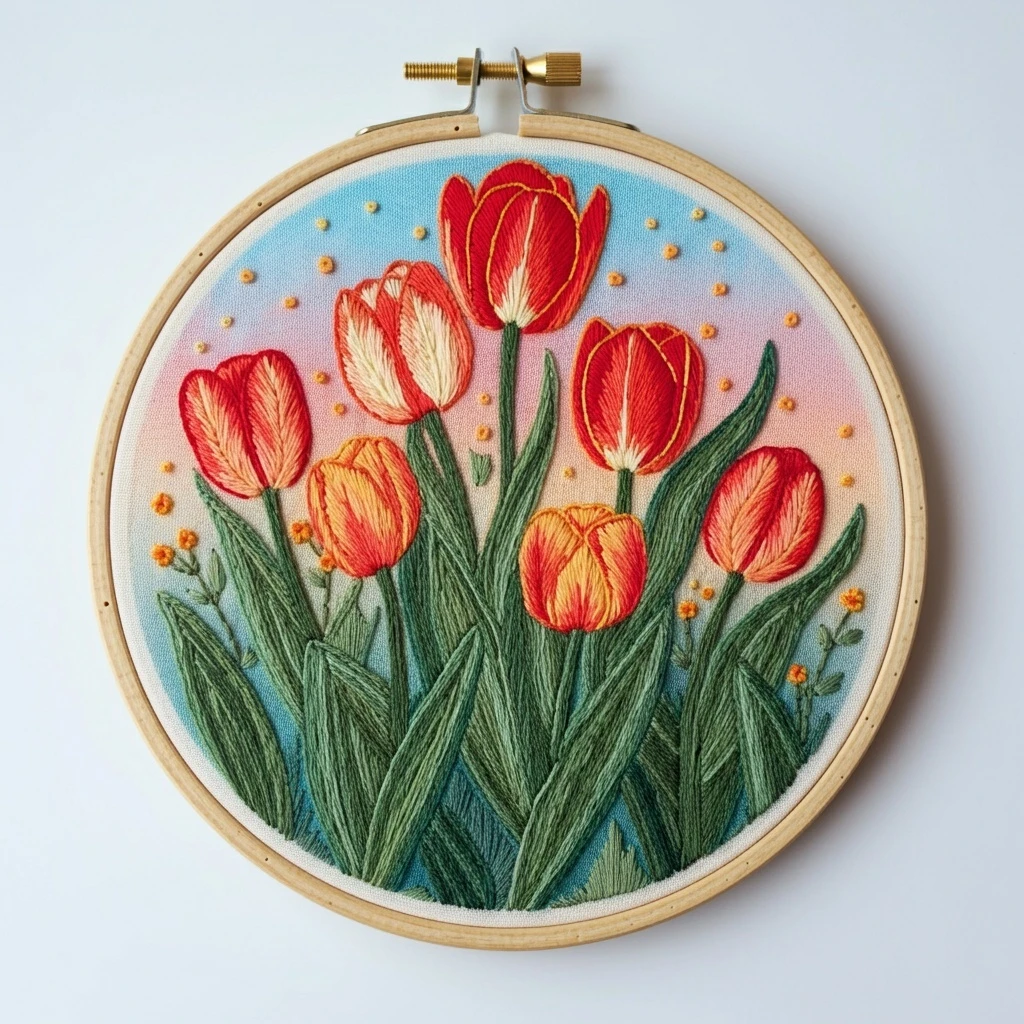
A polished stitching companion for a cheerful tulip garden design: upright stems, rounded spring petals, fresh leaves, and soft garden texture worked in bright pinks, reds, corals, greens, and gentle neutrals.
Suggested DMC Color Palette
This palette is tuned for a tulip-garden motif: saturated bloom colors for the focal flowers, lighter petal shades for highlights, layered greens for stems and leaves, and a few warm neutrals to support soil, basket, or subtle background details if present.
Stitch Map by Design Area
Tulip petals
Use satin stitch for simple petal shapes or short-and-long stitch for more realistic petal curves. Angle stitches from the base toward the petal tip so each bloom looks upright and natural.
Petal folds and centers
Add one-strand split stitch or tiny straight stitches in DMC 335, 321, or 3371 only where petals overlap. A dot of DMC 742 gives warmth without making the flower center too busy.
Stems and leaves
Stem stitch works beautifully for long clean stems. For leaves, use fishbone stitch or long satin stitches with a center vein in DMC 987 and highlights in DMC 3348 or 772.
Garden texture
Use scattered seed stitch, tiny detached chains, and short straight stitches around the base of the flowers. Keep ground texture loose so it supports the blooms rather than competing with them.
Thread Count, Blending & Shading
Outline lightly before filling
Use one strand of a matching darker shade, not black, for most flower outlines. Reserve DMC 3371 for the smallest dark accents and deep creases only.
Fill blooms with soft blends
For red tulips, blend 321 with 335 in the lower petals. For pink tulips, blend 956 with 3716 near the tips. For coral flowers, use 351 as the bridge color between pink and warm orange.
Vary strand count by detail
Use 2 strands for most petal fills, 1 strand for fine petal veins and outlines, and 3 strands only for bold foreground accents or plump detached-chain flowers.
Layer leaves after petals
Stitch main leaves in DMC 470, add lower shadow with 987, then place 3348 or 772 on the upper edge. This sequence keeps the greenery crisp and dimensional.
Texture & Practical Tips
Change stitch angle on each petal. Even a simple tulip looks more realistic when the side petals lean outward and the center petal points upward.
End threads behind matching colors whenever possible. Bright pinks and reds can show through pale fabric if carried across the back.
Work stems first, leaves second, petal fills third, and tiny outlines last. This gives the garden structure before adding decorative detail.
Needle and fabric guidance
- Use a size 7 or 8 embroidery needle for two-strand petals and a size 9 for one-strand details.
- Cotton, linen, or a cotton-linen blend in ivory, soft cream, or pale blush will flatter the tulip colors.
- Keep the hoop taut so satin stitches lie smooth and petal edges remain tidy.
Finishing suggestions
- Press from the back over a folded towel to preserve raised leaf and petal texture.
- Add a few French knots in DMC 742 for pollen or garden sparkle, but keep them sparse.
- For a softer hand-painted effect, leave tiny gaps between neighboring petal colors rather than packing every stitch tightly.