
DMC palette & hand embroidery guide
Hyacinths
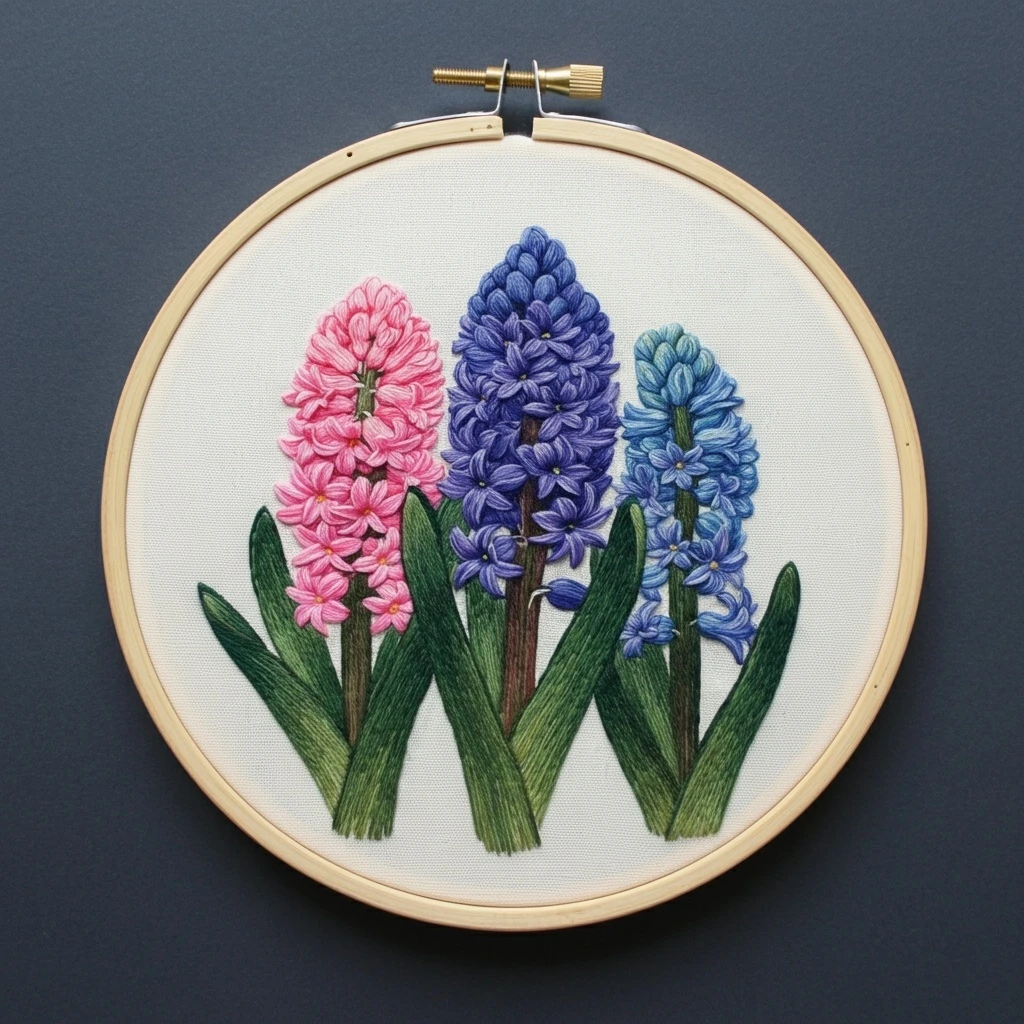
A fresh spring hoop with three dense hyacinth flower spikes: soft pink on the left, deep violet-blue in the center, and airy sky blue on the right. Long glossy leaves and darker vertical stems ground the composition, while small yellow flower centers give the clustered petals a gentle garden sparkle.
Design color read
The reference image uses three distinct hyacinth heads arranged like a small bouquet: warm rose-pink blossoms, a saturated indigo-violet central spike, and a cooler blue spike. The petals are rounded, overlapping, and slightly curled, with darker recesses between clusters. Leaves are long, blade-shaped, and stitched with dark green outer edges, yellow-green veins, and directional fill that suggests glossy spring foliage.
Keep the flower spikes full but not flat: each small floret should have a light edge, a mid-tone body, and a darker tucked-under side.
Thread-count snapshot
- Petals: 2 strands for most satin, fishbone, or lazy-daisy stitches; 1 strand for inner crease lines.
- Leaves: 2 strands for long-and-short fill; 1 strand for fine veins and edge tapering.
- Stems: 2 strands stem stitch, with 1 strand darker couching or backstitch shadows.
- Centers: 1 strand French knots so the yellow dots stay delicate.
Suggested DMC palette
Stitch suggestions
Best order of work
Blending & shading guidance
Pink hyacinth
Use 603 as the main body, then add 818 on the outermost petal tips. Work 602 into lower petals and tucked spaces, especially around the center stalk. For a soft gradient, thread one strand 603 with one strand 818 on highlight florets, and one strand 603 with one strand 602 for mid-shadow petals.
Central violet hyacinth
The center flower is the visual anchor. Start with 333 in the densest middle sections, brighten the top-facing petals with 340, then reserve 791 for the deepest gaps. A few 1-strand 340 stitches over 333 will create a velvety highlight without making the spike too pale.
Blue hyacinth
Keep the right spike cooler and lighter than the central flower. Use 3843 as the main shade, 3846 for the airy edges, and 798 only in the underside curves. This contrast helps the three spikes stay distinct.
Texture notes
- Vary petal size slightly; real hyacinth florets are clustered, not perfectly uniform.
- Leave tiny fabric gaps between some petals to keep the flower heads breathable.
- Curve leaf stitches gently toward the center vein instead of using straight vertical lines.
- Use a laying tool or needle tip to keep satin stitches smooth on the larger leaf sections.
- Do not overfill the top of each spike; a tapered silhouette makes the flowers recognizable.
Outlining details
Outline leaves with split stitch or backstitch in 895 only where the blade needs definition. For the flower heads, avoid full black or heavy outlines; use 602, 333, and 798 as tone-on-tone contour threads. A short dark stitch at the base of each floret gives depth while preserving the soft, botanical style.
Beginner-friendly practical tips
- Transfer only the main spike shapes, leaf edges, and stem lines; place individual petals by eye as you stitch.
- Use a sharp embroidery needle for dense petal clusters so you can pierce between stitches cleanly.
- Keep tension relaxed on lazy-daisy petals; tight loops will flatten the blossom texture.
- Work with shorter floss lengths for violet and blue shades, which can look fuzzy if pulled repeatedly.
- Step back often. The flowers should read as three soft color masses before the fine details are added.
Compact stitch plan
Leaves: long-and-short stitch in 699, shaded with 895 and highlighted with 730. Stems: narrow stem stitch in 838 with green shadow. Flower heads: lazy daisy and short satin petals, using 818/603/602 for pink, 340/333/791 for violet, and 3846/3843/798 for blue. Centers: tiny 726 French knots. Finishing: add selective one-strand tone-on-tone backstitch for petal creases and leaf veins.