
Lotus Third Eye
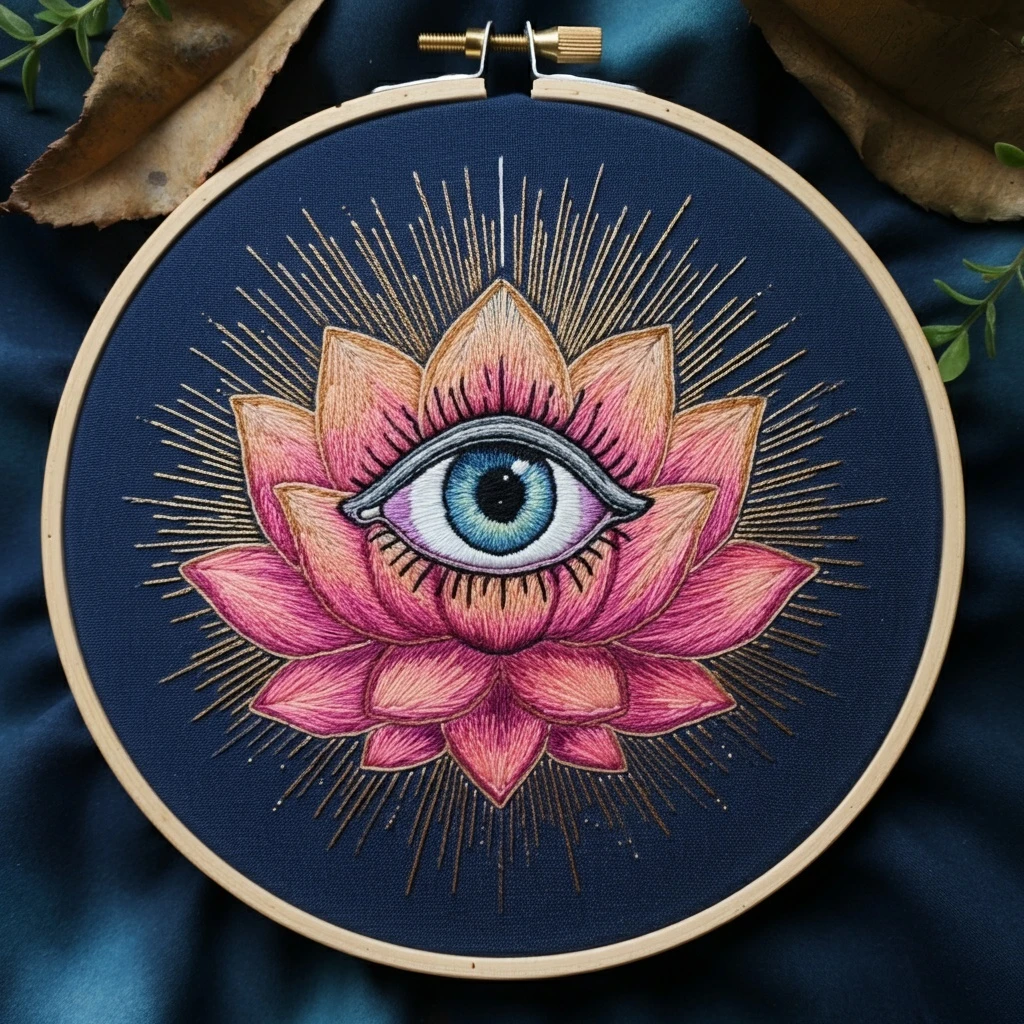
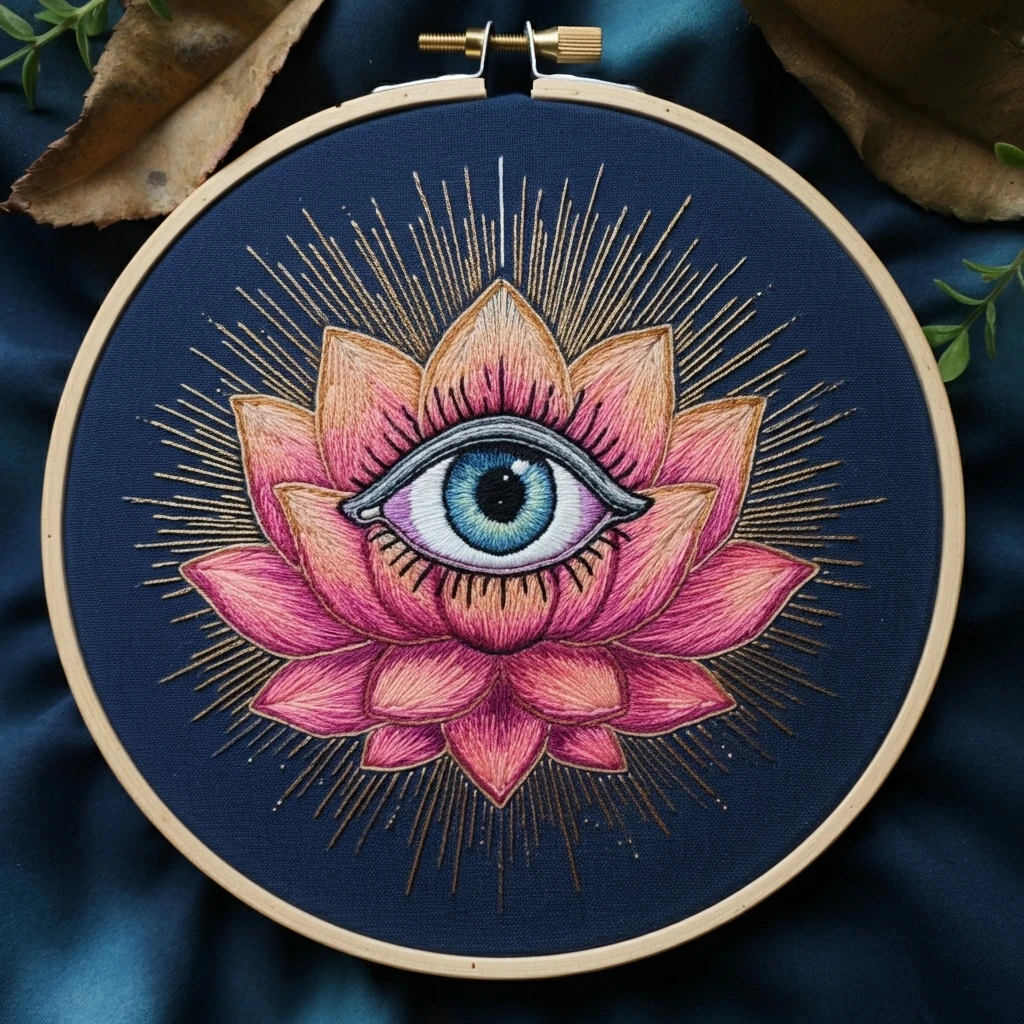
A radiant lotus on deep navy cloth with a watchful blue-green eye, warm peach petals, saturated magenta shadows, black lash detail, and a halo of fine golden sunburst lines. The goal is crisp symmetry, soft petal shading, and luminous contrast.
Design color reading
The artwork uses a spiritual mandala feel: layered lotus petals glow from pale peach centers into rose and raspberry edges, while the eye acts as the high-contrast focal point. The surrounding rays are thin, evenly spaced, and warm gold against a very dark blue ground.
Suggested DMC floss palette
Stitch plan by area
- Lotus petals: work long-and-short stitch from the petal base outward. Use 353 and 3716 in the center, then 335, 3685, and a few 915 strokes near the edges.
- Petal outlines: use split stitch or stem stitch with 3685; add a single strand of 729 along select upper ridges for the warm golden edge seen in the artwork.
- Eye white: satin stitch in B5200 with tiny 762 stitches under the lids so it does not look flat.
- Iris: stitch radial spokes from pupil outward with 3765, 3845, and 3811. Keep stitches short and tapered so the iris remains round.
- Lashes and pupil: use 310 in one strand for lashes and two strands for the filled pupil. Add one B5200 French knot or tiny satin dot for the catchlight.
- Golden rays: use straight stitch with 729 and 3820. Vary lengths, but keep the rays anchored around the lotus to preserve symmetry.
Thread-count guidance
| Detail | Strands | Why |
|---|---|---|
| Petal fill | 1–2 | One strand for realistic shading; two for faster coverage on larger petals. |
| Petal outlines | 1–2 | One strand is elegant; two strands gives a bolder folk-art edge. |
| Iris spokes | 1 | Maintains fine detail and keeps color changes clean. |
| Pupil and heavy lid line | 2 | Creates the strong central contrast visible in the design. |
| Lashes and rays | 1 | Fine lines look more refined and less bulky. |
| Tiny gold dots | 1–2 wraps | Use small French knots or colonial knots for sparkle points. |
Blending ideas
For two-strand work, blend one strand of 353 with one of 3716 for peachy petal glow. Blend 3716 with 335 for mid-pink transitions, and 335 with 3685 for the deepest lower petals. In the iris, blend 3845 with 3811 for a glassy blue-green highlight.
Outlining details
Outline the flower after the fills are complete. Split stitch gives the petals a smooth illustrated edge, while back stitch is easier for beginners. For the upper eyelid, couch a slightly thicker dark line with small stitches so the curve stays graceful.
Texture suggestions
Add petal veins with single-strand straight stitches following the petal direction. Use tiny seed stitches in pale gold around the halo for star-like texture. Keep knots small so they read as shimmer instead of beads.
Beginner-friendly workflow
Mark petal boundaries, eye shape, iris circle, and ray endpoints. Too many transfer lines can muddy the shading.
This keeps the flower luminous and prevents dark pink fibers from contaminating the peach stitches.
Complete iris, pupil, and eye white, then place the lash lines over the finished surface for clean definition.
Straight rays are easy to snag while working nearby areas, so save them for the final pass.
Working on dark fabric
Use a sharp needle and good lighting. Dark navy cloth makes the pink and gold shine, but pale transfer marks can be stubborn; test your marking tool first. A lightweight stabilizer behind the hoop helps prevent puckering around the dense lotus and eye.
Finishing notes
- Press from the back over a towel to protect raised stitches.
- Trim thread tails carefully; dark fabric can reveal pale backs if carried too far.
- For extra ceremony, substitute a few halo rays with metallic gold thread, but keep ordinary cotton nearby for easier stitching.