
DMC Palette & Stitch Guide
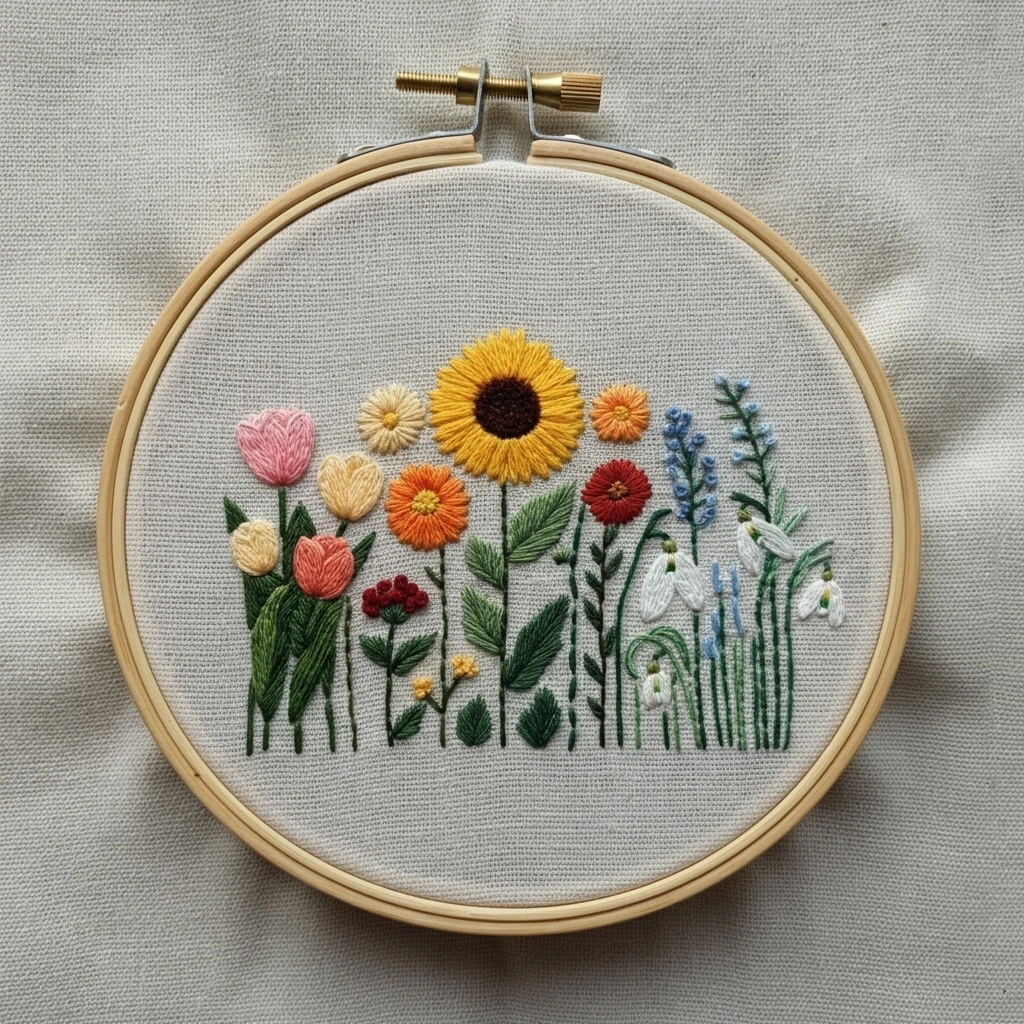
Wildflower Meadow Mini
A compact hoop meadow with a cheerful sunflower, tiny tulip-like blooms, orange and red flowers, blue sprigs, white bells, and layered green grasses stitched across a linen ground.
Colors are visually estimated from the preview image and matched to close DMC cotton floss shades. Use the palette as a practical stitching guide rather than an exact thread-usage chart.
Design Read
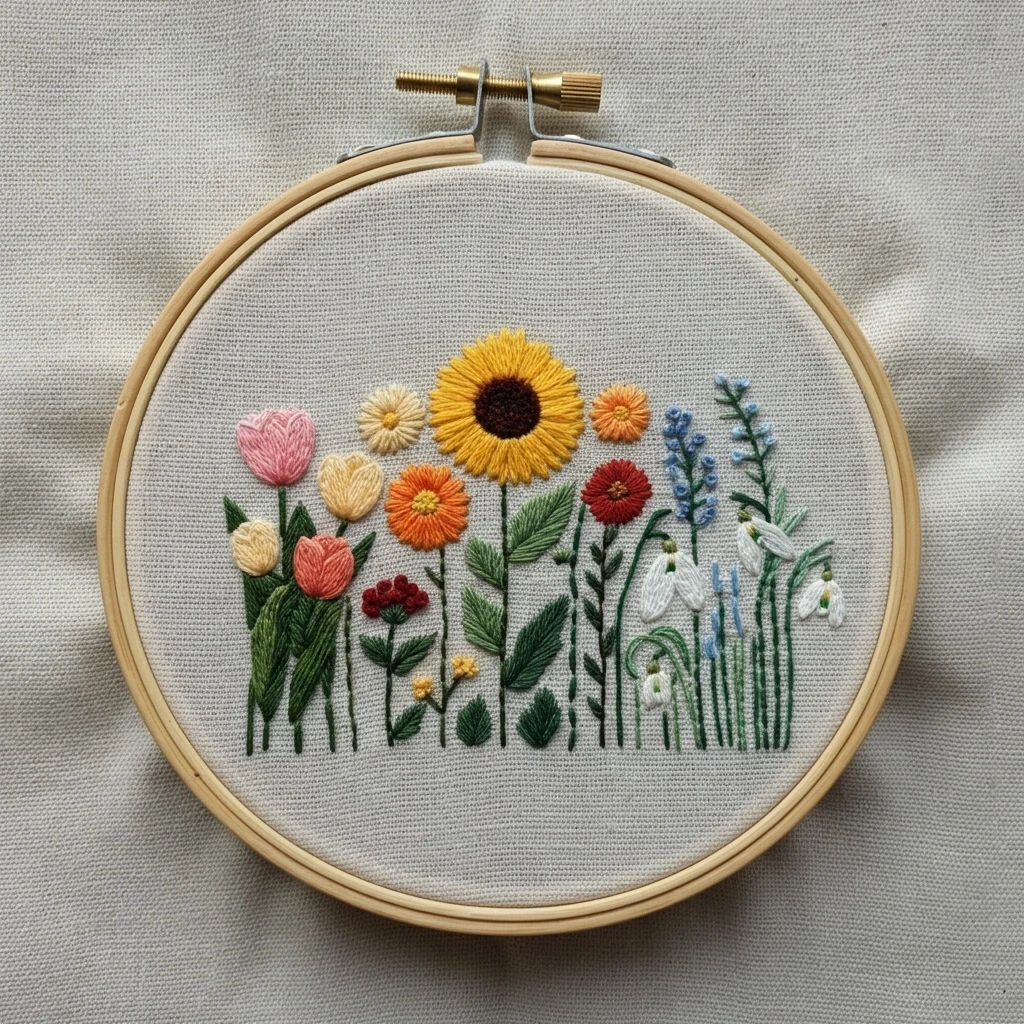
This mini meadow is built as a low horizontal band of wildflowers, so the design relies on clean stem lines, small textured flower heads, and controlled leaf direction. The strongest focal point is the golden sunflower near the center, balanced by pastel tulip shapes on the left and cooler blue-white meadow details on the right.
Visible color families
- Warm sunflower golds with a very dark brown raised center.
- Soft blush pink, coral, cream, orange, and brick red flower accents.
- Deep forest, medium olive, and gray-green stems and leaves.
- Dusty blue sprigs and near-white bell flowers for cool contrast.
Design elements to preserve
- Keep the meadow baseline airy; avoid filling every gap with greenery.
- Use raised knots only where texture helps: sunflower center, berry cluster, tiny yellow flowers, and blue buds.
- Let the sunflower petals radiate outward with slight length variation for a natural hand-stitched look.
Likely DMC Color Palette
A 15-color working palette gives enough range for the mini meadow without making the project fussy. Substitute one shade lighter or darker if your fabric changes the contrast.
DMC 726
Topaz Light
Main sunflower petals and bright yellow accents.
DMC 725
Topaz Medium Light
Sunflower petal bases, golden shading, tiny yellow blooms.
DMC 3371
Black Brown
Sunflower center, deepest flower centers, tiny contrast dots.
DMC 741
Tangerine Medium
Orange daisy petals and warm flower shadows.
DMC 921
Copper
Deep orange petal bases and autumnal meadow accents.
DMC 347
Salmon Very Dark
Red bloom petals, berry cluster, warm flower depth.
DMC 3713
Salmon Very Light
Soft pink tulip bloom and pale petal highlights.
DMC 352
Coral Light
Coral tulip, rosy petal shadows, warm blend areas.
DMC 3822
Straw Light
Cream flower petals and pale daisy highlights.
DMC 3865
Winter White
White bell flowers, petal tips, final sparkle stitches.
DMC 3363
Pine Green Medium
Dark stems, leaf outlines, lower grasses.
DMC 3347
Yellow Green Medium
Leaf midtones, sunflower leaves, small sprigs.
DMC 3052
Green Gray Medium
Soft leaf highlights and calmer grass transitions.
DMC 932
Antique Blue Light
Blue sprig stems, small buds, cool meadow notes.
DMC 927
Gray Green Light
Snowdrop shadows, blue-white highlights, pale stem accents.
DMC 822
Beige Gray Light
Optional neutral highlight on cream flowers and fabric-friendly petal edges.
Stitching Suggestions
| Element | Recommended stitch | Practical notes |
|---|---|---|
| Sunflower petals | Long and short stitch or straight stitch | Use 2 strands. Begin with DMC 725 near the center and place DMC 726 over the outer petal tips. Vary petal length to avoid a stiff wheel shape. |
| Sunflower center | French knots, colonial knots, or seed stitch | Use 2 strands of DMC 3371. Pack knots closely in the middle, then loosen the spacing at the edge for a rounded center. |
| Pink and coral tulips | Satin stitch with split-stitch outline | Outline each small bloom first with 1 strand, then fill with 2 strands. Blend 3713 and 352 by alternating stitches down the petal ribs. |
| Orange and red daisies | Lazy daisy, detached chain, or radial straight stitch | Anchor each petal close to the flower center. Add a single darker stitch at the base of selected petals for depth. |
| Cream daisy | Straight stitch or lazy daisy | Use DMC 3822 with a few DMC 822 shadows near the center. Keep stitches short so the small flower stays crisp. |
| Blue sprig | Stem stitch plus French knots | Use 1 strand for the narrow stem and 2 strands for the blue buds. Add knots on alternating sides to mimic a wild lupine-like spike. |
| White bell flowers | Satin stitch, fishbone stitch, and tiny straight stitches | Use DMC 3865 for bright petal fronts and DMC 927 for the undersides or inner shadow. A single yellow knot can suggest a flower throat. |
| Leaves | Fishbone stitch, fly stitch, or satin stitch | Use directional stitches from base to tip. Mix 3363 in shadowed leaves and 3347/3052 on upper leaf surfaces. |
| Fine stems and grasses | Stem stitch, backstitch, or couching | Use 1 strand for most vertical lines. For sturdier central stems, use 2 strands or whip a backstitched line with the same green. |
| Tiny yellow and red clusters | French knots and seed stitch | Keep knots small with one wrap for scale. Group them irregularly rather than in a perfect circle. |
Thread Count, Blending & Outlining
Thread-count guidance
- 1 strand: thin stems, grass blades, petal outlines, tiny vein details, and delicate blue sprig stems.
- 2 strands: most flower petals, leaves, sunflower petals, and visible meadow stems.
- 3 strands: only for a bolder sunflower center or raised foreground knots; test first so the mini scale does not become bulky.
Blending ideas
- Blend sunflower petals by alternating DMC 725 and 726, not by twisting different strands together; this keeps each petal clean.
- For coral blooms, place DMC 352 at the petal center and a few 3713 stitches along the edges.
- Use DMC 927 sparingly beside 3865 on the white bells so the flowers remain white but still dimensional.
Outlining details
- Use split stitch in matching colors around tulip shapes before filling for neat mini silhouettes.
- A few 1-strand dark green backstitches under leaves help define the meadow without heavy black outlining.
- Outline only the shadow side of white bell petals with pale gray-green; full outlines can make them look cartoonish.
Texture suggestions
- Reserve raised knots for flower centers and berries so they feel intentional.
- Use fishbone leaves with a visible center vein for the larger sunflower leaves.
- Add tiny seed stitches in the lower grass only after all stems are complete, stopping before the base becomes crowded.
Beginner-Friendly Stitch Order
Stabilize and mark lightly. Hoop the fabric drum-tight and transfer only essential outlines: flower centers, main stems, and the low meadow baseline.
Stitch the stems first. Work all vertical stems with 1 strand of green, then add slightly thicker central stems with 2 strands where needed.
Add the main sunflower. Stitch the center after the petals if you want a clean petal edge, or before the petals if you prefer the petals tucked underneath visually.
Fill the left and middle flowers. Complete pink, cream, coral, orange, and red blooms before adding leaves so the flower shapes stay visible.
Layer leaves and grasses. Work larger leaves first, then add skinny grass blades and small sprigs in lighter greens.
Finish with knots and highlights. Add berry clusters, flower centers, blue buds, white bell highlights, and any final seed stitches last.
Helpful Notes for a Clean Mini Finish
- Because the design is small, shorten your thread to about 14–16 inches to reduce fuzzing and tangles.
- Keep the back tidy around the white flowers; dark carried threads can shadow through pale stitches on light linen.
- When changing greens, stitch in small patches rather than completing all leaves in one color. This makes the meadow feel naturally varied.
- If a bloom looks too heavy, add open space instead of more stitches. Mini wildflower designs often look best with visible linen between stems.
- Press from the back on a folded towel after stitching so French knots and raised centers are not crushed.