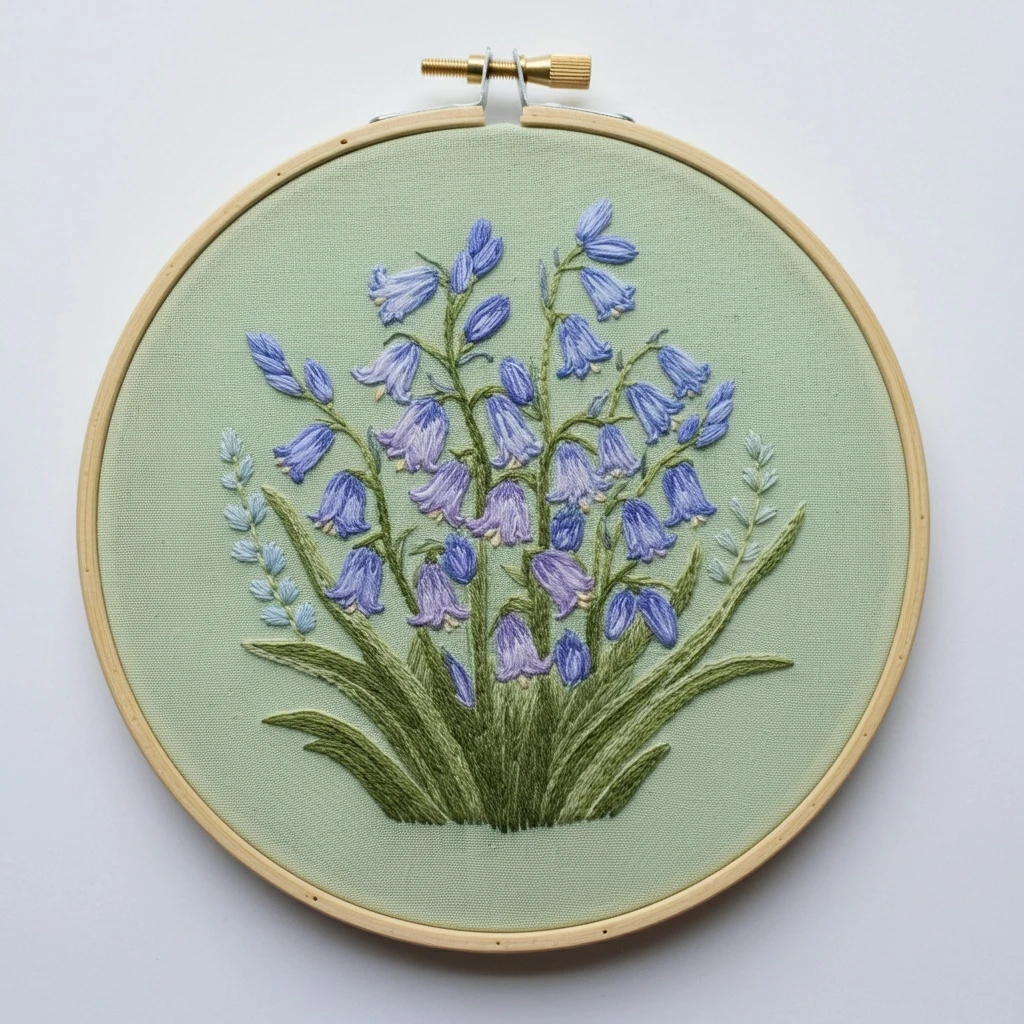

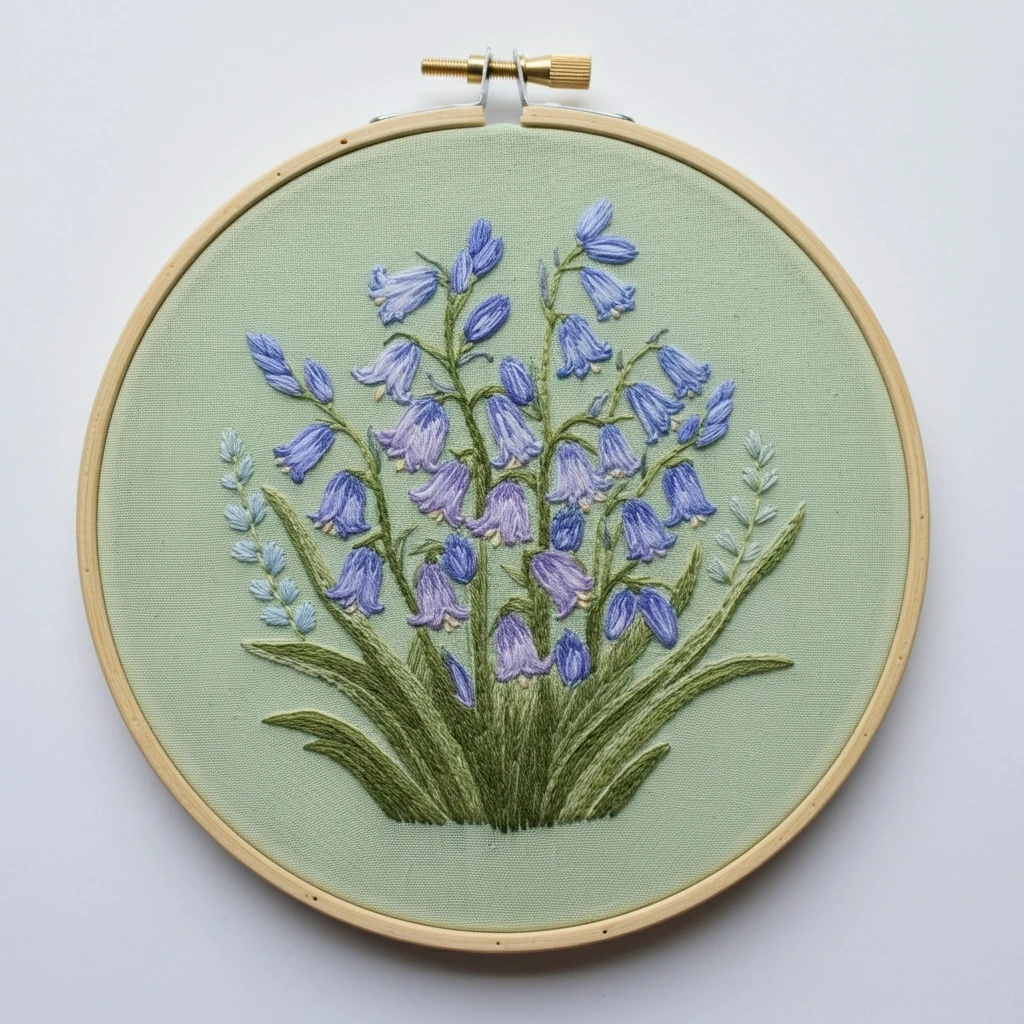
Purple Bluebells Garden
A graceful garden embroidery with drooping purple-blue bell flowers, slender green stems, and soft leafy texture. The prettiest finish comes from cool violet-to-periwinkle shading on the bells, fine curved stem lines, and restrained botanical filler that keeps the flowers airy and delicate.
Design color read
The design reads as a purple-blue woodland flower cluster. The blossoms need a range of violet, blue-violet, lavender, and pale periwinkle so each bell has a shaded mouth and highlighted outer curve. The greens should stay muted and natural, with darker moss at the stem bases and lighter sage on leaf tips.
Suggested DMC floss palette
This palette keeps the bluebells recognizably purple while adding enough blue and lavender variation for shaded, dimensional flowers.
Deepest shadow inside bell mouths and under folded petal edges.
Main purple-blue flower color for most bell bodies.
Soft mid-light petals and outer curve highlights.
Small highlight strokes on petal tips and lifted bell edges.
Cooler bluebell accents, especially where flowers appear more blue than purple.
Periwinkle glints, tiny pale petals, and the softest flower highlights.
Pinpoint highlights at flower openings and tiny sparkle stitches on pale petals.
Warmer purple transition for blossoms that need a rosy-violet softness.
Stem bases, overlapping leaf shadows, and darker garden depth.
Main stems, leaf centers, and natural muted garden greenery.
Leaf tips, fresh stem highlights, and airy foliage filler.
Optional ground accents, seed details, and very soft anchoring at the base.
Stitch map by design element
Bluebell petals
Use long-and-short stitch or small satin stitches, following each bell from the stem attachment down toward the open rim.
Bell mouths
Use one-strand split stitch or backstitch in dark blue-violet to define the lower opening without making it too heavy.
Petal tips
Use tiny straight stitches or lazy daisy tips in light lavender/periwinkle for curled edges and small highlights.
Stems
Use stem stitch or whipped backstitch with one strand. Keep the stems slightly curved to show the natural hanging weight of the flowers.
Leaves
Use fishbone stitch for larger leaves and detached chain stitch for small side leaves. Blend darker green at bases into lighter sage tips.
Garden texture
Use seed stitch, small straight stitches, and occasional French knots around the base for soft meadow-like filler.
Thread-count and blending guidance
| Area | Strands | Blending idea | Practical note |
|---|---|---|---|
| Bluebell blossoms | 1 strand for small bells; 2 strands for fuller petals | Use 333 at the mouth, 340/341 through the center, and 211 or 157 on petal tips. | Shade each bell individually; repeated color placement gives the cluster rhythm. |
| Flower outlines | 1 strand | Use 333 only inside the deepest folds; use 340 for softer outer definition. | Avoid black outlines. Bluebells look more delicate with tonal purple outlining. |
| Stems and leaves | 1–2 strands | Start with 3362 in shadowed bases, then move to 3012 and 3013 along the lit side. | Use one strand for thin stems so the flowers remain the focus. |
| Ground filler | 1 strand | Scatter 3012, 3013, and a few 839 stitches for subtle natural texture. | Keep filler sparse; too many ground stitches can crowd the bell shapes. |
Recommended stitching order
- Transfer stems, bell outlines, leaf shapes, and a few base texture marks with a fine removable pen.
- Stitch background stems and smaller leaves first so flower heads can sit cleanly on top.
- Fill the bluebell blossoms from darkest mouth areas to lighter outer curves.
- Add petal-tip highlights, soft tonal outlines, and any tiny white glints.
- Finish with base seed stitches, small leaves, and a few grounding accents.
Beginner-friendly practical tips
- Use short stitches on the bell rims; long stitches can make small petals look stiff.
- Rotate the hoop as you stitch curved stems to keep hand tension even.
- Thread only 12–15 inches at a time when working pale lavender to prevent fuzzing.
- Keep the darkest purple inside the flowers, not around every edge.
- Step back after each flower cluster to check that the stems still look light and graceful.
Texture, shading, and finishing notes
The polished effect comes from delicate movement. Let the stems arc naturally, place blossoms at slightly different angles, and use color shifts from dark blue-violet to pale lavender to make each flower feel like a tiny hanging bell.
Bell dimension
Think of every blossom as a cupped form. The darkest stitches belong inside the mouth and under the folded rim; the lightest stitches belong on the outer edge that catches light. Leave a tiny gap of fabric at some petal separations for airiness.
Garden softness
Use uneven seed stitches and small detached chains around the lower stems to suggest wild garden growth. Keep greens muted and varied so the purple flowers remain the main visual focus.