
DMC color palette & hand embroidery notes
Soft Pink Peonies
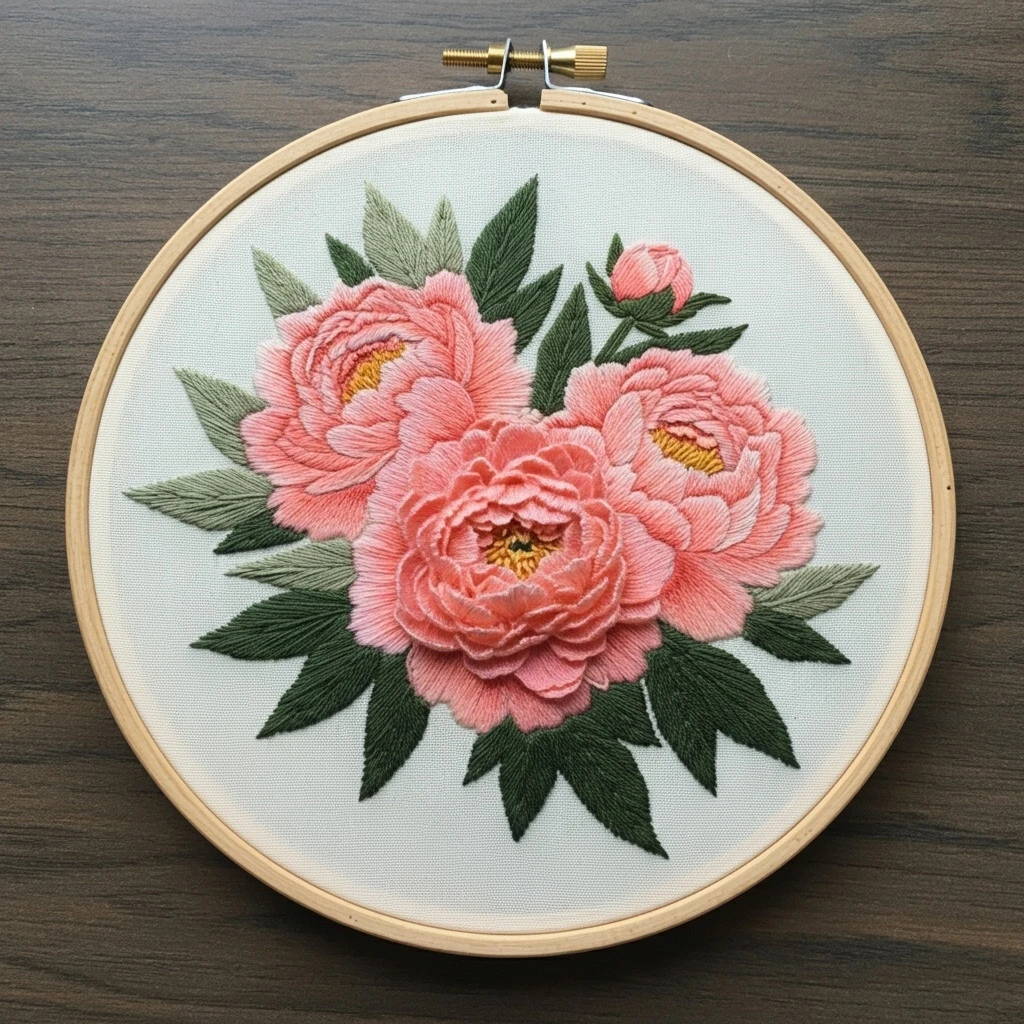
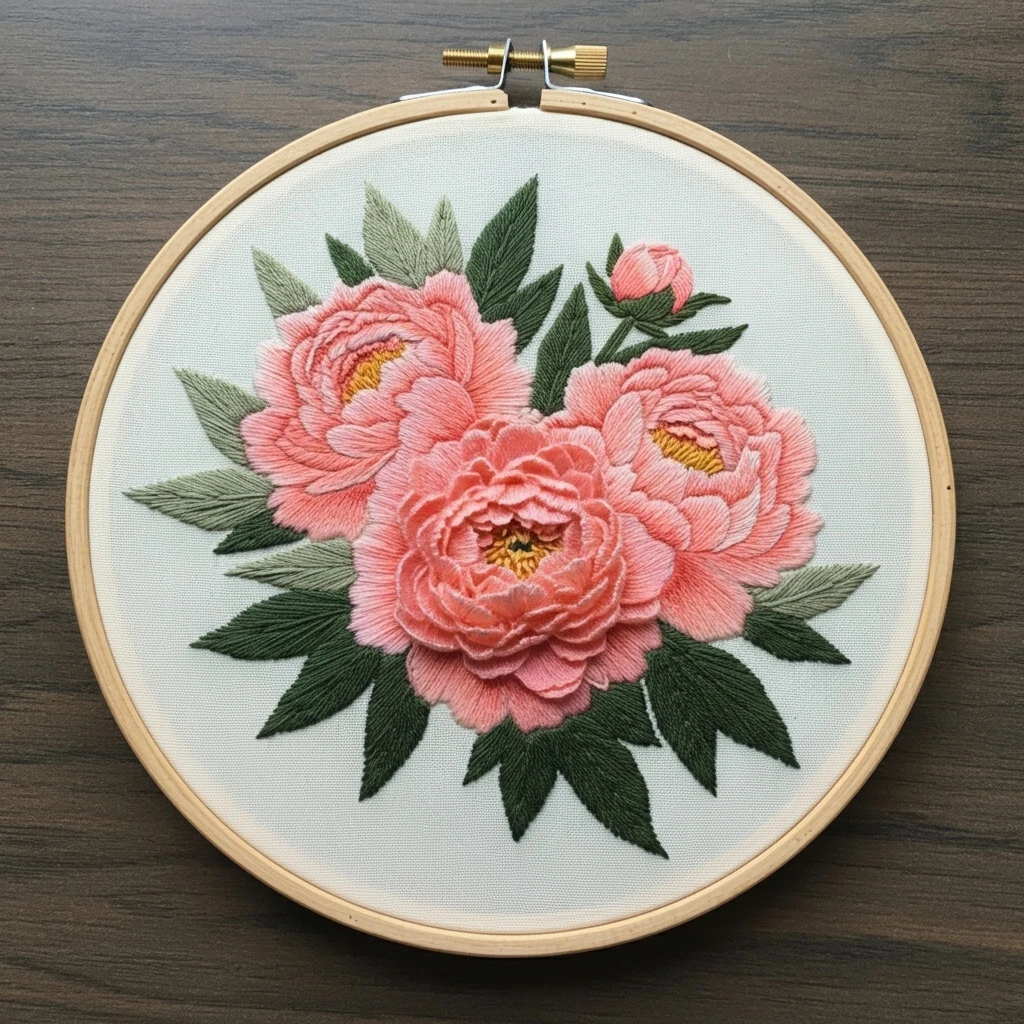
A romantic floral embroidery guide for large layered peony blooms, curled pink petals, softly shaded centers, and fresh green leaves. The overall effect should feel airy and painterly: plush blossom texture, gentle blush transitions, and clean botanical outlines.
Layered petalsBlush pink paletteSoft leaf shadingBeginner friendly
Recommended DMC Palette
This palette keeps the peonies soft rather than sugary: pale shell pinks for outer petals, rose tones for folds, a small touch of burgundy for depth, creamy yellow for stamens, and natural greens for leaves and stems.
DMC 963 Ultra Very Light Dusty RosePale outer petals, petal tips, and soft highlights.
DMC 3716 Very Light Dusty RoseMain light petal color; blends beautifully with 963.
DMC 3354 Light Dusty RoseMid-tone petals and rounded petal bases.
DMC 3731 Very Dark Dusty RoseCurled petal undersides and deeper folds.
DMC 3721 Dark Shell PinkAccent shade for inner petals and shadowed creases.
DMC 315 Medium Dark Antique MauveTiny deepest shadows at flower centers; use sparingly.
DMC 3823 Ultra Pale YellowSoft stamen highlights and warm center glints.
DMC 743 Medium YellowFrench-knot stamens and pollen dots.
DMC 522 Fern GreenMain leaves and smooth green fills.
DMC 3052 Green GrayLeaf highlights and pale undersides.
DMC 520 Dark Fern GreenStems, leaf veins, and shaded leaf bases.
DMC 3865 Winter WhiteOptional petal sparkle and light-catching edges.
Stitch Plan by Design Area
| Area | Best stitch choice | Practical notes |
|---|---|---|
| Outer peony petals | Long-and-short stitch, satin stitch, or split-stitch fill | Use 963 and 3716 with 1–2 strands. Follow each petal curve rather than stitching straight across; this keeps the bloom soft and rounded. |
| Mid petals | Long-and-short stitch with gentle color changes | Work 3716 into 3354, allowing irregular stitch lengths. Keep the direction radiating from the flower center. |
| Inner folds | Split stitch, stem stitch, or short satin shadows | Use 3731 and a few touches of 3721. Place darker stitches under overlapping petals to show curled layers. |
| Deep center shadows | Tiny straight stitches or single-strand back stitch | Use 315 only in pinpoints. Too much dark mauve can make the peony look heavy. |
| Stamens | French knots, colonial knots, or small seed stitches | Use 743 for the main dots and 3823 for lighter highlights. Make knots uneven in height for a natural center. |
| Leaves | Fishbone stitch, satin stitch, or long-and-short fill | Use 522 for the body, 3052 for the upper edge, and 520 for the vein. Angle stitches toward the center vein. |
| Stems and outlines | Stem stitch, split stitch, or fine back stitch | Use 1–2 strands of 520 or 522. Keep outlines delicate so the petals remain the focus. |
Thread Count & Blending Guide
- Petal fills: 1 strand gives the smoothest painterly finish; 2 strands are faster and still soft on medium cotton or linen.
- Petal edges: Use 1 strand of 963 or 3865 to add a few light-catching stitches after the main fill is complete.
- Blended blush: Combine one strand 3716 with one strand 3354 for soft transition petals between pale and medium pink.
- Deep folds: Use one strand 3731, 3721, or 315 for shadow lines. Keep the stitches short and tucked beneath petal overlaps.
- Stamens: 2 strands for French knots. Use a single wrap for small pollen dots and two wraps for raised center knots.
- Leaves: 2 strands for fishbone leaves; add 1 strand of 3052 over selected edges for a dusty green highlight.
Peony softness rule: Do not outline every petal in a dark color. Let stitch direction and subtle value changes define the layers. Reserve darker lines for hidden folds, not exposed petal tips.
Suggested Stitching Order
Transfer the major petal shapes. Mark the outer petal silhouette, inner petal folds, stamen cluster, stems, and leaves. Keep guide lines light so pale pink thread stays clean.
Stitch stems and background leaves. Work the green structure first with 520 and 522. This gives the flowers a stable base and prevents green thread from snagging over finished petals.
Fill the outer petals. Begin with 963 and 3716 around the outside of each peony. Use longer stitches along wide petal areas and shorter stitches where petals tuck inward.
Build middle and inner petals. Add 3354, then 3731 and 3721 in the folds. Keep the darkest shade closest to the center and under overlapping petal lips.
Add centers and finishing highlights. Stitch yellow knots last, then add a few single-strand highlights on petal edges and leaf tips.
Shading, Outlining & Texture Tips
- Petal direction: Stitch from the petal edge toward the base, or from the base toward the edge, but keep each petal consistent. Direction changes are what make peonies look layered.
- Soft color transitions: Feather 963 into 3716, then 3716 into 3354 using uneven long-and-short lengths. Avoid hard color bands.
- Curled edges: Add a slim line of 3865 or 963 on the top edge and a short 3731 shadow just beneath it.
- Leaf dimension: Use 520 for the center vein, 522 for the main fill, and 3052 at the sunlit edge. A few split stitches make the leaf surface look ribbed.
- Center texture: Mix French knots with tiny straight stitches so the stamens look lively rather than perfectly dotted.
Beginner-Friendly Practical Tips
FabricChoose ivory cotton, cotton-linen, or pale oatmeal linen. Avoid very dark fabric unless you plan to strengthen the light pinks with extra strands.
NeedleA size 7 or 8 embroidery needle works well for 1–2 strand petal shading; use size 5 for thicker knots or dimensional areas.
Hoop tensionKeep the fabric drum-tight, especially while satin stitching petals. Loose fabric causes puckering around large floral fills.
- Use shorter thread lengths, about 14–16 inches, for pale pinks so the floss does not fuzz or pick up lint.
- Finish one petal at a time instead of filling all pale areas first. This helps each petal keep its individual curve.
- Step back often. Peony shading should look smooth from normal viewing distance even if individual stitches are visible up close.
- If a petal looks too flat, add just three or four darker stitches at the base rather than restitching the whole shape.
- Press from the back on a padded towel after stitching. Do not flatten French knots or raised center texture.