
Delicate Pink Rose Posy
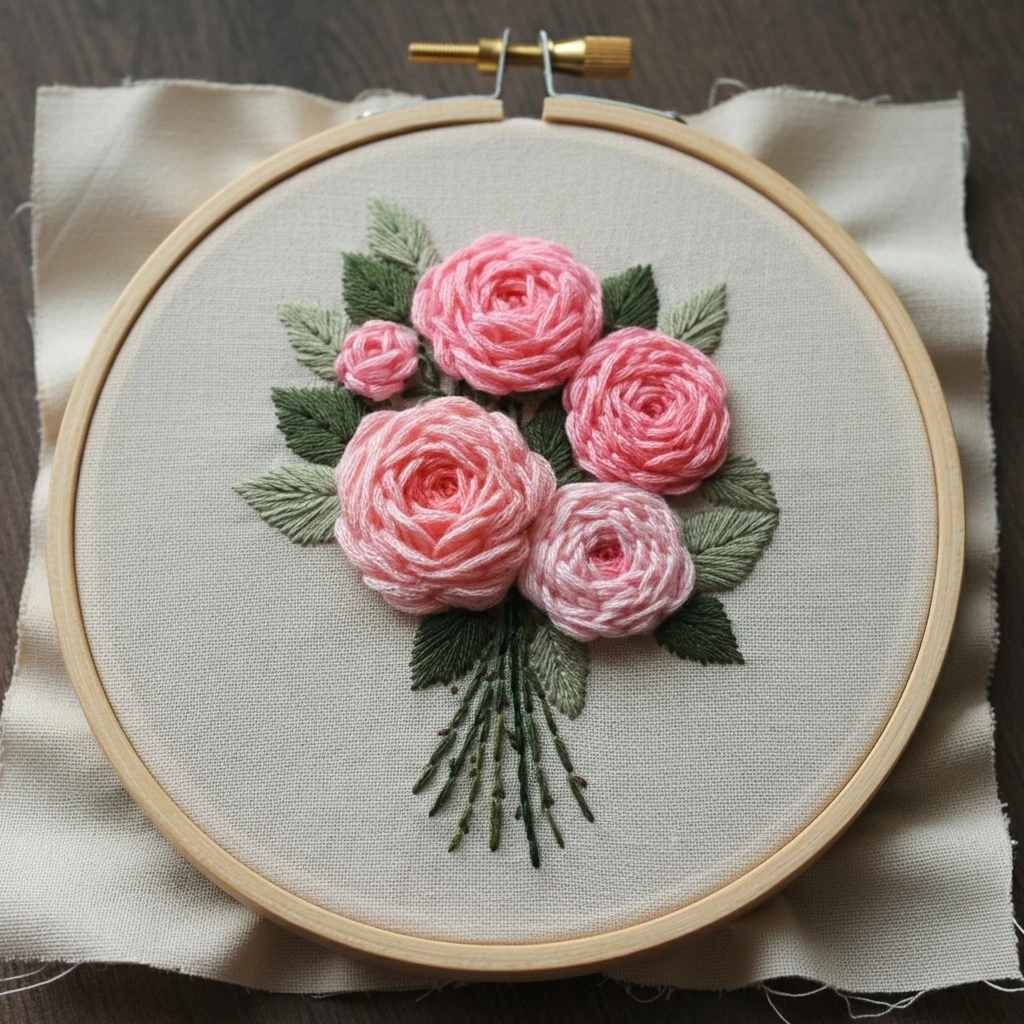
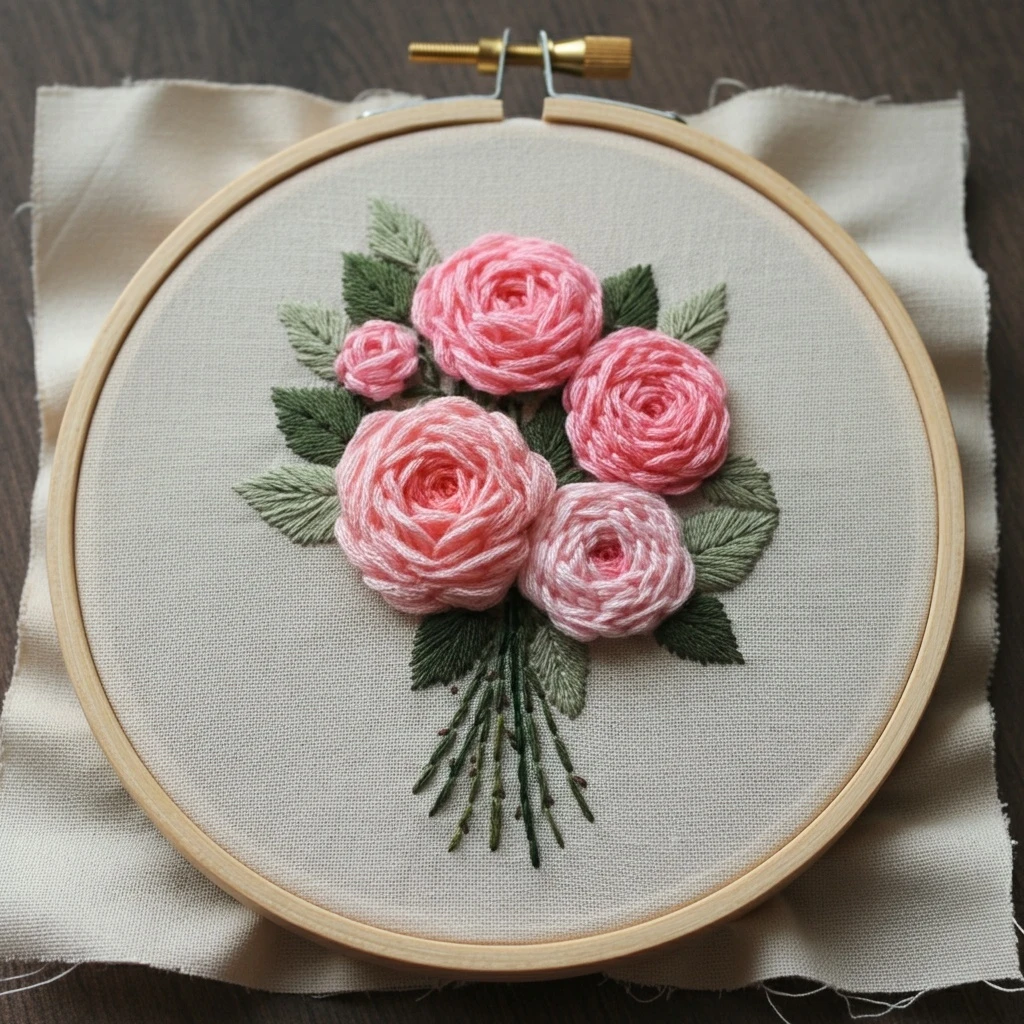
A soft clustered rose bouquet with dimensional pink blooms, muted sage leaves, fine gathered stems, and a natural linen background. This guide favors romantic rose shading, raised petal texture, and beginner-friendly thread choices for a graceful floral hoop.
Design Color Read
The reference image shows five rounded rosette-style flowers: one large bright pink bloom at the top, a warmer coral-pink rose at lower left, deeper rosy centers, two smaller pale-pink blossoms, dark green leaves tucked behind the flowers, and slender descending stems. The overall effect is airy and delicate, so keep contrast controlled and reserve the darkest shades for centers, leaf pockets, and stem accents.
Thread Count Snapshot
- Roses: 3–6 strands for woven wheels, 2 strands for petal shading.
- Leaves: 2–3 strands for fishbone or satin stitches.
- Stems: 1–2 strands for fine stem stitch lines.
- Accents: 1 strand for tiny highlights and dark vein details.
Suggested DMC Palette
Use the pale shades generously to keep the posy soft, then place the deeper pinks sparingly inside petal curls and under overlapping petals.
Rose Stitching Plan
- Start each rose with a small center ring in DMC 760 or 3708 using 2 strands.
- Build volume with woven wheel stitch or loose spiral whipped backstitch using 4–6 strands.
- Alternate 3354 and 3716 as you move outward; avoid perfect rings so petals feel natural.
- Add 818 and a few B5200 single-strand highlights on the top-facing petal ridges.
- For the lower-left warm rose, blend 3708 with 3716 to echo the coral-pink shadow in the image.
Leaves, Stems & Texture
- Leaves: Use fishbone stitch for tapered leaves. Work one side in 522 and the other in 3012, then tuck 3363 near flower shadows.
- Veins: Add a central vein with 1 strand of 934 or 3363 only after the leaf fill is complete.
- Stems: Stem stitch or split stitch with 1–2 strands of 3363; vary the greens so the gathered stems do not look flat.
- Tiny knots: Place small French knots in 611 along the lower stems, wrapping once for a neat seed-like texture.
Blending Ideas
- Needle blend 1 strand 818 + 1 strand 3354 for the palest petal turns.
- Blend 3354 + 3716 for the main pink rose body.
- Blend 3716 + 3708 where petals curl toward the center.
- Blend 522 + 3012 for muted sage leaves with natural variation.
Outlining Details
- Keep rose outlines minimal; let the spiral stitches define the petals.
- Use 1 strand of 760 only in the deepest rose centers.
- Outline leaves selectively with 3363, not black, to preserve softness.
- Anchor stems at the bouquet base with tiny straight stitches in 934.
Fabric & Hoop Tips
- Natural linen or cotton-linen in oatmeal, ivory, or warm beige suits the gentle palette.
- Use a 6–7 inch hoop for comfortable spacing around the bouquet.
- Stabilize loose linen with lightweight backing if using many woven roses.
- Keep fabric drum-tight before starting dimensional flower stitches.
Beginner-Friendly Practical Tips
Stitch back leaves first, then stems, then the largest roses last so the blooms sit visibly on top.
Cut floss around 14–16 inches for pinks; pale shades can look fuzzy if dragged through fabric too often.
For woven roses, keep the center snug and loosen only the outer rounds to create soft raised petals.
One or two deeper stitches in the center are enough; too much dark pink will overpower the delicate look.
Angle fishbone stitches toward the flower cluster so the greenery frames the roses naturally.
Steam from the back only, avoiding pressure on raised roses; let the dimensional petals stay fluffy.