
DMC Palette & Hand Embroidery Notes
Red Pom Pom Wildflower
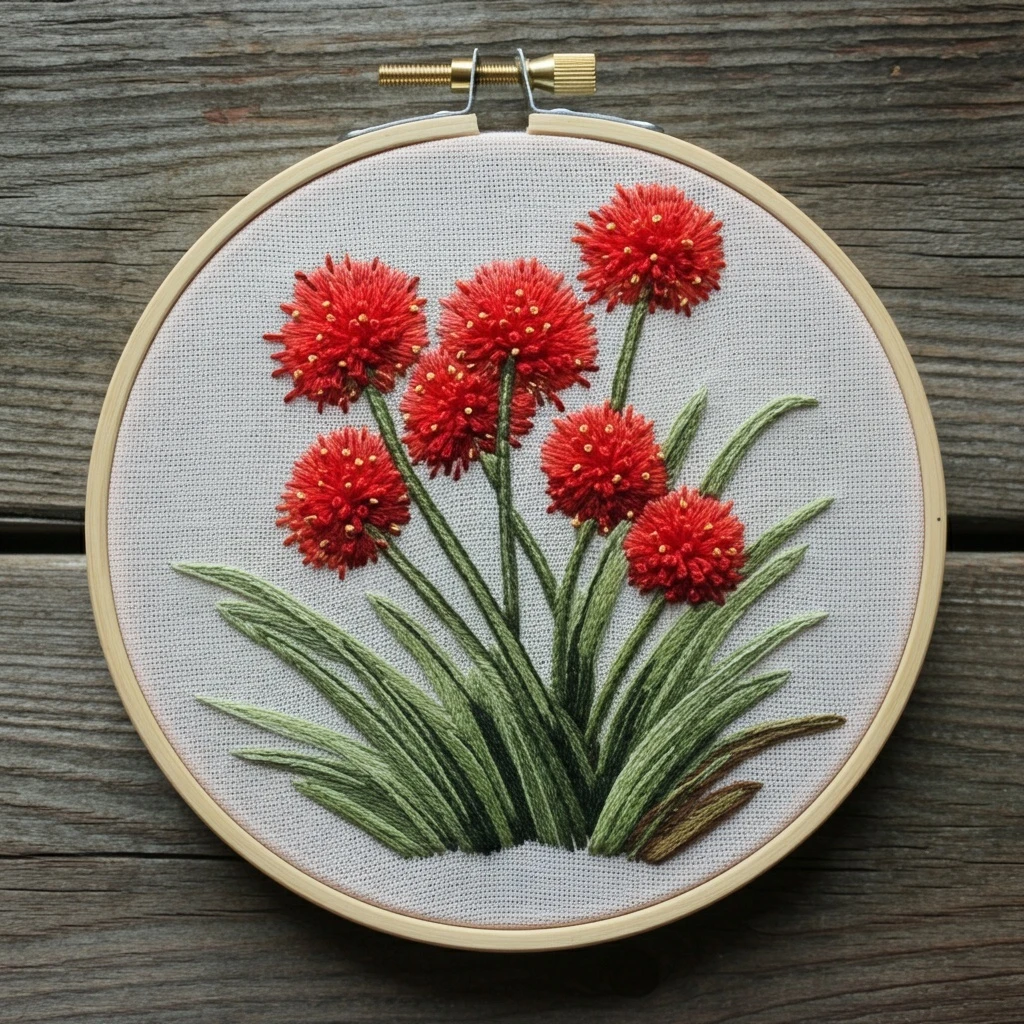
A cheerful hoop design with clustered red pom-pom blooms, golden pollen dots, slim olive stems, and layered grass-like leaves. The look depends on soft dimensional flower texture, lively red shading, and long green leaf strokes that feel natural rather than perfectly symmetrical.
Design Color Story
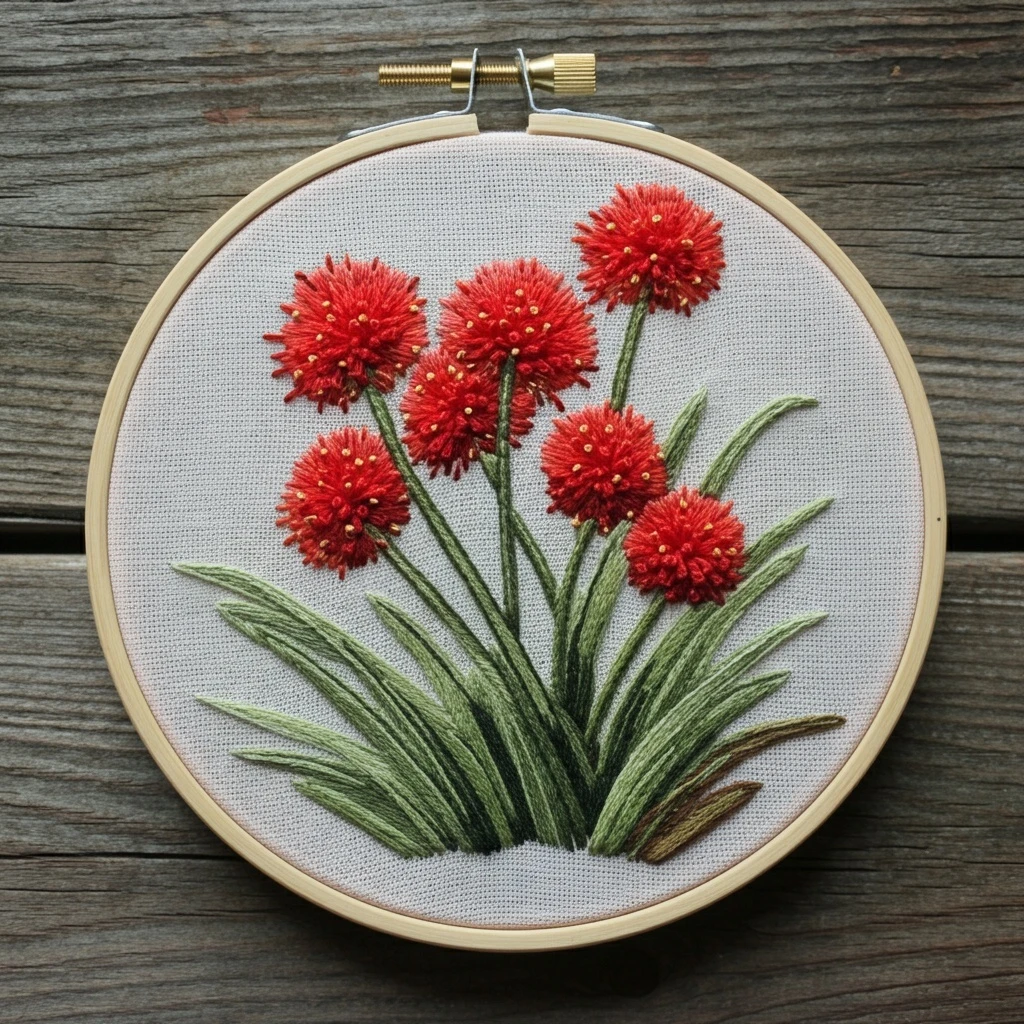
The reference features vivid scarlet flower heads with darker burgundy undersides, coral highlights at the outer tufts, warm yellow seed knots, and a dense base of sage, olive, and deep forest greens. A few brown-green leaves at the lower right add a dried botanical accent and keep the palette rustic.
Core Palette Preview
Suggested DMC Floss Palette
| Color | DMC | Use Notes |
|---|---|---|
| Clear scarlet red | 321 — Red | Main pom-pom flower mass. Use for most radial stitches and raised loops so the blooms read as bright red from a distance. |
| Dark garnet | 814 — Garnet, Dark | Place under flower heads, near centers, and between tuft groups to create depth and shadow. |
| Orange red | 666 — Bright Red | Add punchy accents on forward-facing strands and the sunlit side of each round bloom. |
| Soft coral red | 351 — Coral | Use sparingly on petal tips and upper-left highlights to avoid a flat red disk. |
| Golden pollen | 783 — Topaz, Medium | French knots or colonial knots scattered across each bloom; concentrate a few near centers. |
| Olive stem green | 3011 — Khaki Green, Dark | Primary stems and darker leaf veins. Excellent for split stitch outlines before filling leaves. |
| Sage leaf green | 3012 — Khaki Green, Medium | Mid-tone leaf fill and second strand in blended long-and-short stitches. |
| Pale grassy highlight | 3013 — Khaki Green, Light | Leaf edge highlights, top ridges, and small glints along curved blades. |
| Deep forest green | 520 — Fern Green, Dark | Deepest base shadows where stems gather. Use lightly to avoid making the plant too heavy. |
| Olive brown | 680 — Old Gold, Dark | Lower-right dried leaf detail and warm shadow touches at the grass base. |
Palette balance: Keep roughly 55% greens, 35% reds, 5% gold knots, and 5% brown accents. The flowers should feel plush and saturated, while the leaves should be layered with many directional strokes.
Stitch Types by Area
Thread Count Guidance
Flowers
Use 3 strands for fluffy straight stitches, or 4–6 strands for turkey stitch loops before trimming. For smaller flower heads, reduce to 2–3 strands so the edges stay tidy.
Stems & Leaf Veins
Use 2 strands for stems and central leaf veins. For crisp dark base shadows, use 1 strand of DMC 520 or 3011 on top after the green fill is complete.
Leaf Fill
Use 2 strands for most leaf strokes. Switch to 1 strand for pale edge highlights, especially on narrow tips and overlapping blades.
Blending, Shading & Texture Plan
Red Bloom Depth
Start each bloom with 814 close to the center and lower underside. Work 321 over the main surface, then add 666 and 351 only at the outer tips and upper ridges.
Dimensional Pom-Poms
For the soft ball shape, vary stitch length. Keep the central strokes shorter and denser, then place longer outward stitches around the edge. Trim raised loops unevenly for a natural wildflower texture.
Green Leaf Blends
Blend one strand 3011 with one strand 3012 for middle leaves. Use 3013 along sunlit edges and 520 at the base where many blades overlap.
Outlining Details
- Outline stems first in split stitch so the flower placement stays stable while you build texture.
- Avoid heavy black outlines; the reference relies on tonal shading rather than cartoon borders.
- Use 1 strand of 814 beneath several flower heads to separate petals from the green stems.
- For leaf definition, add a fine center vein after the fill using 3011 or 520, following the curve of each blade.
Beginner-Friendly Order
- Transfer the stems and leaf shapes lightly; mark only the circles for bloom placement.
- Stitch the stems first, then the long leaves from the center outward.
- Add darker base shadows and pale leaf highlights after the main green fill.
- Build each red flower from dark center/shadow to bright outer texture.
- Finish with gold French knots and a few dark red knots to create lively centers.
Practical Embroidery Tips
Keep the Hoop Taut
Raised pom-pom stitches pull on the fabric. Tighten the hoop before beginning the flowers and avoid yanking loops too firmly.
Control Bulk
When working several red blooms close together, finish and secure each flower separately. This prevents bulky thread carries from showing through the pale fabric.
Natural Leaf Direction
Angle every leaf stitch toward its tip. Slightly uneven stitch lengths make the grass clump look organic and hand-rendered.