
Elegant White Lily Floral
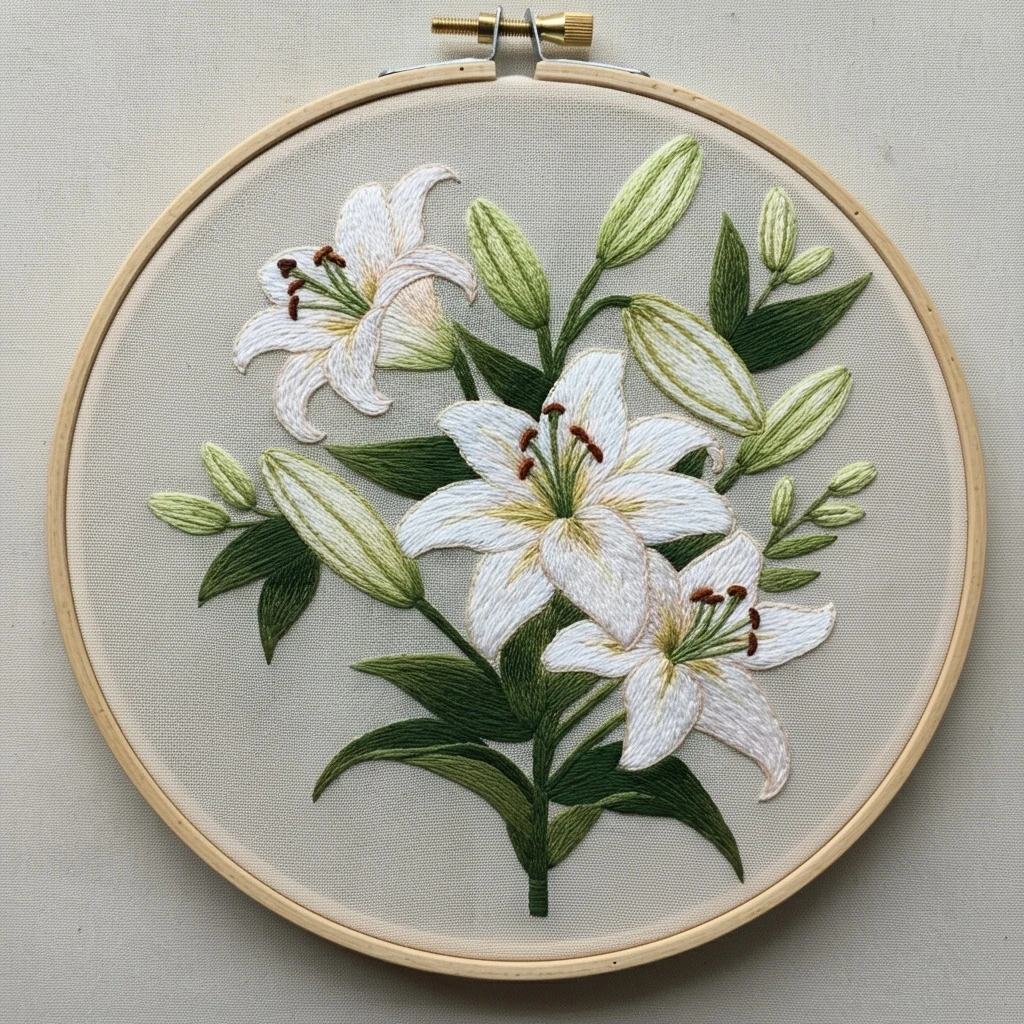
A refined hand-embroidery palette for white lilies, unopened buds, deep green leaves, golden throats, and warm brown stamens. The design relies on soft directional stitches, quiet ivory shading, and crisp green contrast to keep the flowers luminous rather than flat.
Design read
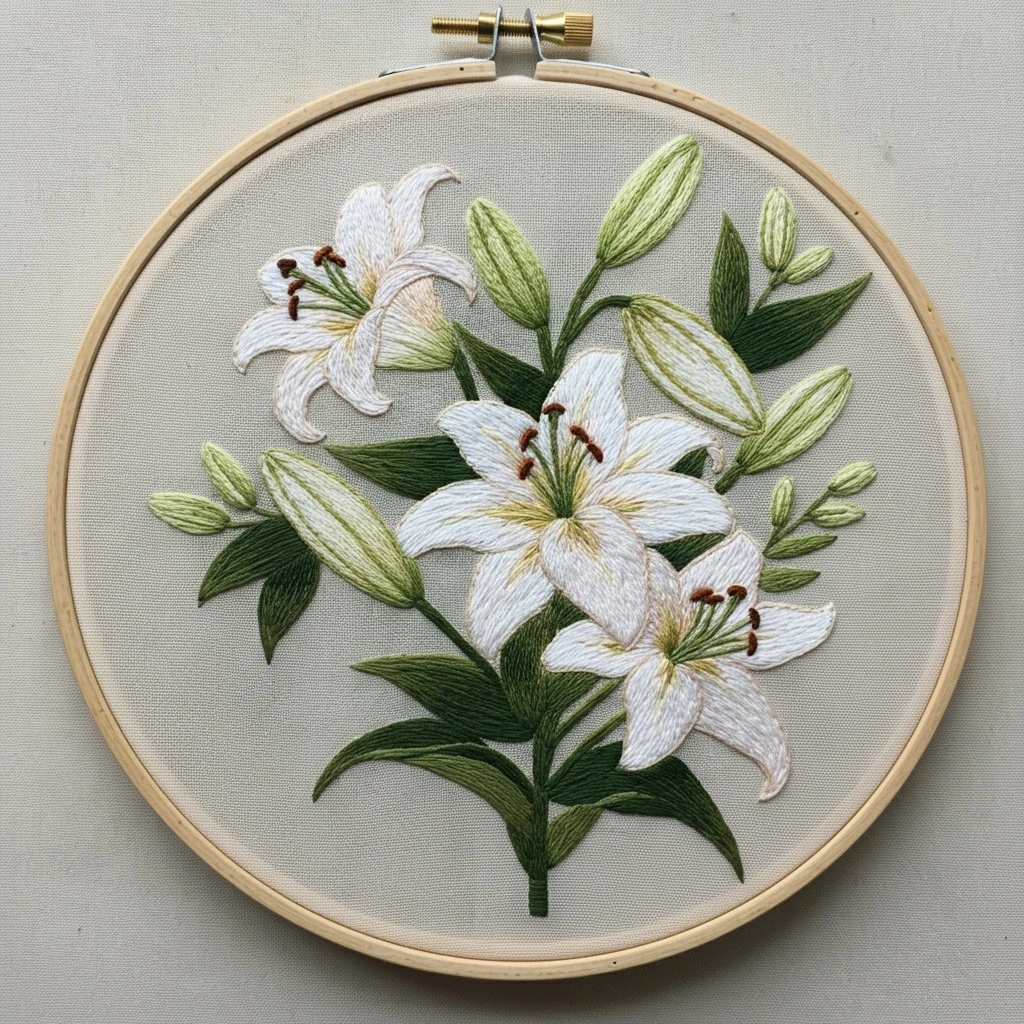
The reference shows a bouquet of open white lilies arranged diagonally inside a hoop, with several pointed buds, sweeping leaves, and narrow stems. The petals are mostly creamy white with pale grey-blue shadows along the folds and faint beige-gold light radiating from the centers.
Use the darkest greens sparingly under the blossoms and at leaf bases, then keep the petals airy with one to two strands. The most attractive result will come from stitch direction: petal stitches should follow each petal’s curve from throat to tip.
Suggested DMC floss palette
Choose a balanced set of whites, cool shadows, olive greens, deep leaf tones, gold, and russet-brown accents. These colors are practical matches for the visible stitched areas in the sample image.
Bright highlights on petal tips and raised edges; use sparingly so the lilies keep dimension.
Main petal fill for the open lilies; ideal for long-and-short satin areas.
Warm cream shadows along folded petal bases and underside curves.
Cool definition for petal separations, tips, and the faint grey linework seen in the sample.
Soft golden rays inside each lily throat; blend lightly into ivory rather than making a hard circle.
Olive shading on buds, veining on pale leaves, and transitional green near flower centers.
Light bud ridges and fresh highlights on small leaf tips.
Mid-tone leaves and stems; a reliable bridge between bright buds and dark foliage.
Leaf body color for the darker foliage behind the lilies.
Deep shadow on leaf bases, central veins, lower stems, and overlapping areas under blooms.
Stamen tips and small curled anthers; use tiny padded or wrapped stitches for texture.
Warm highlight on the brown stamens and occasional rusty accent on the pollen tips.
Stitch map
Leaves, buds & stems
Thread-count guidance
White flowers can quickly become heavy. Fewer strands and directional blending will give the cleanest, most elegant result.
Blending & shading plan
For the lily petals, thread the needle with one strand 3865 and one strand 822 for warm cream transitions. For cooler folds, pair one strand 3865 with one strand 762, then finish the lightest ridge with a single strand of B5200. Avoid filling large areas with pure white only; the reference has visible ivory, pearl-grey, and beige shading that makes each petal readable.
- Start each petal with 3822 at the throat, then feather into 3865.
- Place 822 on lower petals and folded undersides for warmth.
- Use 762 only in narrow shadow lines so the flower still reads as white.
Texture suggestions
Combine smooth long-and-short petals with fishbone leaves and raised anthers. The contrast between glossy petals, ribbed buds, and knotted pollen gives the design a handworked botanical feel.
Outlining details
Use fine split stitch around only the most important petal edges. For the leaves, outline in a matching dark green only where the shape disappears behind another element.
Fabric advice
A natural oatmeal, cream, or pale linen fabric will support the white lilies better than stark white fabric. If using white fabric, strengthen shadows with 822 and 762.
Beginner-friendly practical tips
Work slowly from background to foreground: stems first, leaves second, buds third, petals last, and stamens at the very end.