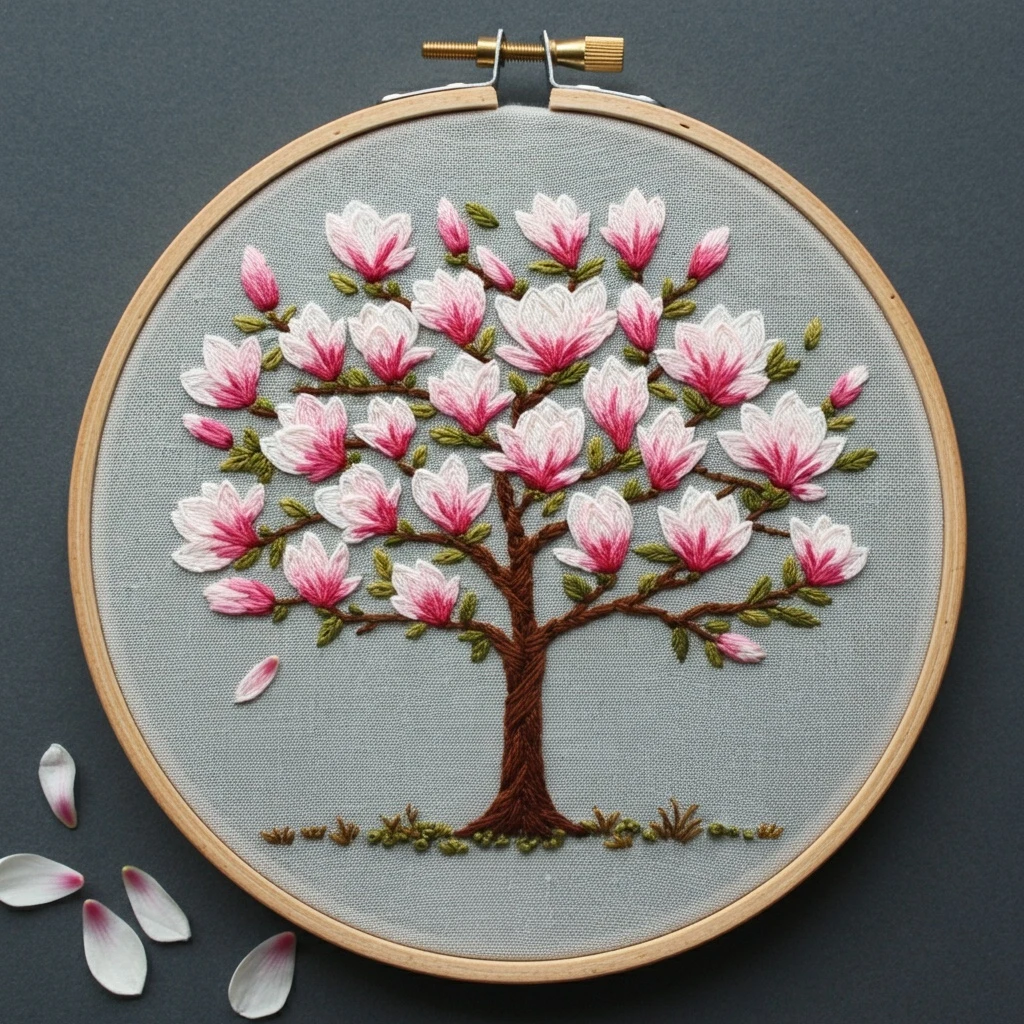

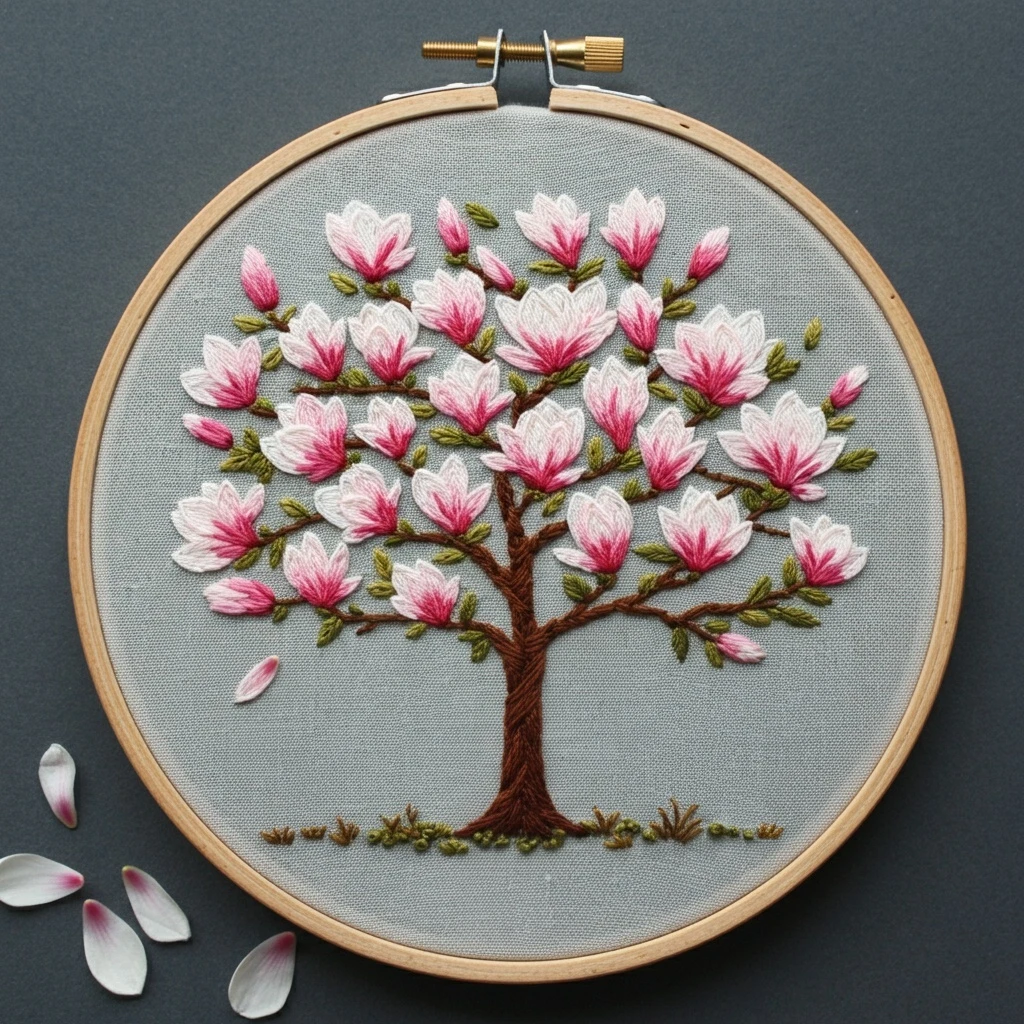
Blooming Magnolia Tree
A polished stitching plan for a graceful magnolia in bloom: creamy petals with blush-pink shading, warm branching bark, fresh spring greens, and soft texture that keeps the design elegant, airy, and approachable for beginners.
Design color reading
The visual focus is the magnolia canopy: pale cream and ivory petals touched with warm blush, rosy shadow, and a few deeper pink accents where petals overlap. Brown branches should be crisp enough to support the blooms, while olive and spring greens add freshness without overpowering the soft flower palette.
Suggested stitch map
- Magnolia petals: satin stitch for simple petals, long-and-short stitch for shaded petals, and detached chain for smaller side blooms.
- Flower centers: French knots or tiny straight stitches in golden yellow and warm brown.
- Branches: stem stitch or split stitch along curves, with short straight stitches for bark ridges.
- Leaves: fishbone stitch for larger leaves and fly stitch or lazy daisy for small leafy accents.
Thread-count guidance
- 1 strand: fine petal veins, delicate outlines, tiny buds, and narrow twig tips.
- 2 strands: most petal shading, branch outlines, leaves, and small fills.
- 3 strands: flower centers, bolder foreground petals, or textured knots when extra lift is desired.
- 4+ strands: use sparingly; thick thread can make magnolia petals look heavy.
Recommended DMC palette
Blending & shading ideas
- Soft petal blend: use 1 strand DMC 3865 + 1 strand DMC 712 for creamy, dimensional petals.
- Blush petal blend: combine 1 strand DMC 712 + 1 strand DMC 225 near the lower half of petals.
- Deep fold blend: use DMC 223 with occasional DMC 3722 at petal bases and tucked edges.
- Bark blend: alternate DMC 898, 975, and 977 in uneven short strokes so branches feel natural.
Outlining details
Use outlines selectively. The branches can be clearly outlined with dark brown, but petal outlines should stay light and broken. A full dark outline around every magnolia petal can flatten the bloom; instead, define only overlapping edges and shadowed bases.
- Use one strand of DMC 223 or 3722 for subtle petal separations.
- Use split stitch in DMC 898 for branch structure before adding bark texture.
- Leave small spaces of fabric between clustered blossoms to preserve an airy tree silhouette.
Texture suggestions by area
Use satin stitch for smooth beginner petals or long-and-short stitch for a painterly shaded look. Angle stitches toward the petal tip.
Stem stitch the main curves, then add tiny straight stitches in lighter and darker browns to imitate bark ridges.
Use fishbone stitch for leaves, detached chain for buds, and a few French knots for flower centers and small highlights.
Beginner-friendly stitching order
- Transfer the design lightly, keeping petal lines fine so they do not show through pale thread.
- Stitch the main branches in DMC 898 and 975, following the curve of the tree.
- Add bark highlights with DMC 977 and keep the strokes uneven for natural texture.
- Fill the magnolia petals with DMC 3865 and 712, then add soft blush shading with DMC 225.
- Place DMC 223 and 3722 only where petals overlap, fold, or meet the flower center.
- Add leaves, buds, centers, and final tiny highlight stitches after the main blossoms are complete.