
White Lilies
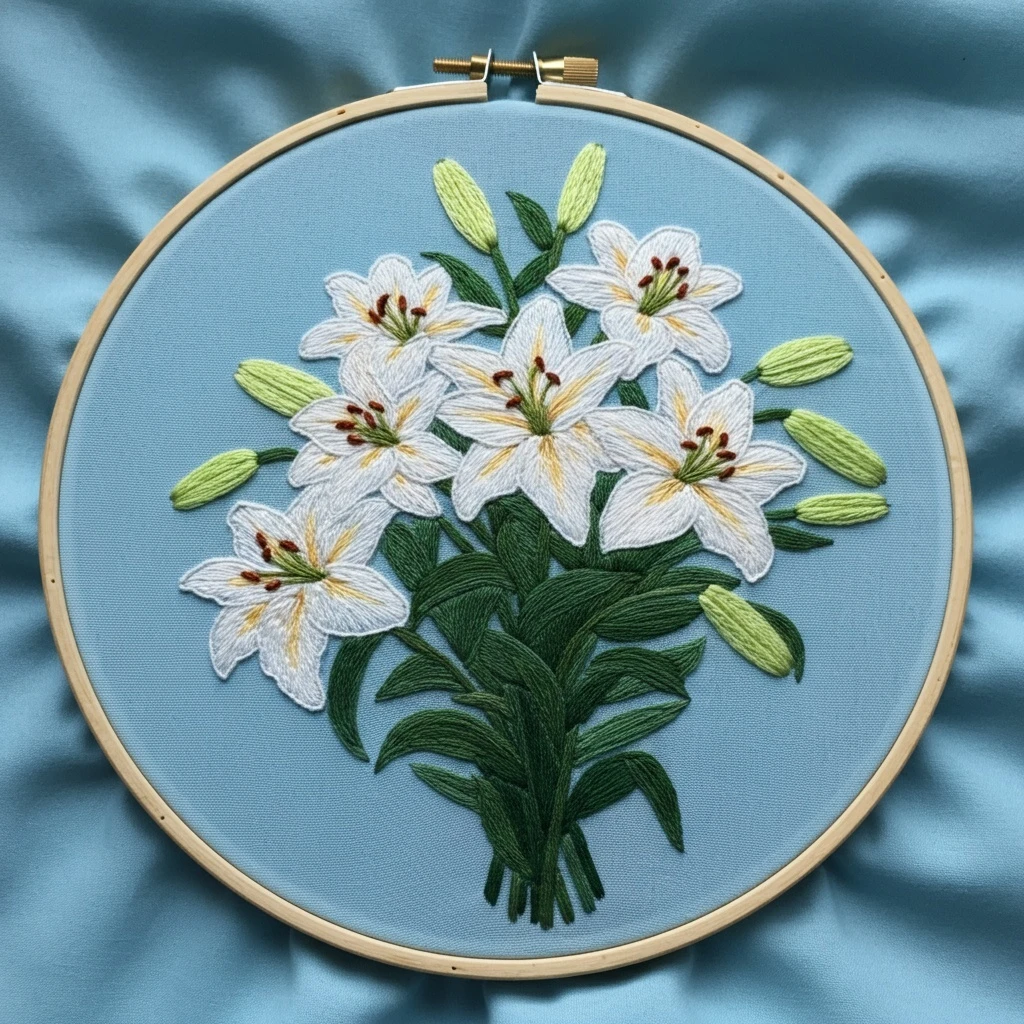
A polished DMC floss palette and practical hand-embroidery plan for a blue-ground hoop filled with white lily blossoms, pale green buds, deep leaves, golden stamens, and warm brown anthers.
Preview
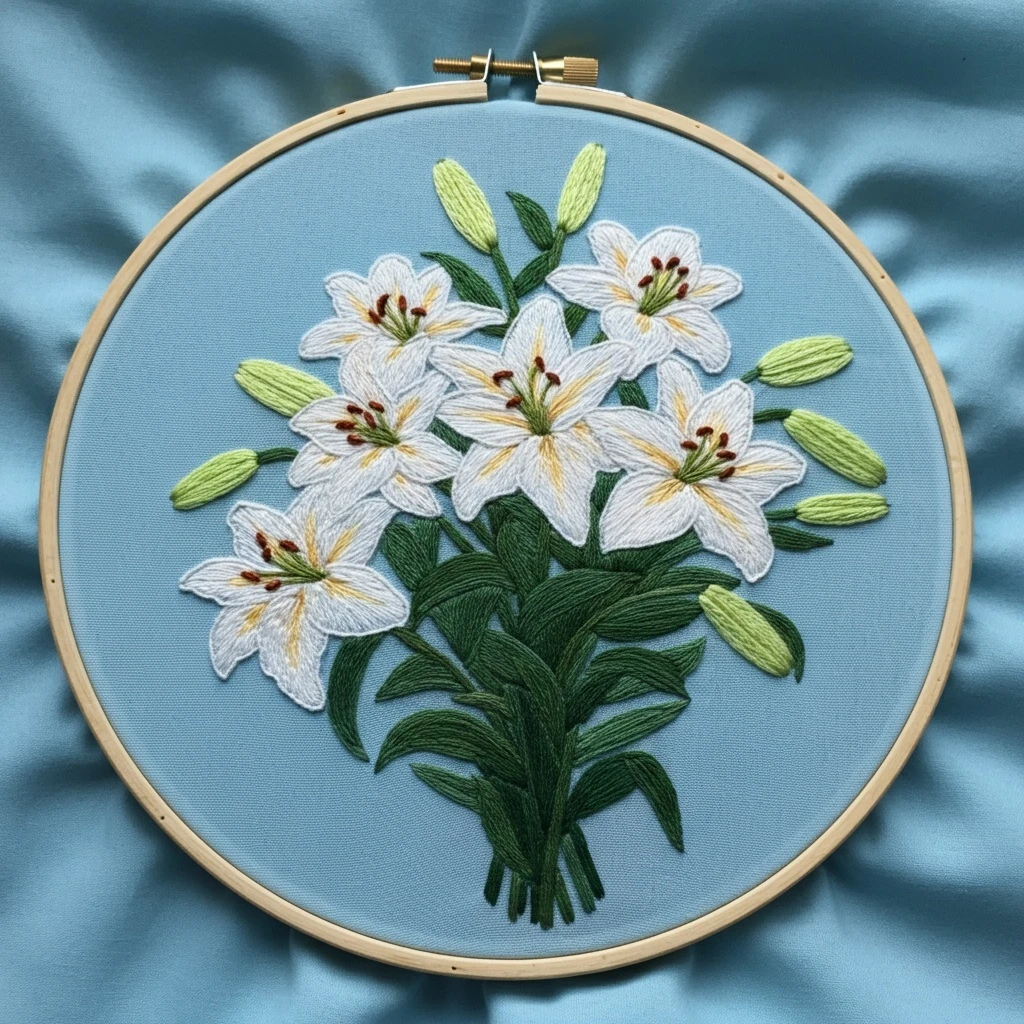
Preview image from the linked design reference. Colors below are visually estimated from the embroidery preview and matched to close DMC shades.
Design Reading
The composition is built around five open white lilies and several unopened buds on a soft blue fabric ground. The flowers need to read as white, but they are not flat: cool gray-blue shadow, winter white highlights, pale cream transitions, and a fine bright outline give each petal its curved shape.
Deep green leaves and stems form the weight of the bouquet, with lighter yellow-green buds lifting the edges. Small gold veins and rusty brown anthers add contrast without overpowering the airy white petals.
Likely DMC Color Palette
Palette based on the visible white lilies, cool petal shadows, yellow centers, brown anthers, dark leaf mass, pale buds, and blue fabric background.
| DMC | Thread color | Practical use notes |
|---|---|---|
| 3865 | Winter White | Main petal fill and brightest lily highlights. Use where petals catch the most light. |
| B5200 | Snow White | Final sparkle on petal edges and small highlight strokes. Use sparingly so the flower still has dimension. |
| 762 | Pearl Gray Very Light | Soft petal shadow, folds, and underside strokes. Excellent for long-and-short shading under white. |
| 415 | Pearl Gray | Fine petal crease lines and deeper shadow under overlapping petals. Blend one strand with 3865 for a gentle transition. |
| 745 | Pale Yellow Light | Warm glow near lily centers and the first layer of yellow throat markings. |
| 3822 | Straw Light | Golden central veins and short radiating strokes inside the blossoms. |
| 920 | Copper Medium | Anthers and tiny warm accents. Use satin stitch or small padded straight stitches. |
| 3371 | Black Brown | Deepest dot at the base of anthers and occasional shadow where stems disappear behind flowers. |
| 3362 | Pine Green Dark | Shadowed leaves, underside of foliage, and the darkest stem overlaps. |
| 986 | Forest Green Very Dark | Main leaves and stems. Use directional stitches following the leaf curve. |
| 987 | Forest Green Dark | Mid-green leaf planes and lighter sides of stems. |
| 772 | Yellow Green Very Light | Unopened buds and bud highlights. Mix with 3348 for rounded shading. |
| 3348 | Yellow Green Light | Bud bases, transition shadows, and fresh green tips near flowers. |
| 3841 | Baby Blue Pale | Optional fabric-mending or background accent shade if tiny gaps need softening; not necessary on a pre-colored blue ground. |
Coverage is a visual estimate, not exact thread usage. The white and green families will do most of the work.
Stitching Suggestions
White lily petals
Long and short stitch gives the best petal shading. Work from the outer petal edge inward using 3865, then tuck 762 and 415 into folds and overlaps.
Petal outlines
Use split stitch or tiny backstitch with 762 for soft outlines. Add a final broken B5200 highlight only on the brightest rims.
Yellow throats
Use single straight stitches radiating from the center in 745 and 3822. Keep these thin and irregular so they look botanical rather than striped.
Anthers
Work small satin stitches, padded straight stitches, or colonial knots in 920, tipped with 3371 for the deepest seed-like shadow.
Leaves
Use fishbone stitch for broad leaves and stem stitch for narrow stems. Directional stitches should follow the leaf spine to create the ribbed texture seen in the sample.
Buds
Use long satin stitches running lengthwise with 772 on the lit side and 3348 at the base. Add a few darker green stitches where the bud attaches to the stem.
Thread Count & Blending
- Petal filling: 2 strands for most long-and-short stitches; 1 strand for delicate crease lines and edge correction.
- Fine outlines: 1 strand of 762 or 415 keeps the white petals soft and avoids a cartoon outline.
- Leaves and stems: 2 strands for filled leaves; 1 strand for thin stems and final vein lines.
- Buds: 2 strands for smooth satin coverage; use 1 strand for the final lengthwise ridges.
- Anthers and knots: 1 or 2 strands depending on scale. Two wraps are enough for small French knots.
Shading & Texture Notes
- Leave tiny slivers of blue fabric between crowded leaves if the design starts to feel heavy.
- Put gray shadows under overlapping petals first, then feather white stitches over them.
- Keep lily centers crisp: thin green filaments, warm yellow throat strokes, and raised brown anthers.
- Use the darkest greens only at the bouquet base and in hidden leaf overlaps.
- Vary petal stitch length so the flower surface looks soft, not like rows of thread.
Where to Start
Beginner-Friendly Practical Tips
- Use a hoop that keeps the blue fabric drum-tight; loose fabric makes long white stitches look wavy.
- Shorten thread lengths to about 14–16 inches when using white floss so it stays clean and smooth.
- Wash hands before stitching the white petals and cover finished areas with a clean cloth while working greens.
- Do not carry dark green thread behind white petals; it may shadow through pale fabric or peek between stitches.
- When unsure, stitch fewer outline lines first. You can always add another tiny gray or white edge stitch at the end.