
DMC palette & hand embroidery guide
Red Daisy Floral
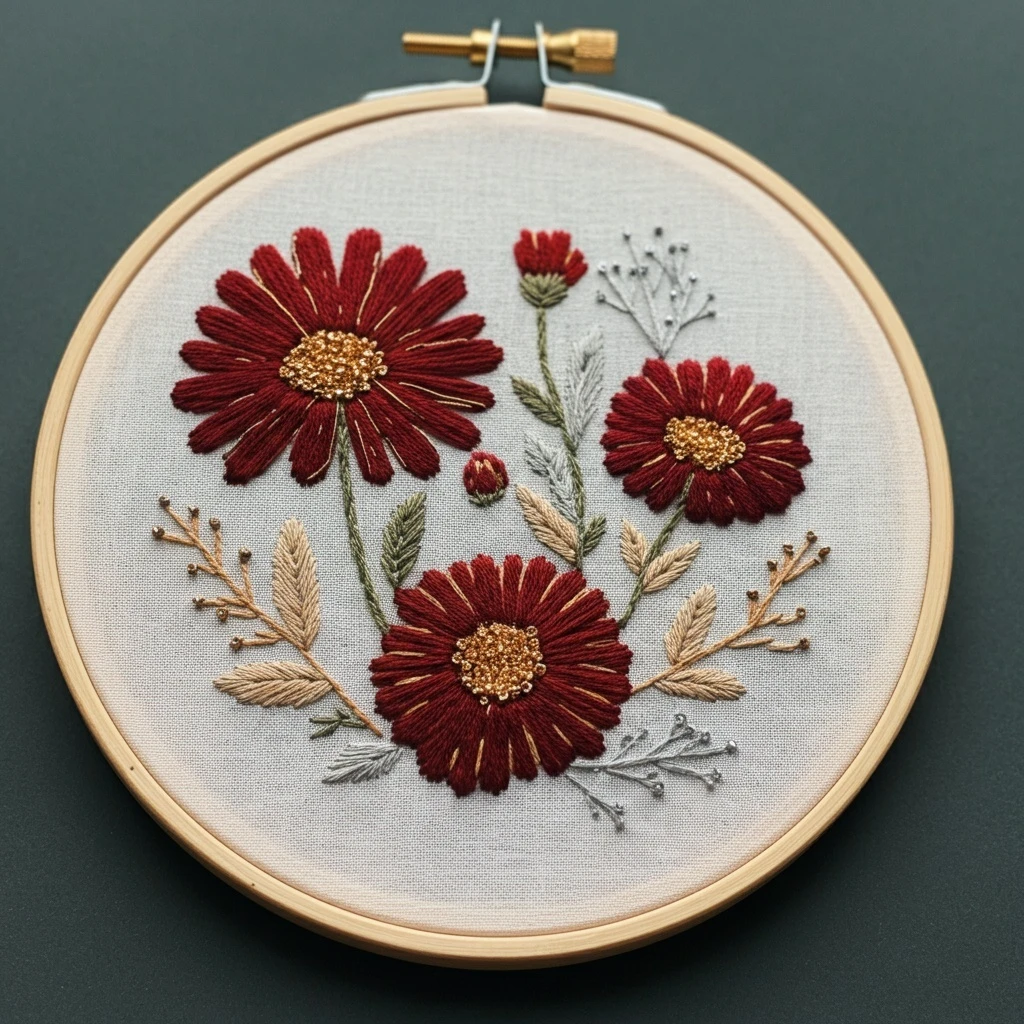
A warm botanical hoop built around velvety garnet daisies, raised golden centers, olive stems, wheat-toned filler leaves, and airy gray-green seed sprigs. The design reads rich and romantic, but it stays beginner-friendly when each flower is stitched petal by petal.
Color impression from the reference
The dominant color is a deep garnet red used in thick, directional daisy petals. It is balanced by small golden knots in the flower centers, muted olive stems, gray-green ferny foliage, and beige wheat leaves that keep the bouquet soft against the pale linen ground.
Polished DMC floss palette
These DMC suggestions are chosen to match the visible tones in the design while giving enough value range for shading, outlines, and small botanical accents.
Stitch map by design element
Long-and-short stitch or padded satin stitch, worked from the petal tip toward the center. Keep each petal’s stitches aligned with its length for the ribbed, velvety look.
Detached chain, lazy daisy, or short satin stitches with 2 strands. Add one darker stitch at the base of each bud to tuck it visually into the calyx.
French knots, colonial knots, or seed stitches in mixed 729, 680, and 676. Vary knot size slightly so the center looks organic.
Stem stitch for curved lines; whipped back stitch for extra smooth stems. Use 2 strands for main stems, 1 strand for tiny branchlets.
Fishbone stitch for pointed leaves; satin stitch for small filler leaves. Change color halfway down the leaf for gentle dimension.
Back stitch or straight stitch for stems with single-wrap French knots at the ends. Keep these light and sparse to preserve the open bouquet shape.
Thread-count and blending guidance
| Area | Suggested strands | Why it works | Optional blend |
|---|---|---|---|
| Large red petals | 3 strands for bold coverage; 2 strands on tight curves | Creates a plush, dimensional petal without becoming bulky at the center. | 1 strand 814 + 1 strand 815 for soft middle shadows; add 816 only on highlight strokes. |
| Small flowers and buds | 2 strands | Keeps the small blossoms crisp and avoids crowding. | Use 815 on the front-facing petal tips and 814 at the base. |
| Golden centers | 2 strands for knots; 1 strand for tiny seed stitches | Raised knots mimic the textured pollen centers seen in the reference. | Mix knots randomly: mostly 729, a few 680 shadows, a few 676 highlights. |
| Main stems | 2 strands | Visible enough to support the flowers while still delicate. | Whip a 3011 back stitch with 3012 for a subtle two-tone twist. |
| Fine gray-green sprigs | 1 strand | Matches the airy, sketch-like filler branches and prevents them from overpowering the daisies. | Switch between 926 and 928 along one sprig for natural fade. |
| Beige wheat leaves | 2 strands for leaves, 1 strand for stems | Gives the dry straw foliage enough body while staying secondary. | Alternate 3864 and 738 on each side of a fishbone leaf. |
Shading, outlining, and texture suggestions
Petal shaping
Begin at the outer petal tip with slightly longer stitches, then shorten stitches as you approach the center. Leave a tiny gap between neighboring petals so each daisy keeps its individual scalloped silhouette.
- Darkest red near the center and lower petals.
- Warmer red only along raised ridges and tips.
- One strand of 814 can be used as a discreet split-stitch outline if a petal edge looks uneven.
Centers and beads
Fill the circular centers from the outside inward. Place darker old-gold knots around the lower rim, medium gold across the body, and light gold in a small upper cluster.
- Use uneven knot spacing for a handmade pollen texture.
- Avoid packing knots too tightly at first; add extras after the petals are complete.
- For more shine, substitute a few knots with metallic gold thread, but keep DMC 729 as the main color.
Leaves and filler foliage
The reference uses three foliage families: olive green leaves, gray-green airy sprigs, and beige wheat leaves. Keeping each family in its own thread range makes the bouquet look intentional.
- Fishbone stitch gives pointed leaves a center vein automatically.
- Use 1-strand back stitch for the light gray sprigs.
- Let beige leaves overlap behind the red flowers for depth.
Outlining details
Outline only where needed. The petals already have strong edges from satin stitching, so a full dark outline can look heavy. Save outlining for petal corrections, stem definition, and tiny seed branches.
- Use 414 for the smallest gray seed tips.
- Use 3011 for green vein lines.
- Use 3864 for tan branch lines rather than a dark brown.
Beginner-friendly stitching plan
- Prepare the fabric: hoop pale linen or cotton tightly, then transfer the design with a fine erasable pen. A slightly warm ivory fabric flatters the garnet and gold palette.
- Stitch stems first: complete the main olive stems and beige branch lines so the bouquet structure is clear before petals are added.
- Add leaves and filler: work green leaves, beige wheat leaves, and gray sprigs next. Keep fine sprigs to 1 strand for a light background effect.
- Build the red flowers: stitch the largest daisy first, then the medium flower, bottom flower, small flower, and buds. Rotate the hoop often so satin stitches always pull comfortably in the petal direction.
- Finish with centers: add golden knots last. This prevents snagging raised knots while the petals are still being stitched.
- Final polish: steam from the back, let dry fully, then trim any fuzzy thread tails on the reverse before framing in the hoop.