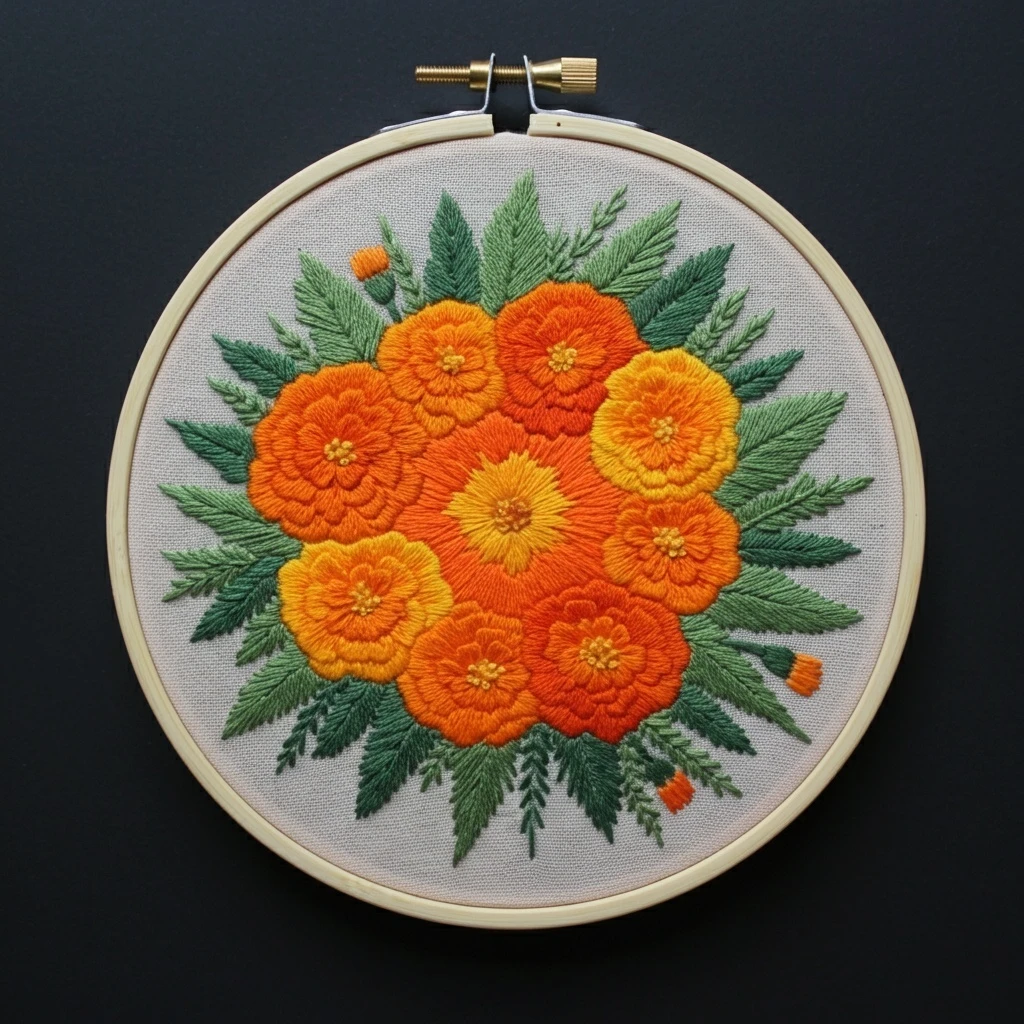

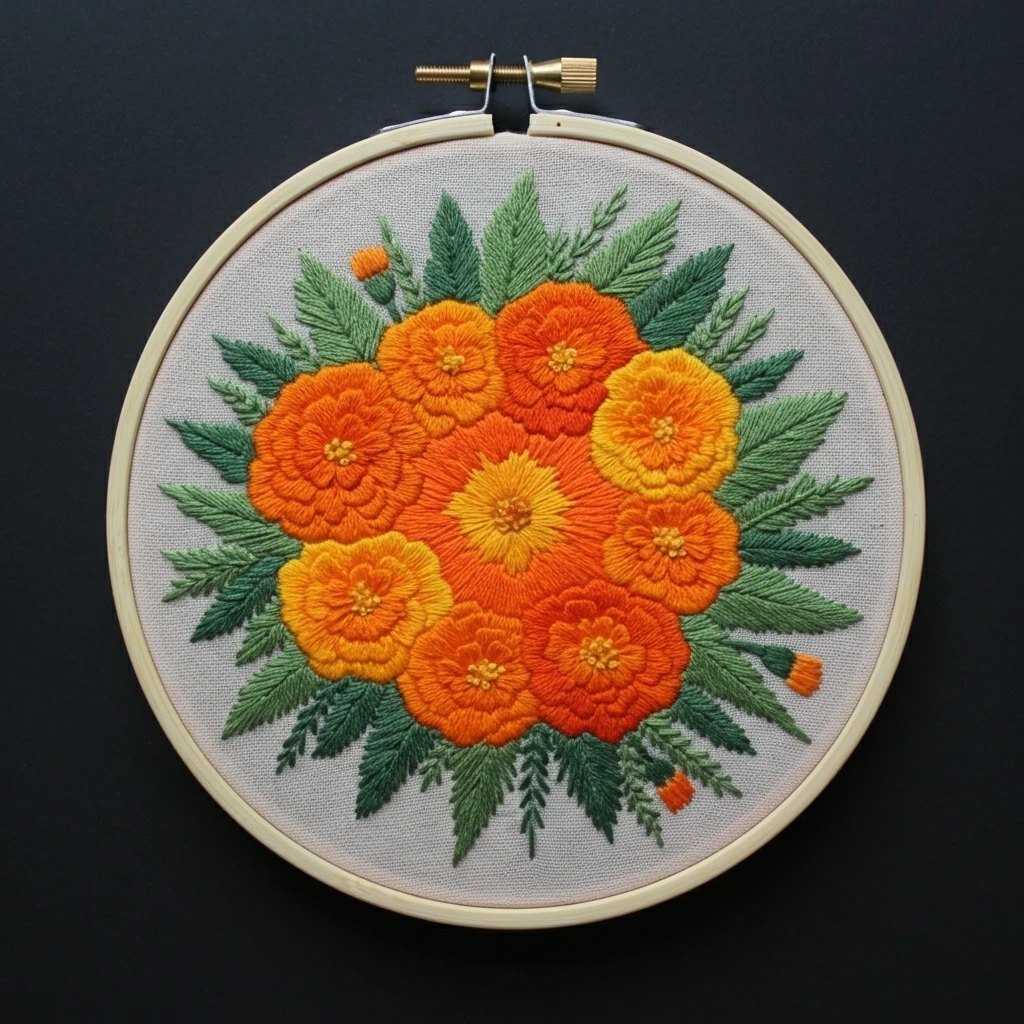
Radiant Marigold Floral Mandala
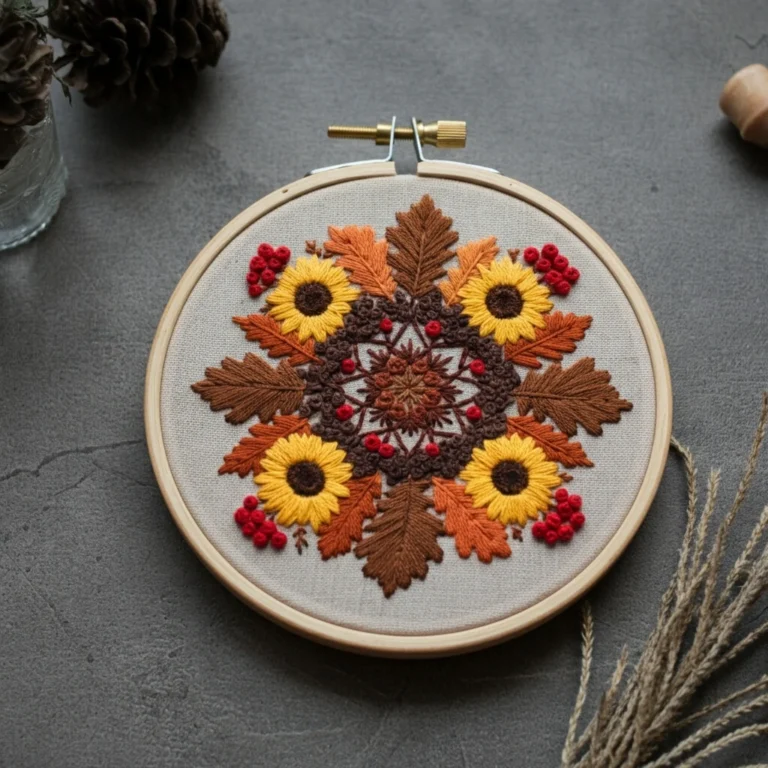
A warm floral mandala inspired by marigold petals, golden sunbursts, and symmetrical botanical ornament. The design should feel rich and glowing: layered orange-yellow petals, deeper rust shadows near the center, sage leaves for balance, and repeated stitch textures that keep the mandala precise and polished.
Design color read
The marigold mandala is dominated by warm yellow, gold, orange, and rust, with small leafy green accents that prevent the palette from feeling too hot. The brightest stitches belong on the outer petal tips and center glints, while the strongest oranges and rusts should sit near petal bases, inner folds, and shadowed ring transitions.
Suggested DMC floss palette
These DMC colors create a glowing marigold effect while preserving enough contrast for clean mandala geometry. Use the darkest rust sparingly; most of the design should feel bright and sunlit.
Deep marigold shadows, petal bases, and inner-ring definition.
Rust-orange transition stitches and warm petal folds.
Strong orange petal shading and structural arcs in the mandala rings.
Main marigold petal color for saturated, cheerful orange areas.
Raised petal centers, bright ring accents, and warm highlight strokes.
Golden center knots, decorative dots, and sunburst filler details.
Lightest petal tips, center glints, and tiny luminous accent stitches.
Soft glow highlights and delicate outer-ring dots where a subtler yellow is needed.
Main sage leaf motifs and green separators between warm floral forms.
Leaf tips, pale green highlights, and airy botanical accents.
Optional cool accent dots or small teal separators to balance the warm mandala.
Selective stem shadows, tiny grounding dots, and warm outline touches.
Stitch map by design element
Central marigold core
Use French knots, colonial knots, or a compact woven wheel in gold and pale yellow. Keep the center raised but neat.
Layered petals
Use long-and-short stitch or satin stitch from the base outward, repeating the same stitch direction on every matching petal.
Petal folds
Use one-strand split stitch in copper or rust along inner fold lines. Break the lines so they look like soft shadows, not heavy outlines.
Mandala arcs
Use stem stitch, whipped backstitch, or chain stitch for curved rings. Keep tension even to preserve the circular shape.
Leaf separators
Use detached chain or fishbone stitch in muted greens. Place leaves consistently between warm motifs.
Dot accents
Use French knots in gold, pale yellow, and occasional teal. Match knot size around the circle for symmetry.
Thread-count and blending guidance
| Area | Strands | Blending idea | Practical note |
|---|---|---|---|
| Marigold petals | 2 strands for full petals; 1 strand for fold lines and highlights | Use 919/921 at the base, 720 and 741 through the body, then 742/744 at the tips. | Stitch opposite petals in pairs so the warm color balance remains even. |
| Center texture | 2 strands for knots; 1 strand for tiny glints | Mix 3820, 744, and a few 745 knots for a textured golden center. | Keep knots compact; a sprawling center can distort the mandala spacing. |
| Leaves and green separators | 1–2 strands | Use 3012 at leaf bases and 3013 at tips; reserve teal for small decorative contrast. | Repeat the same leaf stitch style around the circle for a professional finish. |
| Outlines and ring details | 1 strand | Use 720 for warm tonal outlines and 898 only for the deepest tiny accents. | Avoid dark outlines around every petal. Tonal orange lines keep the mandala radiant. |
Recommended stitching order
- Transfer the mandala with a clear center point, ring guides, and matching petal spacing marks.
- Stitch the central marigold core first to anchor the design.
- Work the main petal ring in opposite pairs, then fill the remaining matching petals.
- Add secondary petals, leaf separators, and curved mandala arcs.
- Finish with knots, tiny highlights, teal accents, and final tonal outlines.
Beginner-friendly practical tips
- Use a printed transfer or compass-drawn guide; symmetry matters more than speed in a mandala.
- Keep fabric drum-tight so the central knots and satin petals do not pucker.
- Use shorter stitches near petal bases and longer strokes toward wider tips.
- Complete all repeats of one color before switching if you want perfectly consistent placement.
- Press from the back on a towel to protect raised knots and textured center stitches.
Texture, shading, and finishing notes
The finished mandala should look like a glowing marigold bloom seen from above: warm, symmetrical, textured at the center, and softly shaded across each petal ring.
Marigold dimension
Place the deepest copper and rust near the center and under petal overlaps. Use medium orange through the main petal body and finish with yellow highlights only at the tips or raised ridges. This keeps the flower rich without losing brightness.
Clean mandala rhythm
Repeat stitch types by ring: knots for the center, satin or long-and-short for petals, stem stitch for arcs, and detached chain for leaves. Consistent texture is what makes the design look polished and intentional.