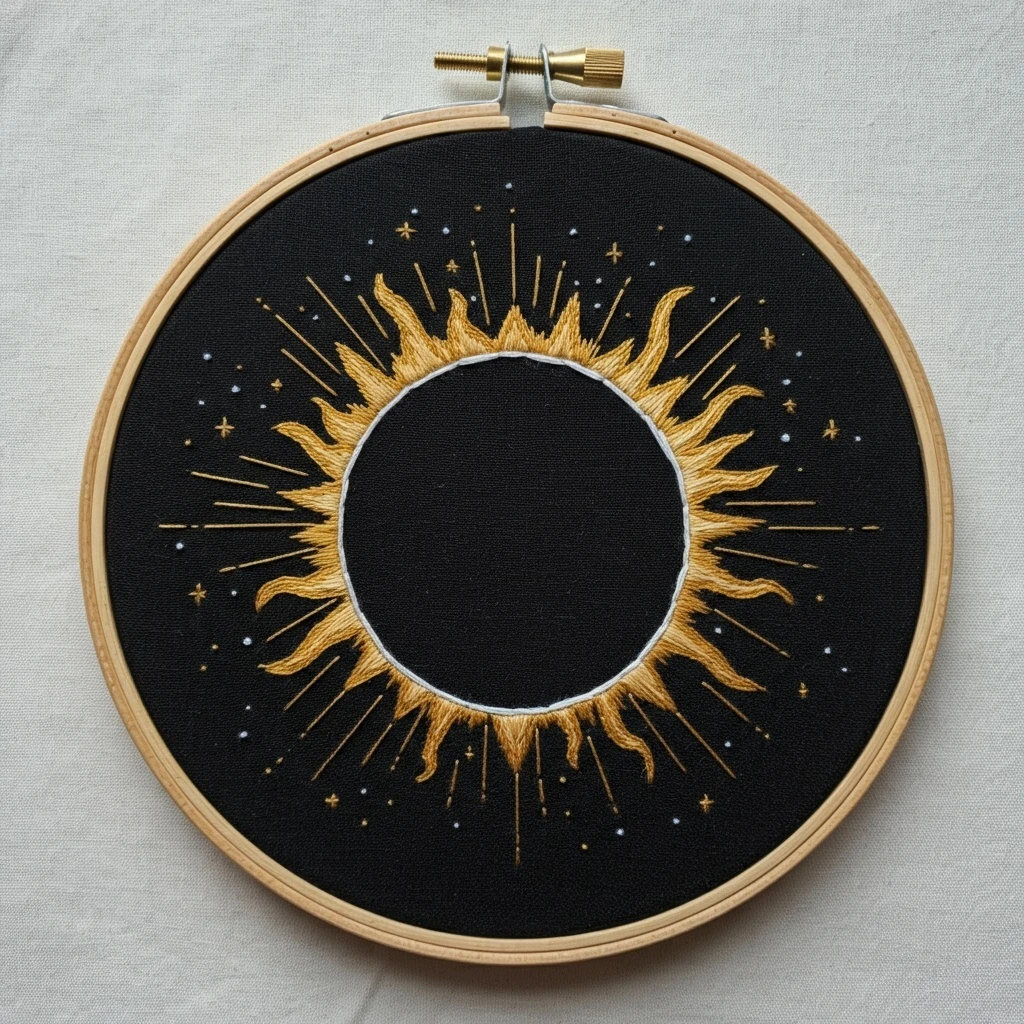

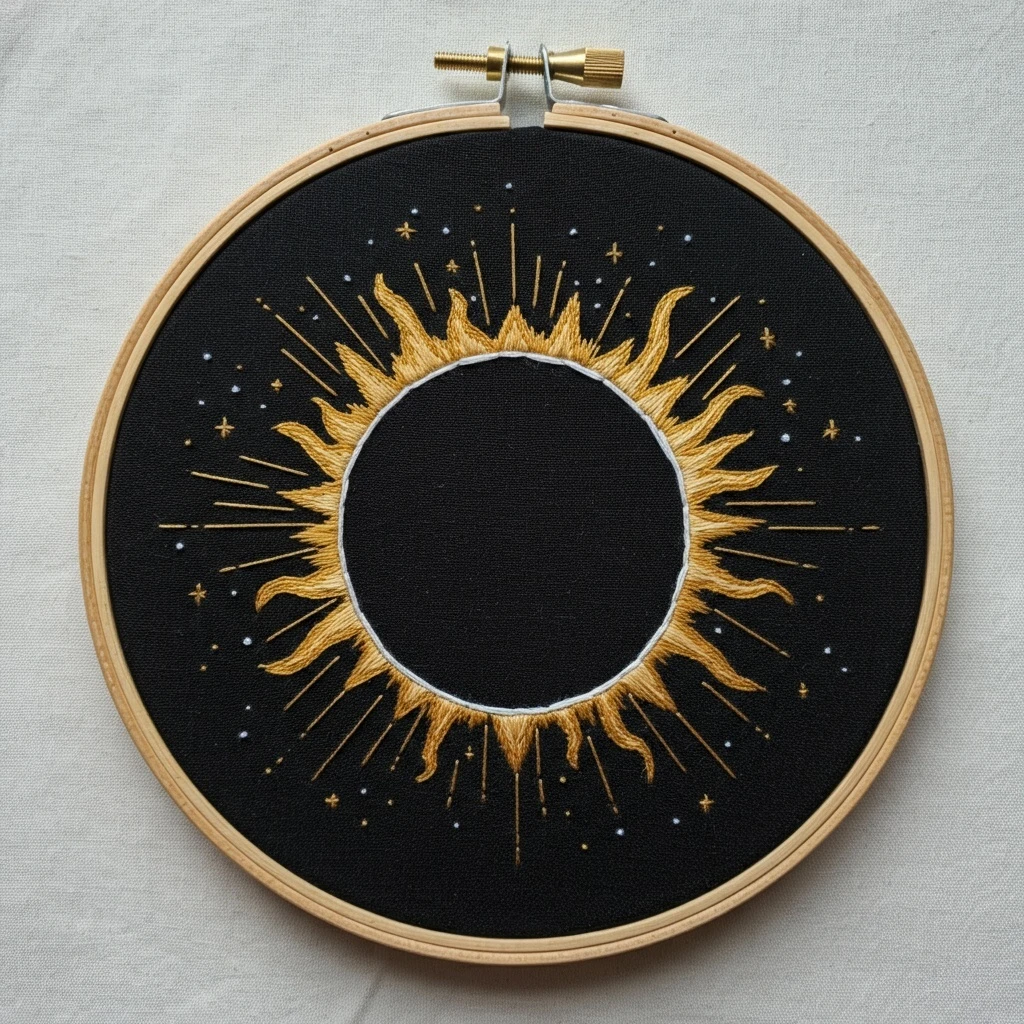
Golden Solar Eclipse
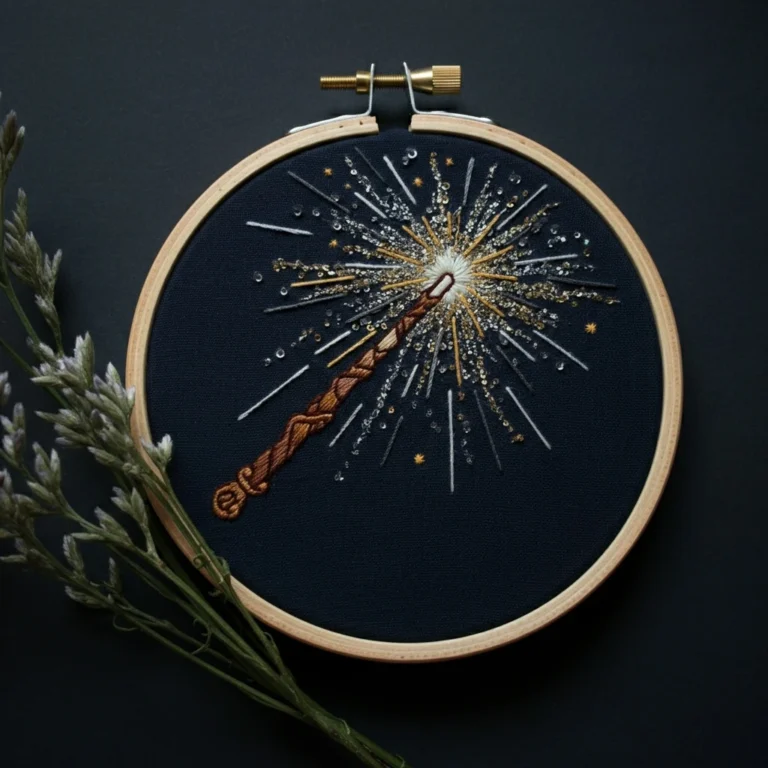
A dramatic celestial hoop built around a dark eclipsed center, glowing golden corona, warm amber rays, and delicate star accents. The embroidery works best with high contrast: matte black or deep navy fabric, layered golds, and crisp metallic highlights.
Design read
The reference suggests a round eclipse motif: a shadowed solar disc framed by luminous gold, ochre, honey, and antique-brass rays. The strongest visual elements are the clean circular outline, bright corona edge, radiating linework, and small cosmic sparkles. Keep the center smooth and quiet so the stitched gold halo feels radiant.
Best visual strategy
- Use the darkest threads sparingly inside the eclipsed disc; let the fabric do most of the shadow work.
- Build the halo with concentric rings: pale yellow closest to the light, deeper gold toward the outer rays.
- Add metallic floss only after cotton stitches are complete to avoid snagging.
Core DMC palette
DMC 310 — BlackEclipsed center, tiny star dots, deepest ray gaps.
DMC 3799 — Pewter Gray Very DarkSoft shadow ring if stitching on lighter fabric.
DMC 3078 — Golden Yellow Very LightInner corona, brightest glints, star centers.
DMC 726 — Topaz LightWarm highlight band around the eclipse.
DMC 725 — TopazMain golden rays and medium halo fill.
DMC 783 — Topaz MediumOuter ray shading and antique golden depth.
DMC 977 — Golden Brown LightBronze accents at ray bases and shadowed gold.
DMC 780 — Topaz Ultra Very DarkDeep bronze outlines and warm contrast lines.
DMC B5200 — Snow WhitePinpoint sparkle tips; use one strand only.
DMC E3852 — Dark Gold MetallicOptional final glimmer for stars and select rays.
Stitch types
- Split stitch/back stitch: crisp circle outlines and ray edges.
- Satin stitch: short smooth fills for thicker rays and small moon bands.
- Long & short stitch: glowing gradients in the corona.
- Straight stitch: fine rays radiating outward.
- French knots: stars, dust, and tiny light points.
Thread-count guidance
- 1 strand for stars, tiny outlines, and delicate ray tips.
- 2 strands for most back stitch outlines and standard rays.
- 3 strands for bold outer gold rays on dark fabric.
- Use metallic as 1 strand or couched over cotton for control.
Blending ideas
- Blend 1 strand 3078 + 1 strand 726 for a buttery inner glow.
- Blend 1 strand 725 + 1 strand 783 for warm mid-gold rays.
- Blend 1 strand 783 + 1 strand 977 for aged-brass shadows.
- Reserve E3852 for the final 5–10% of visible highlights.
Suggested stitching order
Detail & texture notes
| Corona | Layer pale stitches close to the disc, then feather darker gold outward. Avoid filling every gap; small slivers of dark fabric increase glow. |
| Ray lines | Use straight stitch from the center outward. Anchor long rays with tiny couching stitches if they exceed 1 inch. |
| Circle edge | A whipped back stitch in 726 over 783 gives a raised, glowing rim. |
| Stars | French knots in B5200 or 3078, plus tiny cross stitches in metallic gold for larger sparkle points. |
| Metallic | Use shorter lengths, a larger needle, and slow tension. Metallic should accent the design, not cover every gold area. |
Beginner-friendly practical tips
- Start with cotton floss first. Metallic thread is easier once the main structure is secure.
- For a clean eclipse, rotate the hoop often so your needle always follows the curve comfortably.
- Do not pull satin stitches too tightly on the circular band; tension can warp the fabric and flatten the glow.
- When stitching on black fabric, keep a lint roller nearby and place a pale cloth on your lap so the holes are easier to see.
- Test every gold combination on a scrap first. Dark fabric intensifies warm yellows, so one shade lighter often looks more luminous.