
Design #145 · Moonlit Animals & Botanical Hoop Art
Lunar Garden Black Cat
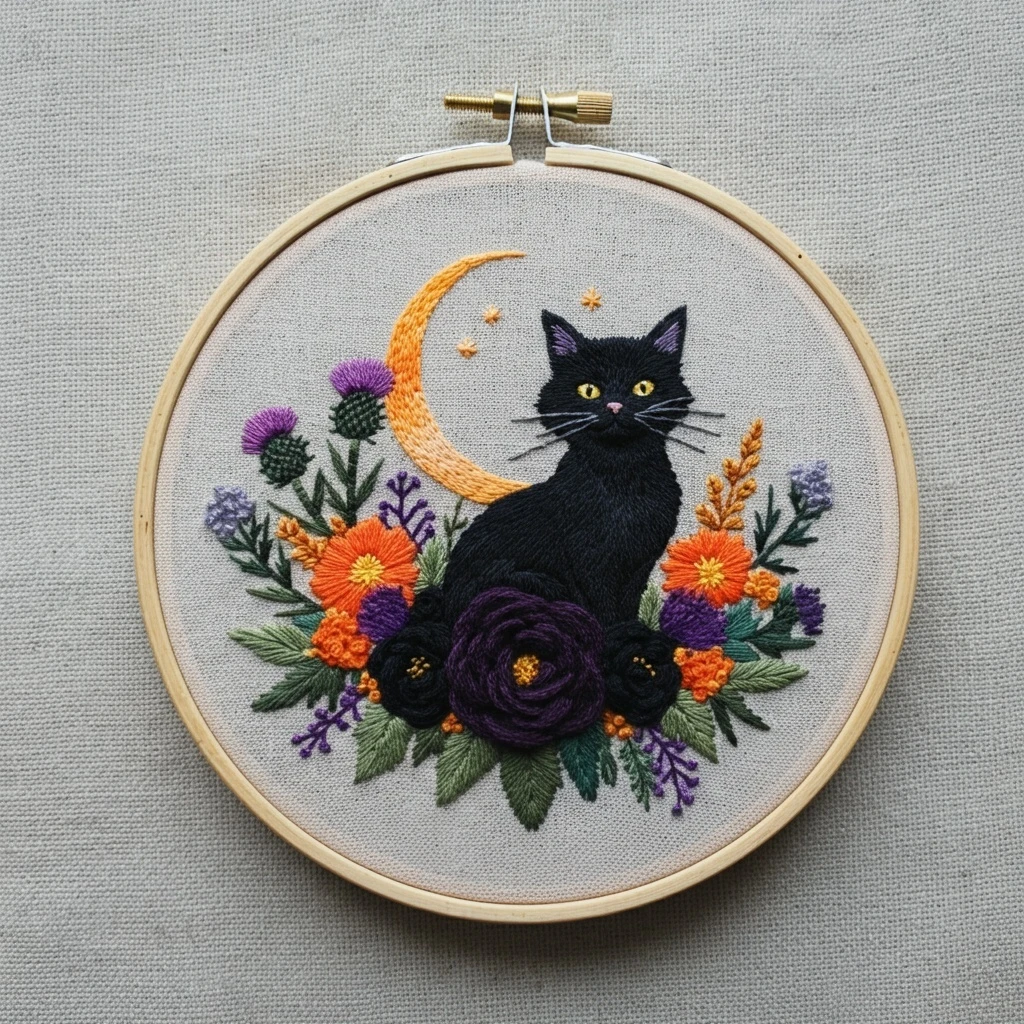
A polished DMC palette and practical stitching plan for a seated black cat framed by a golden crescent moon, orange flowers, purple blooms, dark roses, lavender sprigs, and layered garden greenery.
Design read
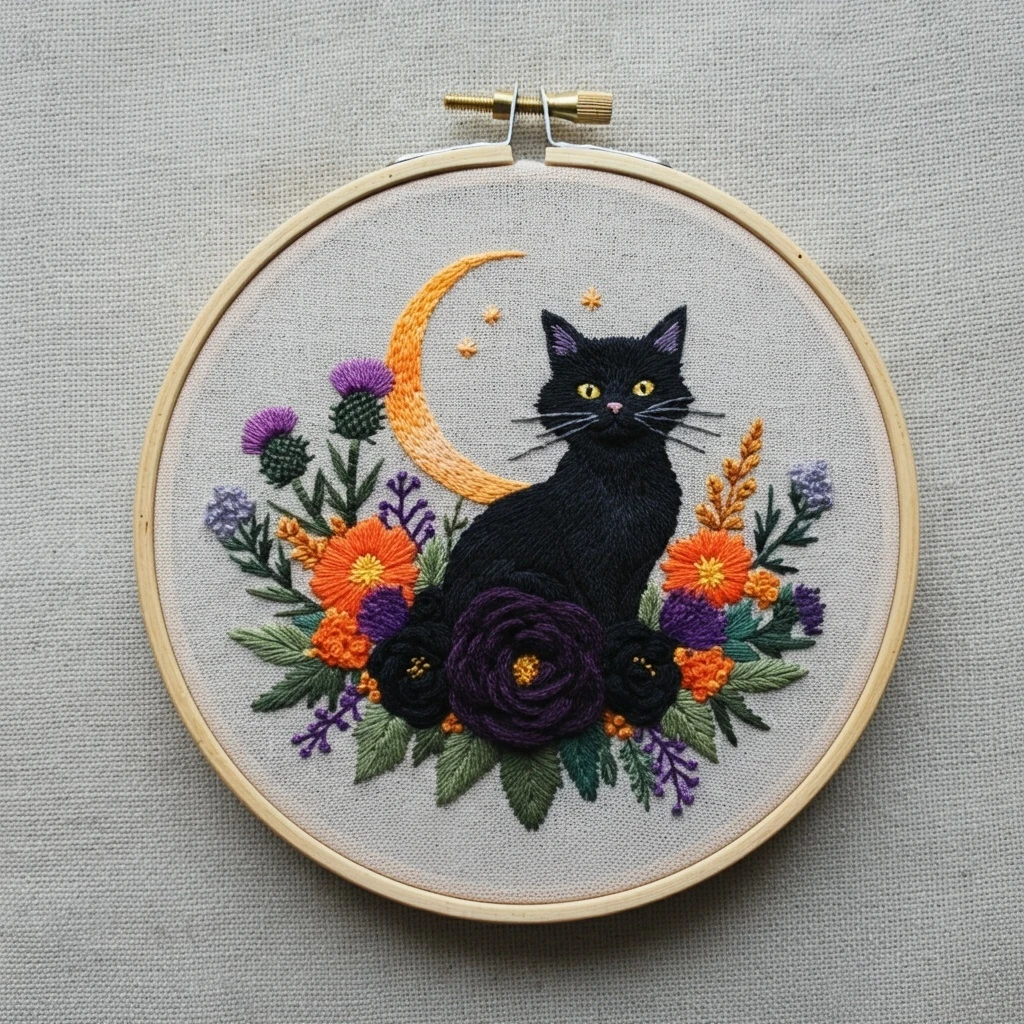
The preview has a dramatic center: a velvety black cat with small yellow eyes and violet inner ears, set in front of a warm crescent moon. The lower half is dense and textured, with dark purple roses, bright orange blossoms, golden flower centers, thistle-like purple flowers, dusky lavender sprigs, and deep green leaves. The design works best when the cat is kept smooth and dark while the garden border is built with raised knots, leafy directional stitches, and bright warm accents.
black cat focal pointgold crescent moonpurple rosesorange marigold accentslayered greeneryThread strategy
Use mostly two strands for filled flowers, leaves, moon, and the cat body. Use one strand for whiskers, eye outlines, tiny stems, and delicate facial details. Add French knots and small seed stitches last so they stay crisp and raised.
Likely DMC Color Palette
Colors are estimated from the visible hoop preview and matched to close DMC embroidery floss shades. Coverage percentages are visual estimates, not exact thread usage.
| DMC | Color | Name | Coverage | Where it appears / practical use |
|---|---|---|---|---|
| 310 | #111111 | Black | 22% | Main cat silhouette, darkest rose shadows, deep outlines. Keep stitches parallel and smooth so the cat reads plush rather than flat. |
| 3799 | #424242 | Pewter Gray Very Dark | 7% | Subtle cat fur highlights, muzzle separation, and soft shadow changes inside black areas. Use sparingly with one strand. |
| 317 | #8c8c8c | Pewter Gray | 3% | Whiskers and tiny reflective strokes. Best in one strand with long straight stitches or couching for clean lines. |
| 972 | #ffb13b | Canary Deep | 10% | Crescent moon body, small stars, bright golden flower centers, and warm highlights on orange blossoms. |
| 3821 | #f3ce65 | Straw | 4% | Moon highlight edge and cat eyes. Blend with 972 for a glowing yellow-gold look. |
| 741 | #e56f25 | Tangerine Medium | 8% | Bright orange flower petals, small clustered blooms, and warm garden accents around the cat. |
| 720 | #c9541c | Orange Spice Dark | 5% | Petal bases, orange flower shadows, and dimensional ridges in golden seed heads. |
| 550 | #4b176f | Violet Very Dark | 9% | Large front rose, purple berry flowers, dark sprigs, and deepest violet accents. Excellent for shadowed petals. |
| 3837 | #6d2d89 | Lavender Ultra Dark | 6% | Purple rose midtones, thistle tops, cat inner ears, and decorative botanical stems. |
| 552 | #8a4db2 | Violet Medium | 4% | Lighter purple petal tips, fuzzy thistle highlights, and small lavender blossoms. |
| 3363 | #4b6642 | Pine Green Medium | 9% | Dark leaves behind the flowers, thick stems, and shadowed foliage close to the cat. |
| 3051 | #657f4d | Green Gray Dark | 7% | Medium leaves, ferny texture, and transitions between the dark foliage and lighter leaf tips. |
| 3053 | #9aaa6b | Green Gray | 5% | Leaf highlights, front leaf veins, and airy botanical pieces that should not overpower the flowers. |
| 3852 | #cd8a2d | Straw Very Dark | 4% | Darker moon base, wheat-like sprays, and golden knot shadows in flower centers. |
| 761 | #f6a0a5 | Salmon Light | 2% | Cat nose and tiny warm facial detail. One strand is enough. |
| 3865 | #f4f0df | Winter White | 2% | Optional sparkle dots, eye catchlights, and tiny highlights on knots or petals. |
Stitching Suggestions
Cat body and face
Fill the cat with long and short stitch or careful satin-stitch sections, changing direction with the curve of the head, chest, and paws. Work mostly in DMC 310, then add very thin 3799 strokes along the cheek, chest, and shoulder to suggest fur without making the cat gray.
Crescent moon and stars
Use split stitch to outline the crescent, then fill with long and short stitch in 972 blended with 3821. Place the darkest gold, 3852, along the inside curve to make the crescent feel dimensional. Small stars can be straight stitch crosses or tiny detached stitches.
Flowers and roses
Use woven wheel stitch for the large purple rose, switching from 550 in the center to 3837 and 552 near the outer petals. Orange blossoms can be satin stitch or long and short stitch with 741 on the tips and 720 near the centers. Add raised French-knot centers with 972 and 3852.
Leaves and stems
Work large leaves with fishbone stitch using 3363 at the base, 3051 through the middle, and 3053 on the tips or veins. Thin stems and decorative purple sprigs look best in one strand of stem stitch or backstitch.
Thread-count guidance
- 1 strand: whiskers, eyes, tiny stars, leaf veins, fine stems, facial features, delicate outlines.
- 2 strands: cat fill, moon fill, most petals, leaves, medium stems, rose petals.
- 3 strands: optional for fluffy thistle tops, bold orange flower centers, or extra-raised foreground knots.
- 6 strands: avoid for most areas unless you intentionally want chunky texture; this design benefits from controlled detail.
Blending ideas
For the moon, thread one strand of 972 with one strand of 3821 for a warm glow. For the rose, blend 550 + 3837 on middle petals. For the cat, blend 310 + 3799 only on small highlight strokes so the black remains rich.
Texture, outlining, and shading plan
Where to Start
- Transfer the main cat, moon, and large flower shapes clearly; mark only the simplest lines for tiny sprigs so the fabric does not get crowded.
- Stitch the crescent moon first because it sits cleanly behind the cat and establishes the warm color story.
- Fill the black cat next, working from head to body with consistent stitch direction and subtle gray highlights.
- Add the larger flowers and roses, then fill surrounding leaves and stems from back to front.
- Finish with whiskers, eyes, French knots, stars, and small sparkle stitches.
Beginner-friendly practical tips
- Use a sharp embroidery needle and keep thread lengths around 14–18 inches to reduce fuzzing, especially with black floss.
- Black areas can hide stitch direction; pause often and view the hoop from a distance to check the cat silhouette.
- Do not pull whiskers or long straight stitches too tightly, or the fabric may pucker.
- For flowers, stitch from the outer petal edge toward the center to keep the petal tips neat.
- Use a hoop that holds the fabric drum-tight; dense black fill and French knots need stable tension.
- When substituting colors, keep the value contrast: very dark cat, warm moon, saturated orange flowers, and deep purple foreground rose.