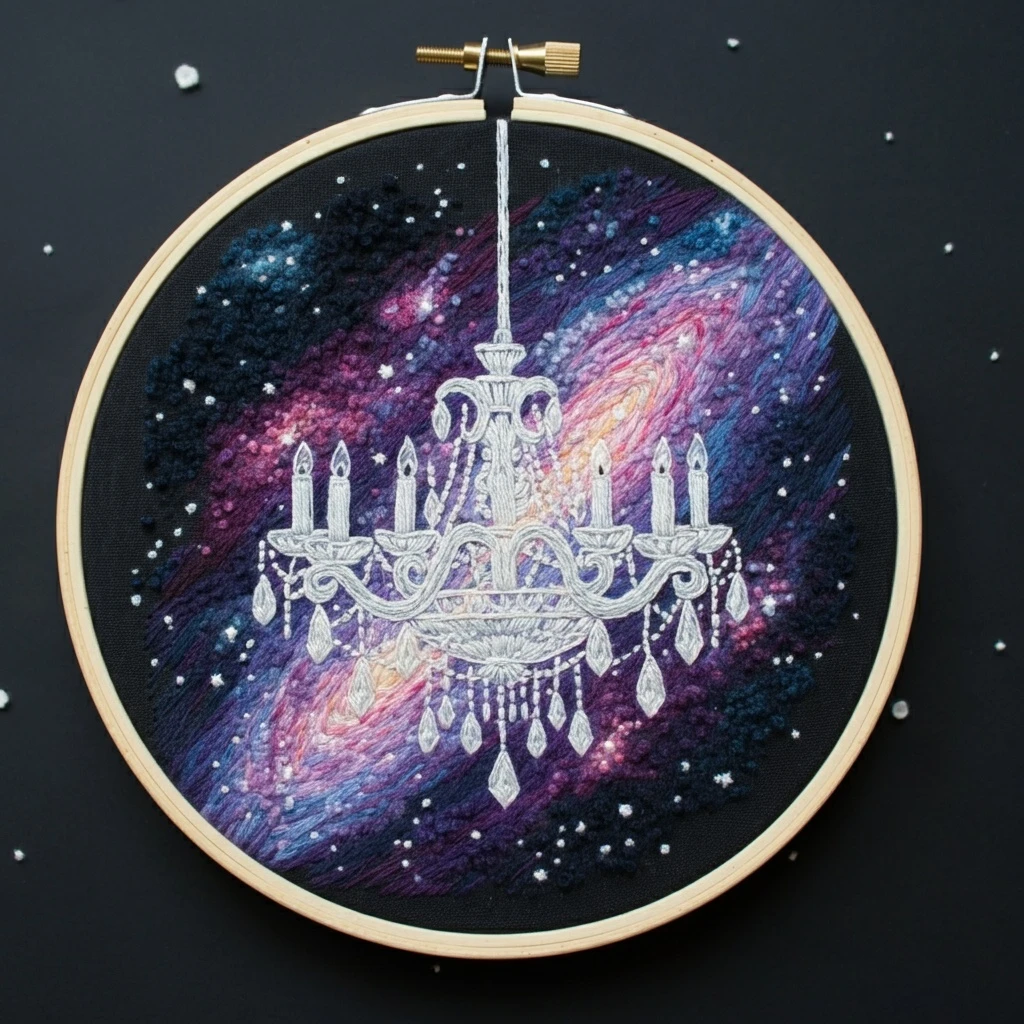

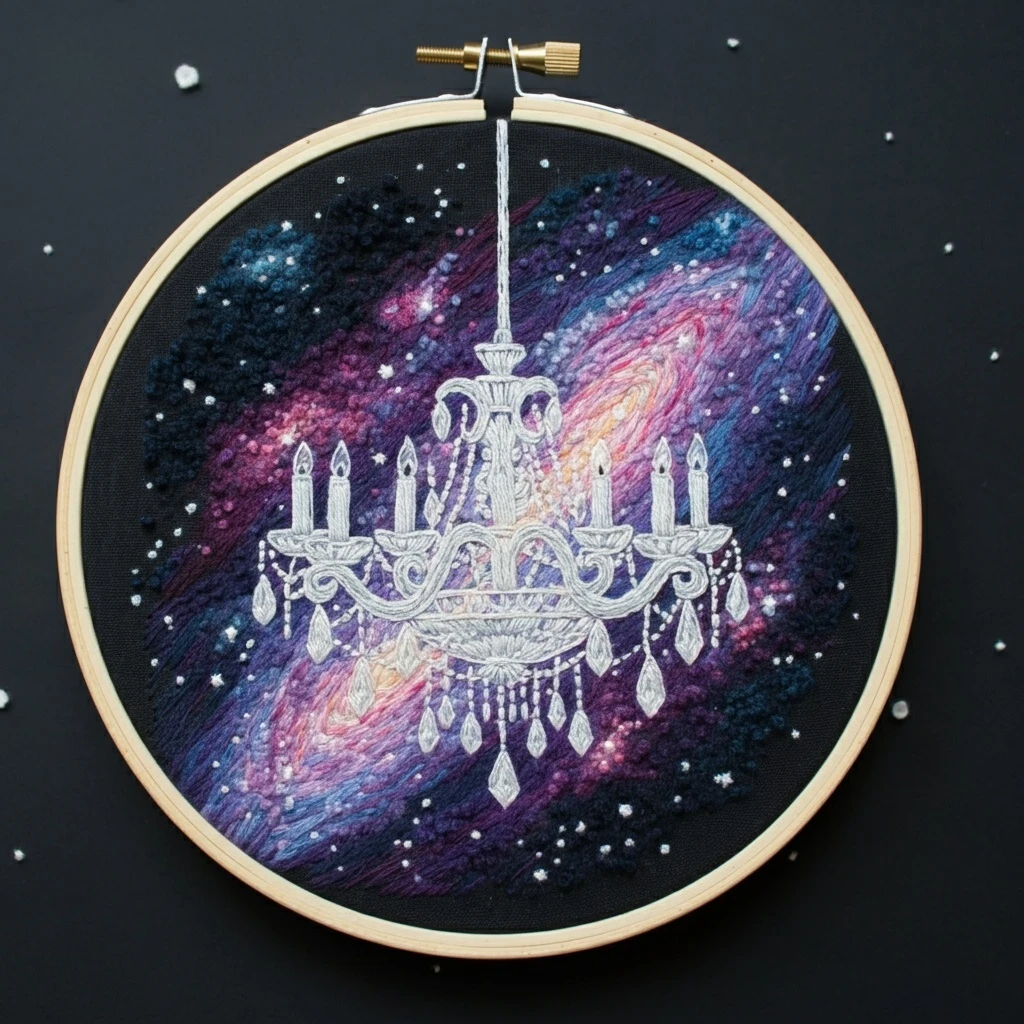
Galactic Chandelier
A luminous chandelier floating in a violet-blue nebula: cool white metalwork, candle glows, crystal drops, scattered stars, and sweeping galaxy texture on a deep night background.
Observed Color Story
The design is built around a bright white chandelier centered over a dramatic galaxy wash. The background moves from black-navy at the outer hoop into teal, blue, purple, magenta, rose, and pale peach light near the diagonal nebula core. The chandelier itself needs several whites and blue-grays so the candles, arms, crystals, and hanging beads stay readable instead of becoming one flat white shape.
Use the darkest fabric or stitched background first, then layer the galaxy in directional strokes. Reserve the cleanest whites for the chandelier’s final highlights and the brightest stars.
Quick Stitch Plan
Suggested DMC Palette
Stitch Types by Area
| Area | Recommended stitches | Practical note |
|---|---|---|
| Galaxy wash | Long-and-short, seed stitch, tiny straight stitches | Work in uneven diagonal strokes; do not make bands too tidy. |
| Nebula glow | Feather stitch, split stitch, blended satin | Blend peach into pink, then purple and blue, using mixed needles. |
| Chandelier outline | Split stitch, stem stitch, backstitch | Keep curves smooth with short stitches around scrolls and candle cups. |
| Chandelier body | Satin stitch, padded satin, couching | Use 762 as the base, 415 for shadow, B5200 only for the top gleam. |
| Crystal drops | Satin stitch, fly stitch, single straight stitch facets | Add one blue-white or gray facet on one side for a cut-glass effect. |
| Stars | French knots, colonial knots, cross stars | Vary size: one wrap for dust, two wraps for bright stars. |
Thread Count & Blending
- Galaxy background: 1 strand for painterly streaks, 2 strands for darker fill at the rim. Change direction often but keep the overall motion diagonal.
- Bright nebula center: blend 1 strand DMC 3824 with 1 strand 3687; then shift to 3687 + 553 and 553 + 333 for a soft fade.
- Chandelier frame: 2 strands for split-stitch outlines. Use 1 strand for inner filigree and bead strings so the decorative details stay delicate.
- Crystal highlights: 1 strand B5200 or 3756, with a final optional touch of E5200 on only the brightest points.
- Stars: use 1 strand for straight-stitch stars and 2 strands only for the largest knots. Too many thick stars can compete with the chandelier.
Build the darkness
Start with DMC 310 and 823 around the hoop edge. Leave broken gaps so later blues and violets can sit on top like cosmic dust.
Paint the nebula
Stitch loose, directional bands from lower left to upper right using teal, violet, magenta, and apricot. Let colors overlap irregularly.
Float the chandelier
Outline after the background is finished. Add white highlights last so the chandelier appears crisp and glowing above the sky.
Shading Guidance
For the chandelier, think of the light source as coming from the galaxy behind it. Place soft gray shadows under the lower bowl, inside scrolls, and beneath candle cups. Then place B5200 on top edges, bead tips, and the right/upper facets of the crystals. In the galaxy, avoid solid blocks; use short overlapping stitches, mixed-thread needles, and small knots to create the speckled, misty look.
A useful blend ladder: 310 → 823 → 3768/3844 → 333 → 550 → 553 → 3803 → 3687 → 3824 → 745/B5200.
Texture Suggestions
- Cosmic dust: scatter seed stitches in 3844, 553, 3687, and B5200.
- Light streaks: use long single-strand straight stitches laid over darker fill.
- Bead chains: tiny French knots or detached chain stitches in 762 and B5200.
- Candle flames: one lazy daisy in 745 with a single 3824 stitch at the base.
- Metal scrolls: couch a slightly thicker strand with 1-strand securing stitches for smooth curves.
Beginner-Friendly Practical Tips
Transfer clearly
On dark fabric, use white transfer paper, a water-soluble white pen, or basting lines. Mark only the main chandelier and largest nebula direction, not every star.
Control metallics
Cut E5200 shorter than cotton floss, use a larger needle, and let the thread untwist often. Add it at the very end to avoid fraying.
Protect the whites
Wash hands before the chandelier stage and keep a scrap cloth over completed galaxy stitches while working the white filigree.
For a simpler version, stitch the galaxy with fewer colors and keep the chandelier in 762, 415, and B5200. For a more advanced version, add seed beads to selected crystal drops and replace a few star knots with silver metallic thread.