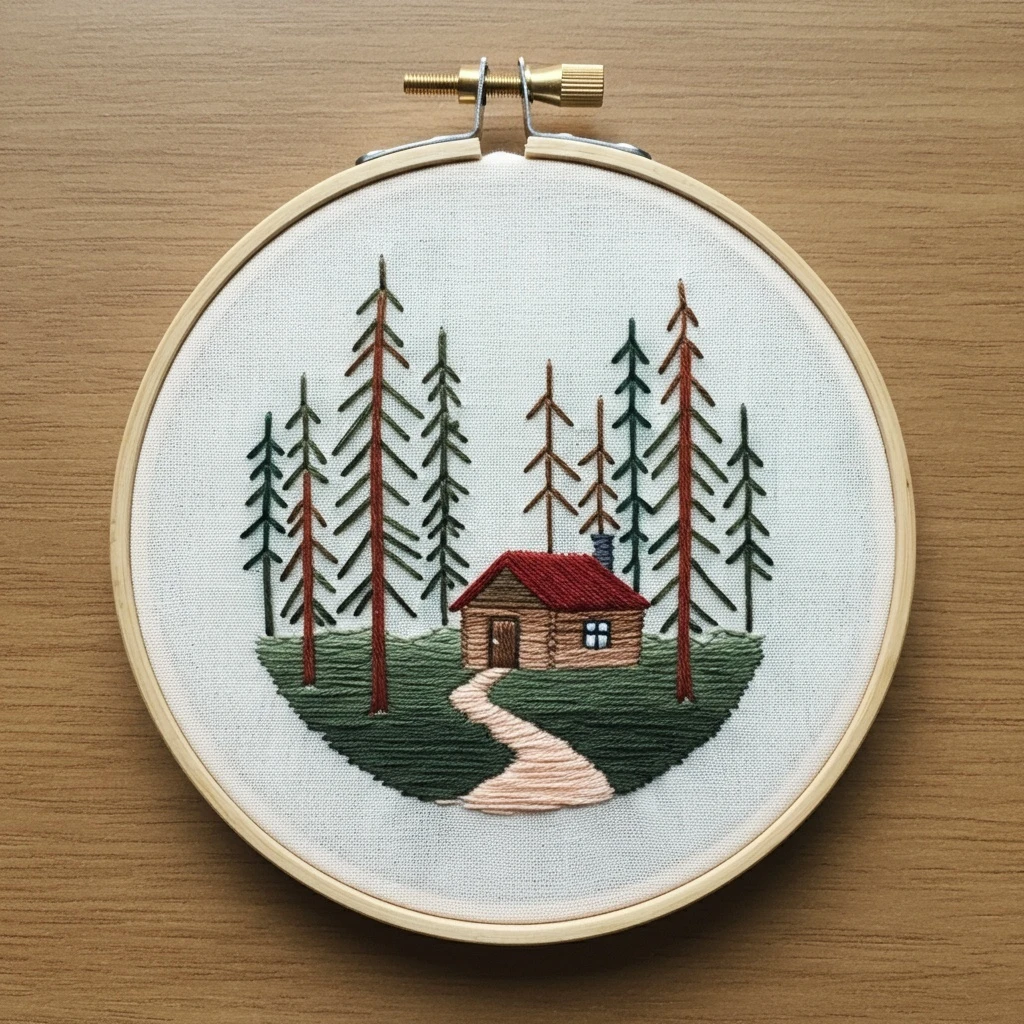

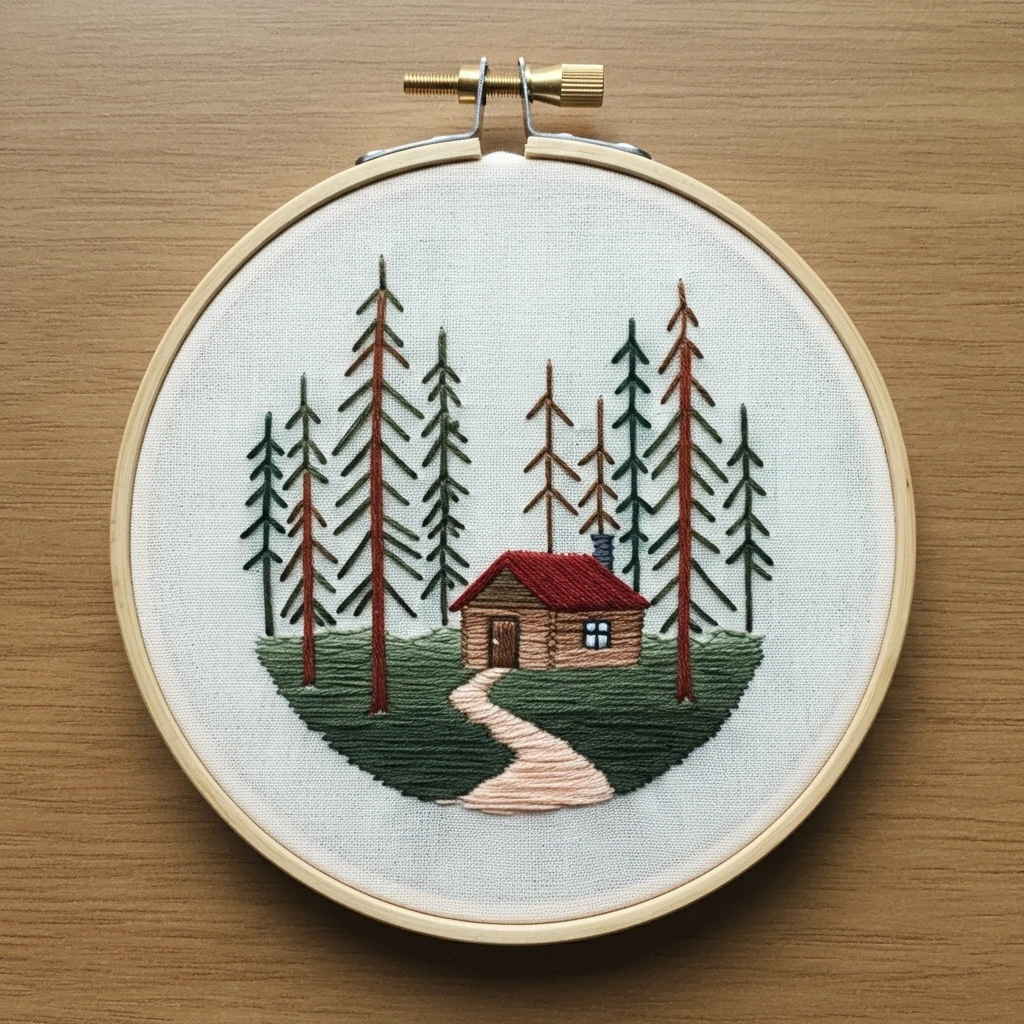
Rustic Forest Cabin
A cozy woodland hoop with tall pine silhouettes, a small log cabin, a curved pale path, deep stitched ground, warm timber walls, and a rich red-brown roof. The palette below keeps the design earthy, dimensional, and beginner-friendly while preserving the quiet forest-cabin mood.
Core DMC Color Palette
Use these colors as a practical floss plan rather than a rigid chart. The sample image has muted rustic lighting, so slightly browned greens and warm neutrals will look more natural than bright primary shades.
Very Dark Forest Green
DMC 934Use for deepest pine interiors, tree outlines, and the darkest lower edge of the forest floor. One strand makes crisp branch silhouettes; two strands give strong shadow.
Deep Pine Green
DMC 935The main evergreen color for branches and dense ground stitching. Blend with 934 for shaded pines and with 3363 for softer middle foliage.
Muted Woodland Green
DMC 3363Good for lighter tree limbs, mid-ground grass, and the top layer of horizontal ground stitches where light catches the hill.
Moss Highlight
DMC 3012Add sparingly along upper grass ridges or a few forward-facing pine needles. Keep it subtle so the cabin stays warm and rustic.
Reddish Bark Brown
DMC 801Ideal for pine trunks and dark cabin log gaps. It echoes the reddish vertical trunks in the reference and ties the roof to the forest.
Cabin Timber Brown
DMC 975Use for log walls, warm bark strokes, and soft wooden accents. Stitch in short horizontal lines to mimic rounded cabin logs.
Light Cedar Tan
DMC 437Use for wall highlights and the light side of individual logs. It helps separate the cabin from the dark tree background.
Dark Umber Detail
DMC 838Excellent for the cabin door, window frames, chimney marks, undersides of roof edges, and fine shadow accents.
Cabin Roof Red
DMC 902Main roof color. Use satin stitch or close long-and-short stitch following the roof slope for a plush, cozy cabin top.
Warm Roof Highlight
DMC 3777Add to the upper roof plane and a few roof-ridge stitches. Blend with 902 to keep the red roof textured rather than flat.
Soft Path Cream
DMC 948Main color for the winding path. Stitch horizontally or diagonally in gentle rows so the path feels handmade and slightly raised.
Path Shadow Peach Brown
DMC 758Use along the path edges and lower bends. A few blended stitches with 948 create a soft dirt-and-light effect.
Window Blue
DMC 3753Use for small window panes. Keep stitches tiny and neat; one strand can make the panes glow without overpowering the cabin.
Snowy Linen Highlight
DMC 3865Optional for bright window sparkle, path highlights, and the tiniest light-catching accents on the cabin edges.
Stitch Placement & Texture Plan
The design works best when the pines stay linear and airy, the cabin is compact and detailed, and the ground becomes the heavy stitched base that anchors everything inside the hoop.
Thread Counts, Blending & Shading
Use strand changes to create scale: thin distant trees, stronger foreground trunks, plush cabin details, and a dense stitched base.
Recommended strand counts
- 1 strand: window panes, chimney lines, far pine branches, tiny roof outline corrections.
- 2 strands: most tree branches, cabin log lines, roof satin fill, path fill.
- 3 strands: only for the lower forest floor if you want a heavier, raised texture.
Useful blends
- 934 + 935: deep shaded pine branches and the lower hill.
- 935 + 3363: middle foliage with softer rustic color.
- 902 + 3777: roof rows with warm light variation.
- 948 + 758: path turns and shadowed edges.
Shading order
- Outline major shapes lightly first.
- Fill darkest greens at the base and behind the cabin.
- Stitch the cabin and roof after the background trees.
- Add final highlights last so they stay clean and visible.
Beginner-Friendly Embroidery Notes
This pattern looks detailed, but it is built from simple repeated stitches: straight stitches for trees, satin stitches for the roof and path, and short horizontal strokes for the cabin walls.
How to keep it neat
- Use a sharp needle and keep fabric drum-tight in the hoop.
- Start with the tall trees, then stitch the ground, then cabin details.
- For tree branches, make each stitch from the trunk outward so the branch tips stay tapered.
- Keep roof satin stitches parallel; uneven roof direction is more noticeable than uneven grass.
Outlining details
- Use one strand of 838 around the door, windows, chimney, and lower roof edge.
- Use split stitch around the cabin if your fabric is loose-weave or the edges look fuzzy.
- Do not outline every pine branch; the straight stitches already create a natural silhouette.
- For the path, outline only the shadow edge with 758 rather than a hard dark line.
Finishing Suggestions
A rustic cabin design benefits from a warm, handmade finish. Keep the backing tidy and let the natural fabric show through the open sky.
Fabric choice
Use cream, oatmeal, or light natural linen. Avoid stark white unless you want a wintery cabin feel; the reference is softer and warmer.
Hoop size
A 6 inch hoop gives a compact ornament feel; an 8 inch hoop allows more open space around the tallest pines and makes the cabin easier to detail.
Final texture
Add a few single-strand seed stitches in 3012 near the hill top and a tiny 3865 window sparkle. Stop before the piece looks busy.