
DMC palette & practical hand embroidery notes
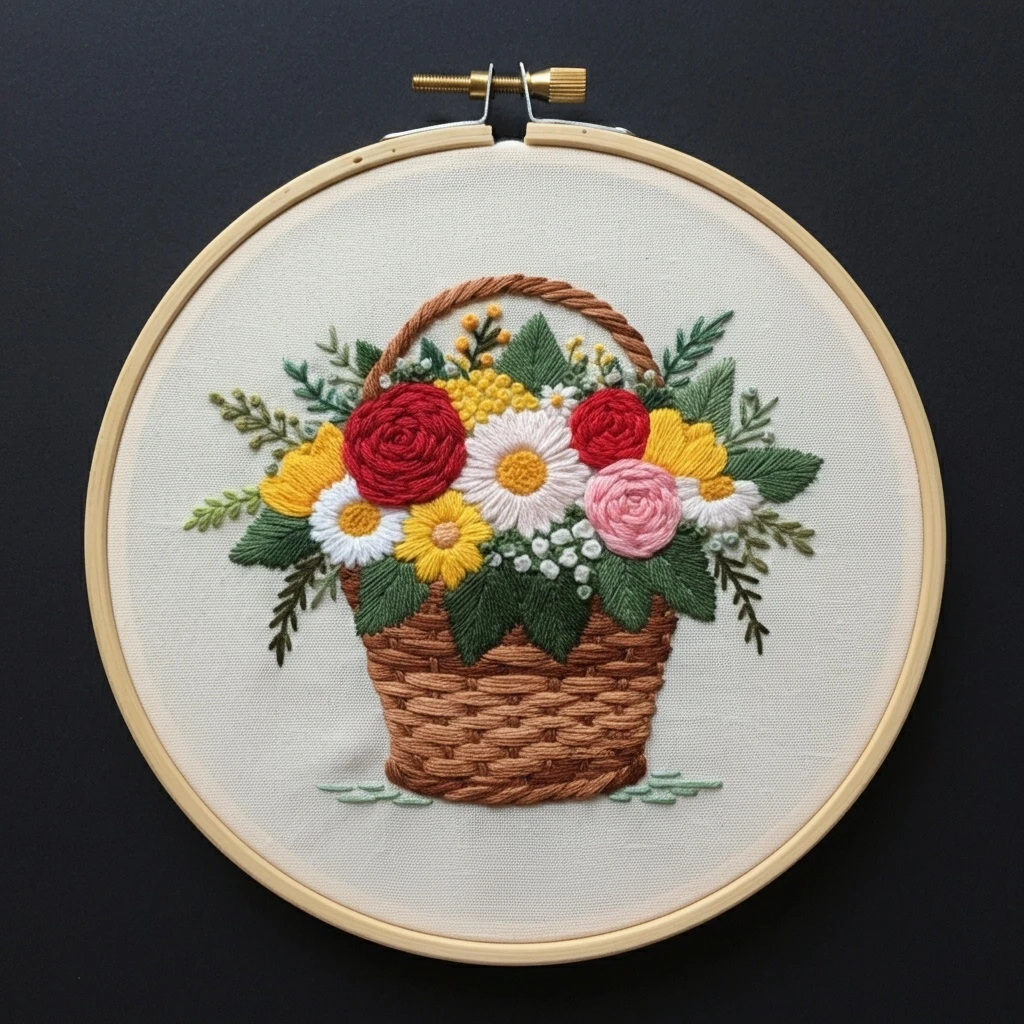
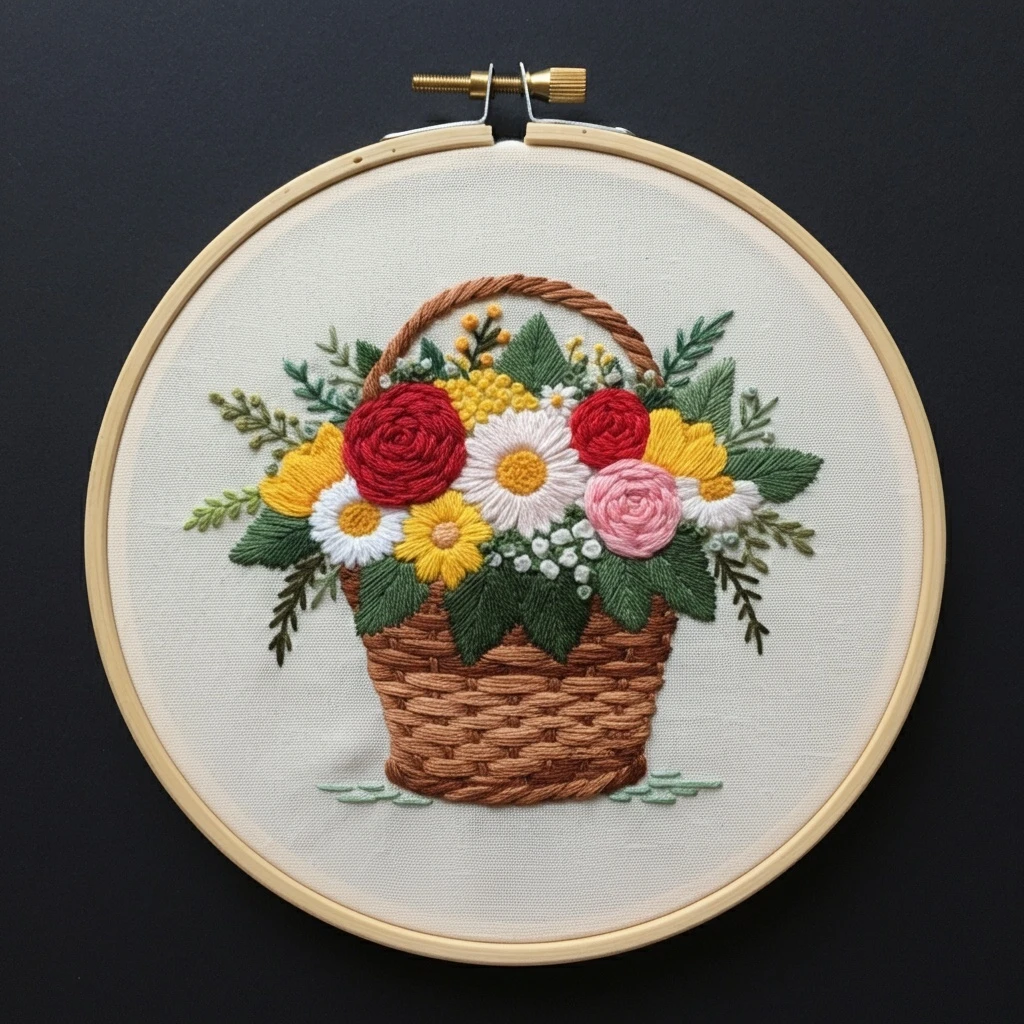
Woven Basket Floral Arrangement
A warm cottage-garden basket design calls for straw browns, leafy greens, soft blossom pinks, creamy highlights, and deeper berry accents. The goal is a raised, textured basket that feels woven by hand, with flowers that sit lightly above it in layered stems and clustered petals.
Design read
This motif is best approached as three layers: the basket base, the leafy support stems, and the flower heads. Keep the basket slightly heavier and more dimensional than the blooms, so it visually anchors the arrangement. Work stems first, then basket weave, then petals and final highlights. The arrangement benefits from small color shifts rather than harsh outlines: tan to brown in the basket, sage to pine in the leaves, and pale pink/cream to rose in the blossoms.
Best fabric pairing: natural linen, oatmeal cotton, or light warm beige ground. These fabrics flatter the basket browns and keep the pale blossoms visible without making the overall piece feel stark.
Suggested DMC floss palette
Stitch plan by design area
Basket and handle
- Use horizontal satin stitch or long-and-short stitch for broad wicker bands.
- Add alternating rows in DMC 977 and 434, then tuck short dark 433 stitches between rows to imitate woven gaps.
- For a raised rim, couch two or three strands of 977 with one strand of 434, following the basket curve.
- Keep handle stitches slightly arched and directional; avoid filling it as a flat block.
Flowers and buds
- Use lazy daisy petals for simple flowers and detached chain clusters for looser blossoms.
- Place French knots in 3821, 335, or 3685 for centers, buds, and berry-like detail.
- Blend 3713 with 3865 for pale pink flowers; add one stitch of 335 at the base for depth.
- Reserve B5200 for final highlights only so the bouquet keeps a soft handmade look.
Thread-count and blending guidance
| Area | Recommended strands | Why it works |
|---|---|---|
| Fine stems and leaf veins | 1 strand | Keeps the greenery delicate and prevents crowding between flower clusters. |
| Leaves | 2 strands | Gives enough coverage for satin or fishbone stitches while preserving crisp edges. |
| Basket body | 2–3 strands | Creates a sturdier, tactile base; use 3 strands for the rim and lower shadow. |
| Flower petals | 2 strands | Soft coverage for detached chain, satin petals, and small woven rose stitches. |
| Knots and accents | 1–2 strands | Use one wrap with 2 strands for round dots; two wraps with 1 strand for tiny seeds. |
Simple blends to try
- Basket highlight: one strand DMC 977 + one strand DMC 3821 for sunlit wicker.
- Basket shadow: one strand DMC 434 + one strand DMC 433 for the deepest weave marks.
- Soft blush flower: one strand DMC 3865 + one strand DMC 3713 for creamy pink petals.
- Natural leaf: one strand DMC 3053 + one strand DMC 3012 for muted green variation.
Outlining, shading, and texture notes
Outlining details
Use split stitch with one strand of DMC 433 around only the lower basket and deepest handle edge. For petals, outline selectively with a single strand of 335 or 3865, never a heavy dark line. Leaves can be defined with one-strand back stitch in 3012.
Shading direction
Let basket stitches follow the wicker direction, not the outer shape alone. Flower petals should radiate from each center. Leaves look most natural when worked from base to tip with a center vein left visible or added afterward.
Texture suggestions
Vary stitch height in the basket rows, add tiny seed stitches in 3821 around flower centers, and scatter a few single-strand green straight stitches behind the bouquet for airy filler stems.
Finishing polish
After the main stitching is complete, add only a few B5200 highlights to petals and one or two golden 3821 touches along the basket rim. Too many highlights can flatten the warm vintage effect.
Beginner-friendly working order
- Transfer the design lightly; keep basket weave lines visible but not dark.
- Stitch the thinnest stems first using one strand of 3012.
- Add larger leaves with fishbone or satin stitch in 3053 and 3012.
- Work the basket from the back or top edge downward, alternating 977 and 434.
- Add basket shadows with small 433 stitches only after the main weave is filled.
- Stitch flower petals from pale to dark, then add knots and final highlights last.
Practical tip: when the design gets crowded, stop tying knots behind small flower clusters. Instead, weave the tail under nearby stitches on the back. This keeps the bouquet smooth and prevents bumps from showing on the front.