
Festive Pinecone Holiday Wreath
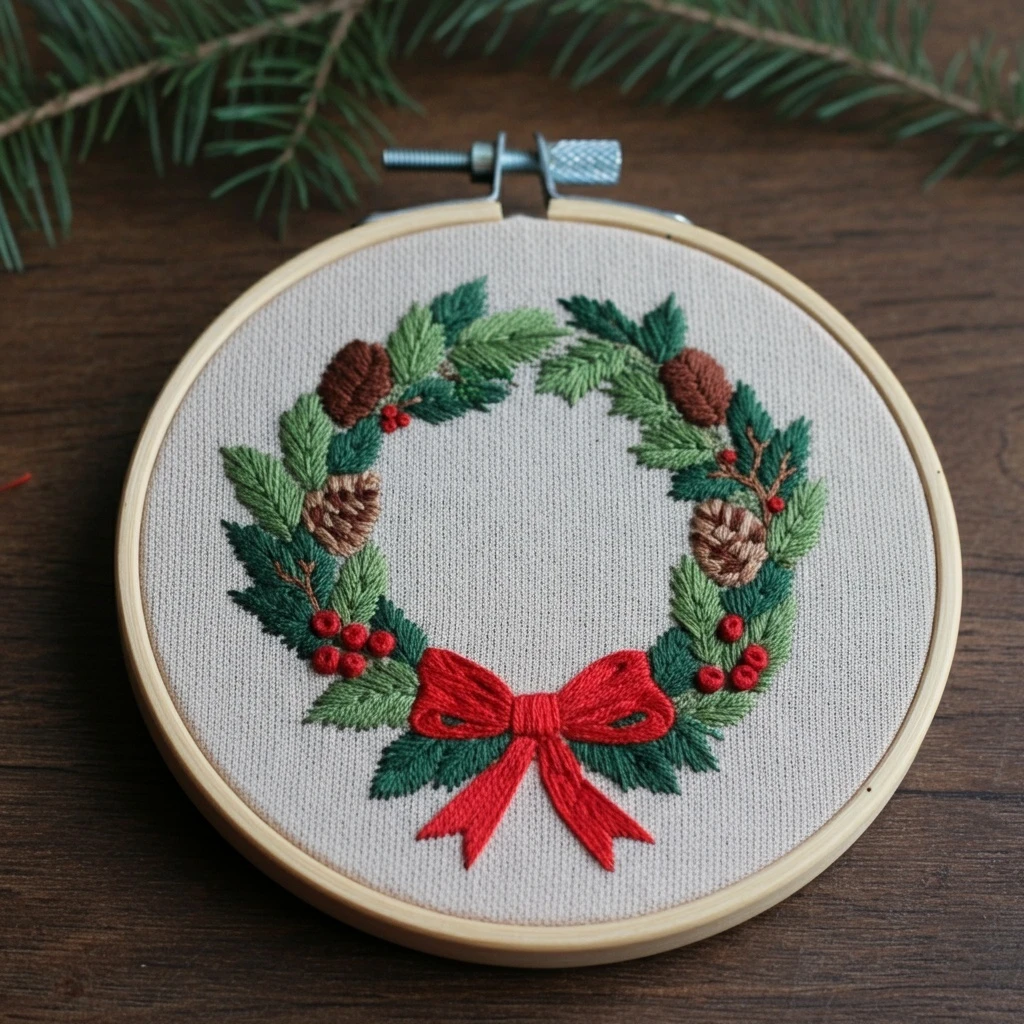
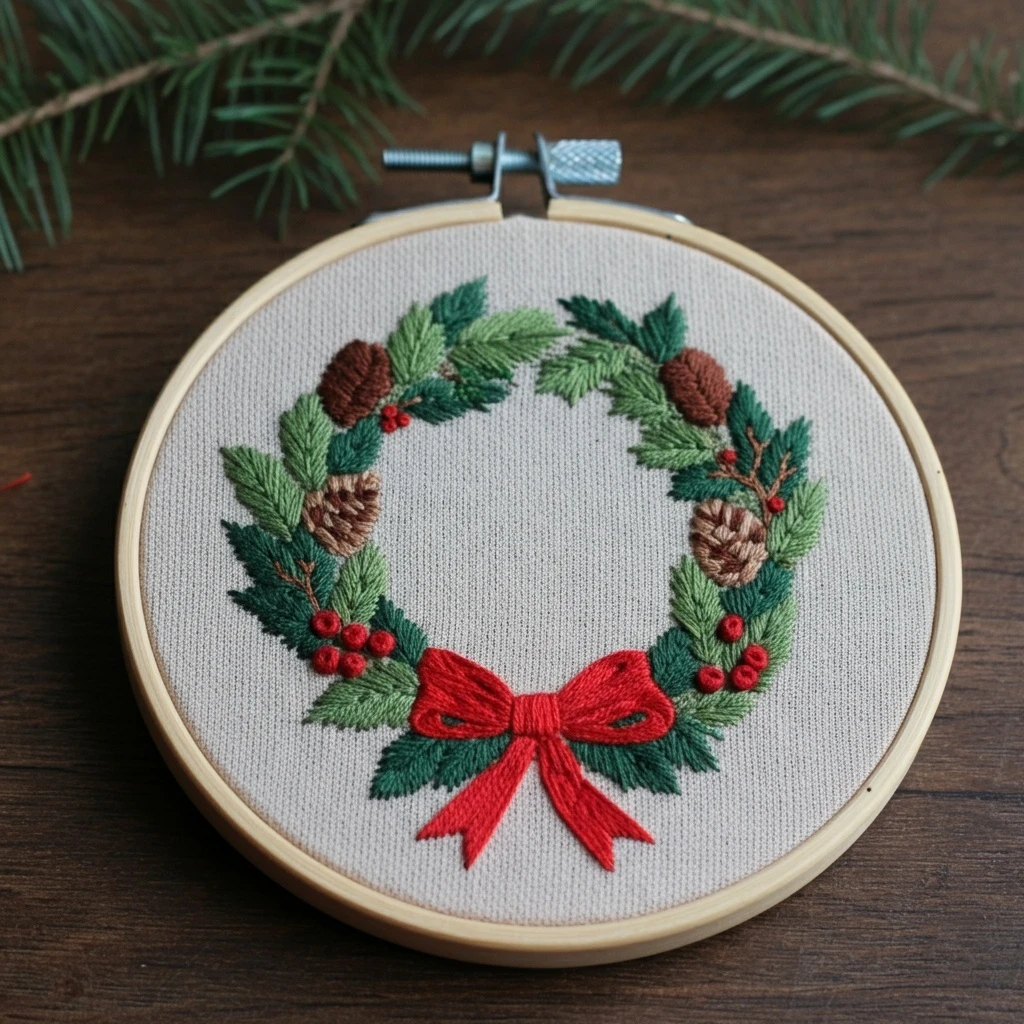
A warm holiday hoop with layered pine and cedar foliage, textured pinecones, glossy red berries, and a classic red bow. The design works best when the greenery is stitched in several close shades, the pinecones are built with raised texture, and the bow is kept smooth and directional.
Design color read
The reference image is dominated by deep evergreen foliage, softer sage-green leaf clusters, warm brown pinecones, bright red berries, and a saturated red bow on natural linen. A successful palette should avoid using a single green: the wreath needs dark inner shadows, mid pine tones, yellow-green highlights, and a few brown twig accents to keep the circle lively.
Main mood
Traditional Christmas colors with natural woodland texture: evergreen, berry red, pinecone brown, and pale linen.
Best focal point
The bow should be the cleanest and brightest element. Keep it smooth so it contrasts with the textured wreath.
Texture priority
Use short directional strokes for foliage, padded or layered stitches for pinecones, and tiny raised knots for berries.
Suggested DMC floss palette
Use the colors below as a practical matching palette. Keep one strand reserved for fine outlines and two strands for most filled shapes; switch to three strands only when you want plush berries or dense pinecone texture.
Stitch plan by design element
Pine and fir needles
Use straight stitch and fishbone-style directional stitches with 1-2 strands. Start with DMC 934 or 500 underneath, add 501 and 367 as the main layer, then finish with tiny 368 or 3013 strokes at the tips.
Broad green leaves
Use closed fly stitch, leaf stitch, or long-and-short stitch. Work from the outside edge toward the vein so each leaf has a natural center line. Outline only selected leaves with one strand of 934 or 500 to avoid a heavy cartoon effect.
Pinecones
Build with padded satin stitch, detached chain scales, or short overlapping straight stitches. Lay 801 in the shadow gaps, cover scale faces with 400, then touch the front edges with 434. For extra dimension, pad the cone oval first with brown scrap floss.
Red berries
Use French knots, colonial knots, or small padded satin circles with 2-3 strands. Start with 815 at the lower edge, fill with 321, and add a single 666 highlight stitch or knot on the upper-left side.
Ribbon bow
Use smooth satin stitch or long-and-short stitch following the curve of each bow loop. Keep the stitches angled from the knot toward the outer edges. Use 815 in fold lines, 321 for the body, and 666 on top ridges.
Twigs and fine branches
Use stem stitch or back stitch with one strand of 400 or 801. Add a few small straight-stitch offshoots so the branches feel tucked naturally between the greenery.
Thread-count and blending guidance
Recommended strands
- 1 strand: fine outlines, leaf veins, twig details, pinecone shadow gaps.
- 2 strands: most leaves, bow fill, pine needles, and mid-size pinecone scales.
- 3 strands: berries, padded pinecone texture, or extra-plush bow knot only.
Blending ideas
- For natural pine: blend one strand 500 + one strand 501.
- For sage leaves: blend one strand 367 + one strand 3012.
- For pinecone warmth: blend one strand 400 + one strand 434 on front scales.
- For ribbon shadows: blend one strand 321 + one strand 815 at the folds.
Beginner-friendly stitching order
Transfer and mark the circle
Lightly mark the wreath ring, bow center, major pinecones, and berry clusters. Avoid drawing every needle; stitch direction will create detail.
Stitch background greenery first
Begin with the darkest pine branches behind the main leaves, using 1-2 strands. Keep stitches radiating around the wreath circle.
Add medium and light leaves
Layer 501, 367, 368, and 3012 over the dark base. Alternate green families so the wreath looks mixed rather than flat.
Build the pinecones
Pad the cone shape lightly, then add overlapping scale stitches from the back of the cone toward the front. Finish with small light-brown tips.
Work the bow smoothly
Stitch the knot first, then the loops, then the tails. Follow each ribbon shape with long, smooth stitches and keep tension even.
Finish with berries and outlines
Add berries last so they sit proudly on top of leaves. Use one-strand dark accents only where needed: under berries, inside pinecones, and at bow folds.
Finishing and texture notes
Fabric choice
Natural linen or cotton-linen in oatmeal, warm white, or pale beige complements the woodland holiday colors and hides small transfer marks.
Needle choice
A size 7-9 embroidery needle works well for 1-2 strands. Switch to a slightly larger needle for 3-strand berries or padded pinecones.
Tension control
Keep the fabric drum-tight in the hoop. Pine needles and satin bow stitches look cleaner when the fabric does not flex while stitching.