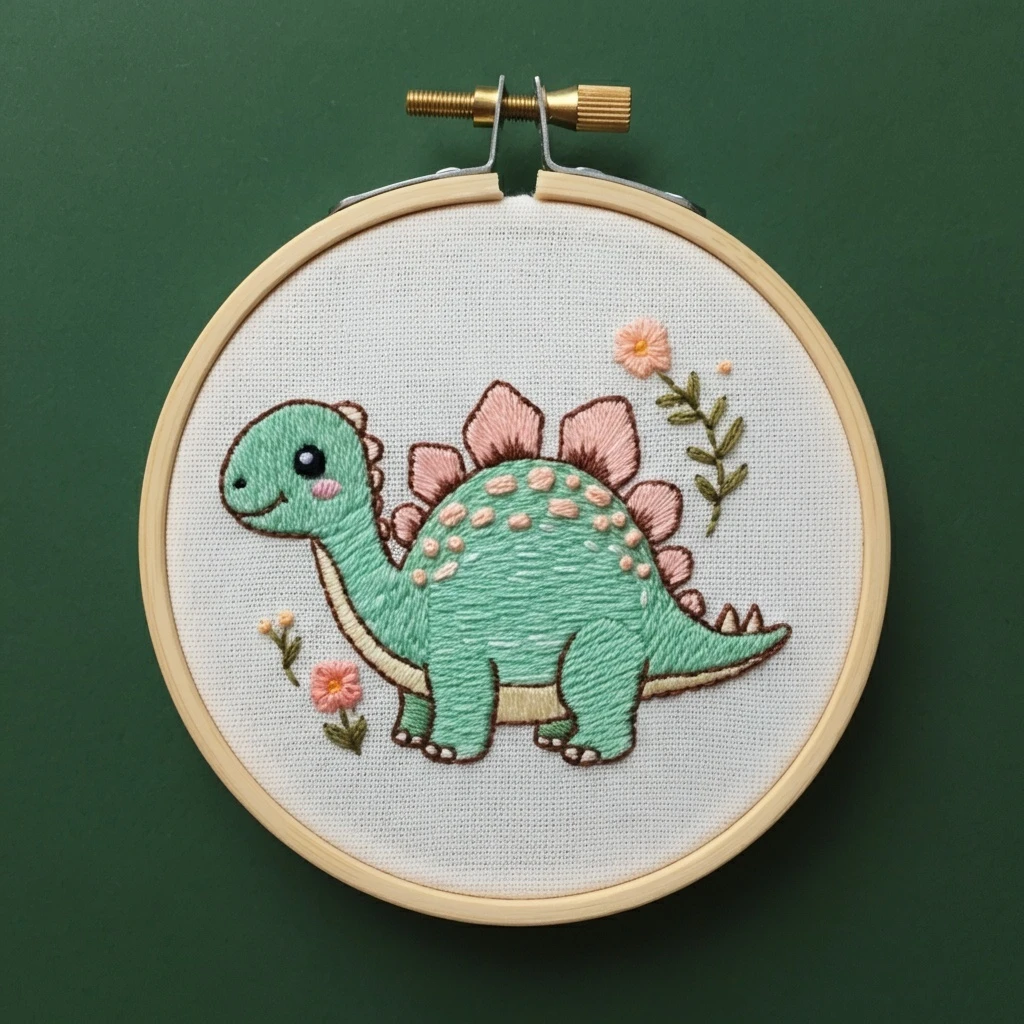

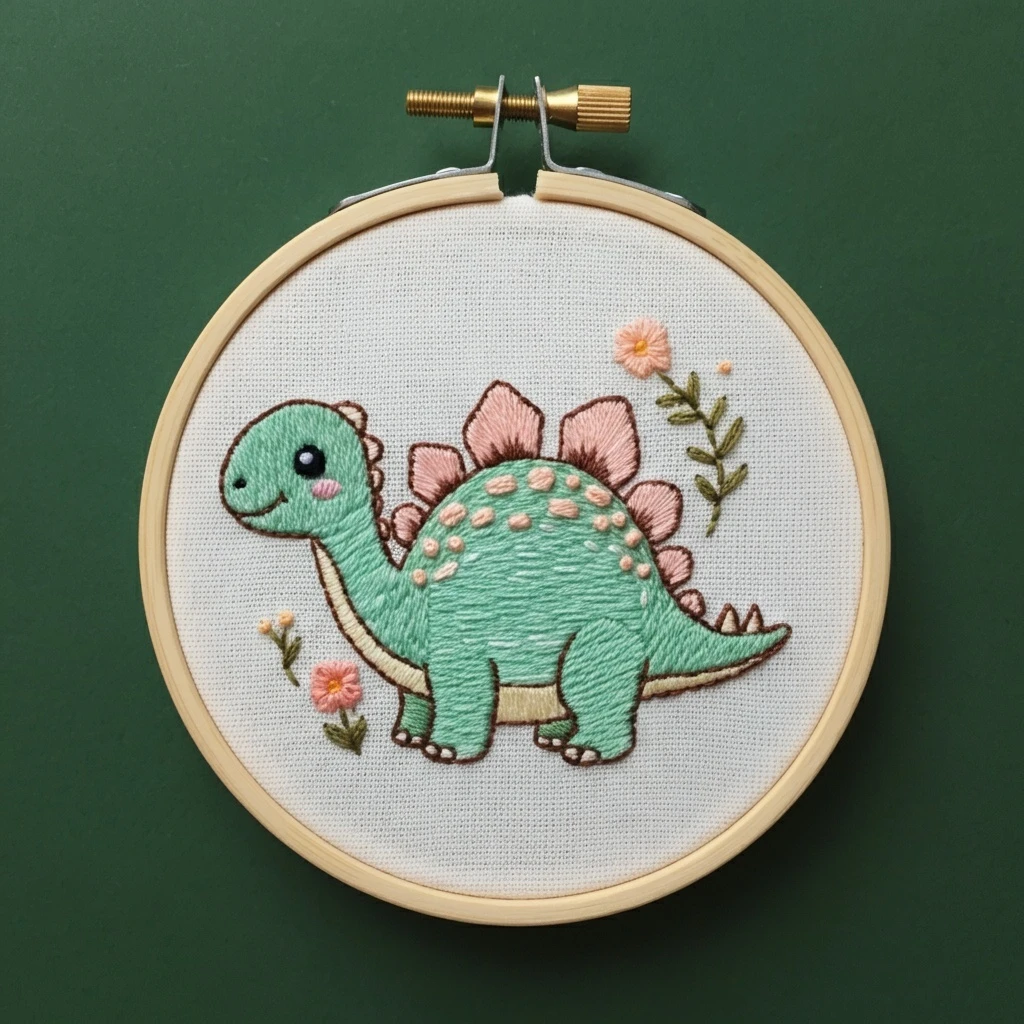
Cute Pastel Dinosaur
A soft, beginner-friendly dinosaur design with a mint green body, creamy belly, chocolate-brown outline, blush cheeks, peachy plates, tiny flowers, and olive sprigs. The look works best with smooth filled stitching, rounded outlines, and gentle color transitions rather than high-contrast shading.
Suggested DMC Color Palette
Stitch Plan by Design Area
Dinosaur body
Use satin stitch or long-and-short stitch following the curve of the belly, neck, and tail. Keep the stitch direction gently horizontal through the body and slightly vertical on the neck for a rounded plush effect.
Back plates
Fill each peach plate with satin stitch from base to tip. Shade the base with DMC 760 and the outer edge with DMC 761 or 3713 so the plates look soft rather than spiky.
Belly and underside
Work DMC 746 in split stitch rows or padded satin stitch. Add a narrow line of DMC 739 or one strand of 898 at the lower edge only if extra separation is needed.
Flowers and sprigs
Use lazy daisy petals for flowers, French knots for centers, stem stitch for stems, and detached chain or fishbone stitch for the olive leaves.
Face details
Use one strand of DMC 898 for the smile and nostril. Work the eye in DMC 310 with a tiny DMC 3865 straight stitch or French knot highlight.
Spots and toes
Use small satin ovals, seed stitches, or colonial knots in pale salmon and cream. Keep these details raised but small so they remain cute and not cluttered.
Thread Count & Blending Guidance
| Area | Recommended strands | Practical note |
|---|---|---|
| Body fill | 2 strands | Gives smooth coverage without bulky edges. Use 1 strand for final soft direction lines if needed. |
| Outlines | 1–2 strands | Use 1 strand for face, toes, and tiny plates; 2 strands for the outer body if the fabric weave is coarse. |
| Flowers | 2 strands petals, 2–3 wraps knots | Keep petals loose and rounded. Use a single darker stitch at the petal base for depth. |
| Leaves and stems | 1–2 strands | One strand looks delicate; two strands are easier for beginners and read clearly on linen. |
| Eye | 2 strands black, 1 strand white | Secure carefully from the back so the tiny highlight stays crisp. |
Soft mint blend
- Blend one strand DMC 964 + one strand DMC 959 for gentle body shadows.
- Use pure DMC 964 on the cheek, upper neck, and center belly-facing curves.
- Add DMC 958 sparingly under feet and along the tail underside.
Peach accent blend
- Blend DMC 3713 + 761 for pastel plates.
- Use DMC 760 only at the plate bases or lower petals.
- Repeat the same salmon shades for cheeks and body spots to unify the design.
Outlining, Shading & Texture Suggestions
For the rounded cartoon style, outline after most filling is complete. A back stitch is easiest, while split stitch creates a softer plush edge around the body. On curves such as the smile, tail, and belly, use short stitches so the line stays smooth.
Rounded body texture
Use directional long-and-short stitches and avoid perfectly straight block fills. Slightly changing stitch angle around the shoulder, hip, and tail makes the dinosaur feel dimensional.
Raised cute details
Work spots, toes, and flower centers last. French knots and tiny padded satin ovals give the piece a tactile handmade finish.
Clean brown linework
Use DMC 898 in one strand for small areas. For the outside edge, two strands are fine, but keep tension light so the brown outline does not pucker the fabric.
Beginner-Friendly Practical Tips
- Start with the largest mint body area, then stitch the belly, plates, flowers, and final outlines.
- Use a 6-inch hoop with firm, drum-tight fabric tension to keep satin stitches smooth.
- Short satin stitches are easier to control than very long ones; divide large areas into natural sections.
- Keep thread lengths around 35–45 cm to reduce fuzzing in the pastel colors.
- Transfer details lightly so pencil or pen marks do not show through pale DMC 746 and 3713.
- For a softer baby-nursery finish, replace pure black outlining with dark coffee brown except for the eye.
- Stitch the eye and cheek last so the expression stays clean and bright.
- Press from the back on a towel after stitching to preserve knots and padded texture.