
Autumn Pathway Serenity
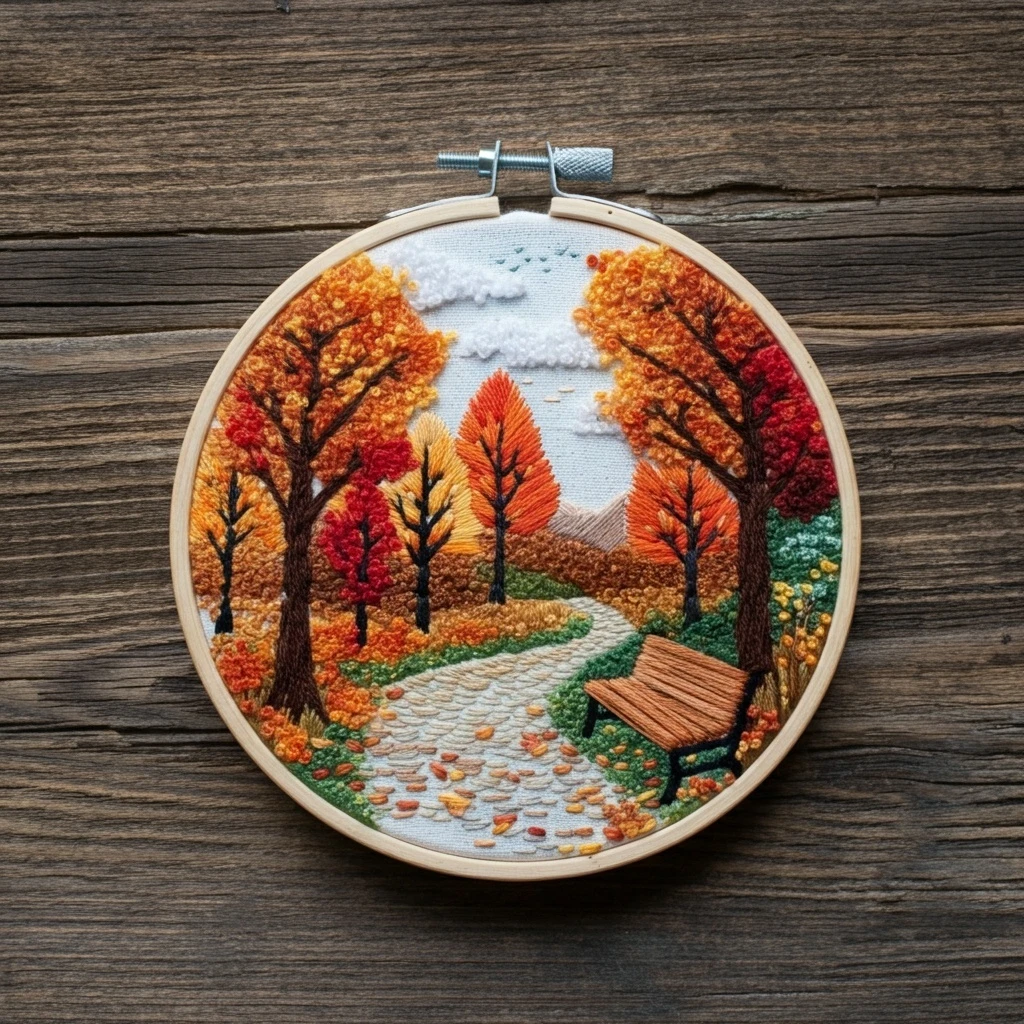
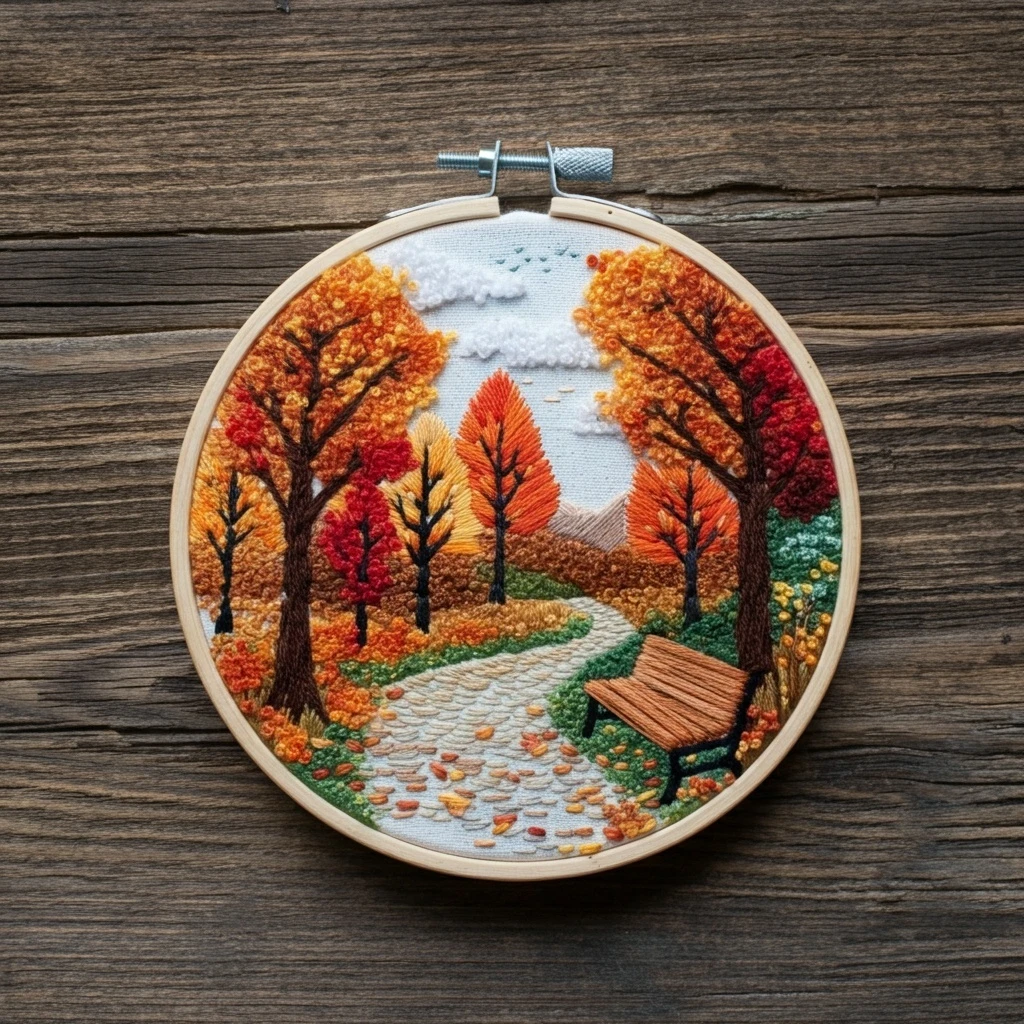
A warm woodland pathway design with rust leaves, soft golden ground cover, dark tree accents, muted green foliage, and gentle sky highlights. This guide translates the scene into practical DMC choices and beginner-friendly embroidery methods.
Color Story from the Design
The reference image reads as a quiet forest walk: a curving path pulls the eye inward, framed by russet-orange leaves, ochre grasses, deep brown trunks, olive shrubs, and pale cream light. Keep the palette warm and slightly muted so the path feels calm rather than overly bright.
Main focus
Use glowing oranges and golds for the canopy and fallen leaves, with darker russet at leaf edges and shaded clusters.
Depth builders
Deep browns, taupes, and olive greens create tree trunks, distant woodland shapes, and shadowed undergrowth.
Atmosphere
Cream, pale peach, and soft grey-blue can be used sparingly for path highlights, sky gaps, and misty distance.
Suggested DMC Floss Palette
Stitch Map by Design Area
| Area | Best stitches | Thread guidance | Practical notes |
|---|---|---|---|
| Curving path | Long and short stitch, split stitch, seed stitch | 2 strands for fill; 1 strand for fine cracks | Angle stitches with the curve of the path so it recedes into the forest. Mix 642 + 3826 for warmer center highlights. |
| Autumn leaf canopy | Detached chain, fly stitch, lazy daisy, scattered straight stitches | 2 strands for leaves; occasional 3-strand foreground accents | Cluster 921, 922, 783, and 918 irregularly. Natural leaf masses look best when slightly random. |
| Tree trunks and branches | Stem stitch, split backstitch, couching | 1-2 strands; use 938 only for deepest accents | Work bark vertically in 975 and 938, then add tiny 640 stitches on the light side for dimension. |
| Ground cover and leaf litter | Seed stitch, French knots, straight stitch sprinkles | 2 strands; 1 strand for distant flecks | Layer darker leaf tones first, then add topaz and copper light flecks last so the surface sparkles. |
| Distant shrubs and forest edge | Small satin stitch, seed stitch, woven filling | 1-2 strands | Use 730 and 734 sparingly among the oranges to keep the design balanced and not too monochrome. |
| Sky/light gaps | Tiny satin stitch, very light long and short stitch | 1 strand | Keep 746 minimal. Small highlights are more elegant than large white patches. |
Thread Count, Blending & Shading
Recommended strand plan
1 strand fine branch tips, distant path texture, narrow outlines, tiny sky highlights.
2 strands most foliage, path fill, trunks, shrubs, and general scenic stitching.
3 strands a few foreground leaves or knots only, where extra texture is useful.
Blends that suit the scene
- 921 + 922: lively copper-orange leaf transitions.
- 922 + 783: golden sunlit leaf tips and path sparkle.
- 975 + 640: natural bark with less harsh contrast.
- 734 + 3826: olive-gold dry grasses along the walkway.
- 642 + 746: pale path highlights and atmospheric distance.
Outlining & Texture Suggestions
Outlining details
Use split backstitch in 975 for tree silhouettes and path edges. Reserve 938 for tiny accents only so the serene mood stays soft.
Leaf texture
Alternate detached chain stitches and short straight stitches. Place a few French knots in 783 and 922 where leaves gather near the foreground.
Path texture
Use broken seed stitches instead of dense satin fill. Leave a little fabric breathing room so the walkway looks soft and calm.
Depth control
Distant elements should be stitched with 1 strand and lower contrast. Foreground leaves can use 2 strands and warmer colors.
Beginner-Friendly Workflow
- Transfer the main path curve, tree trunks, and largest foliage borders first; do not trace every tiny leaf.
- Stitch tree trunks and path outline before adding scattered leaves, so the structure remains clear.
- Fill the path with soft long and short stitches in 642, then add 3826 and 746 highlights.
- Add leaf clusters in three passes: dark 918/975 shadows, mid 921/922 leaves, then 783 sparkle stitches.
- Step back often. Scenic embroidery looks best when color clusters are balanced from a distance.
- Press from the back on a towel after stitching to protect knots and raised texture.
Finishing Notes
For a peaceful autumn finish, mount the piece in a warm wooden hoop or frame it with a linen mat. A natural oatmeal, cream, or pale beige fabric will support the copper foliage without competing with it. Keep knots small, outlines selective, and highlights restrained for a polished woodland-path effect.