
DMC palette & hand embroidery notes
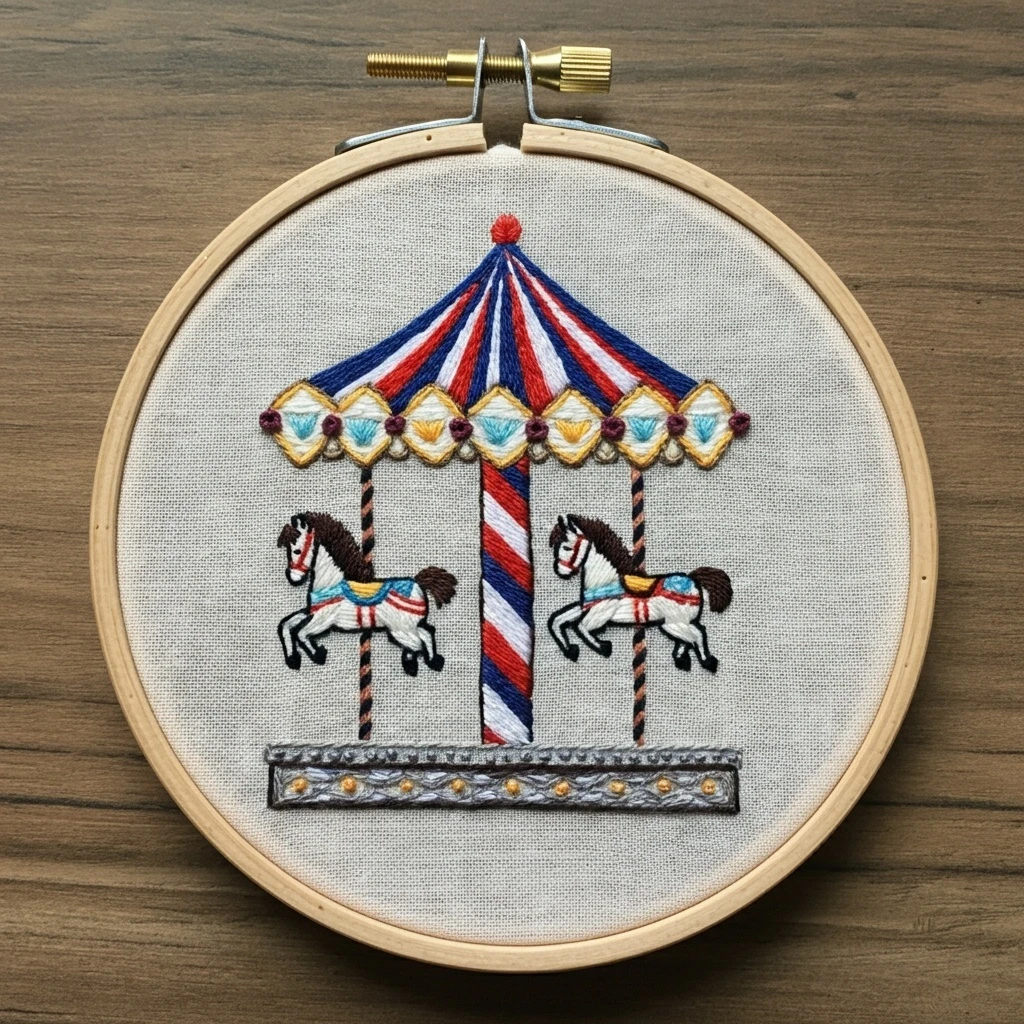
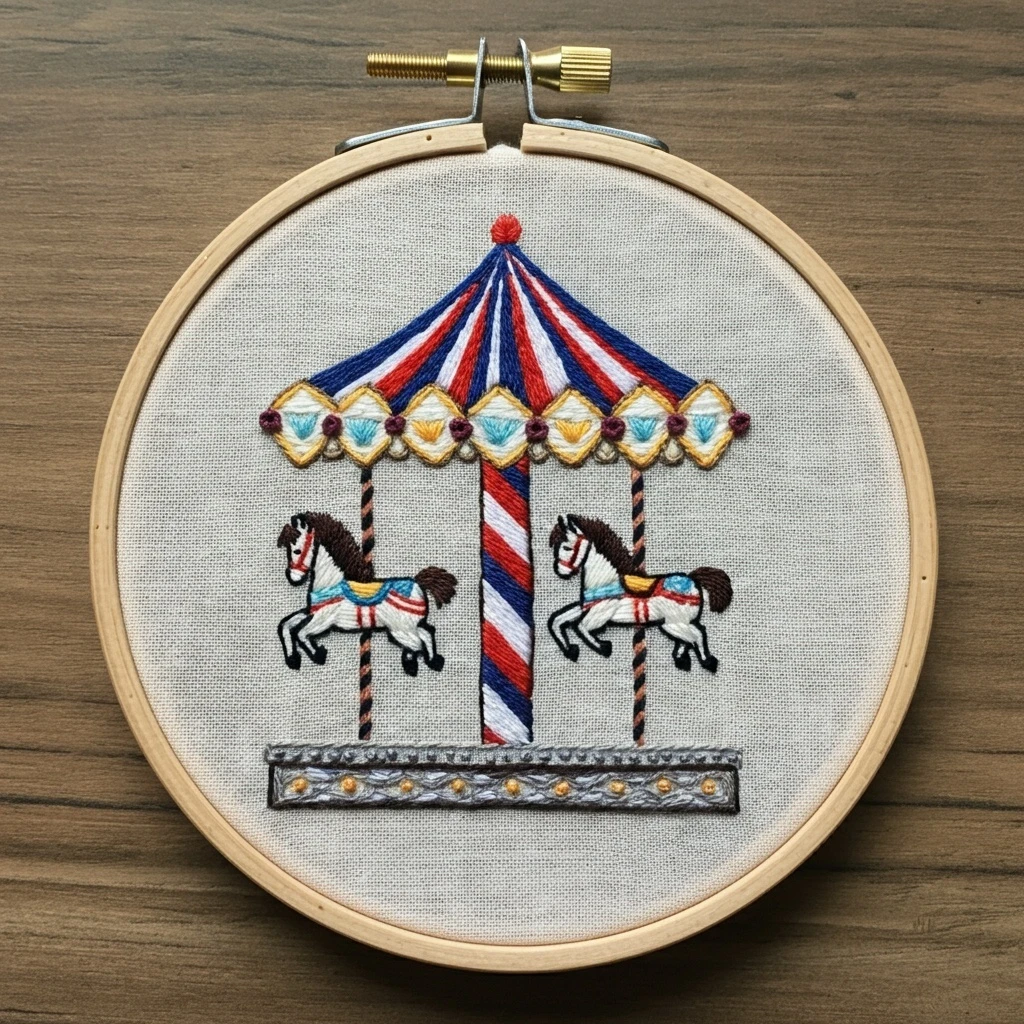
Embroidered Merry Go Round
A bright carousel design with a striped circus canopy, two white horses, gilded trim, teal saddle accents, candy-cane poles, a textured gray platform, and bold black outlining. The palette below keeps the piece playful while giving the horses, roof stripes, and metal base enough contrast to read clearly on natural linen.
Color story from the design
The sample uses a classic carnival scheme: deep navy and true red canopy panels, creamy white horse bodies, warm gold scallops and bulbs, turquoise saddle details, dark brown manes and tails, black sketch-like outlines, and silvery gray platform stitching. Keep the background cloth neutral so the carousel stripes stay crisp.
Suggested stitches by design area
| Area | Stitch choice | Practical notes |
|---|---|---|
| Striped canopy | Long-and-short satin or split stitch fill | Start at the top point and work downward in tapered wedges. Keep red and navy stitches angled along the roof lines so the canopy feels tented rather than flat. |
| Scalloped valance | Satin stitch fill with couching or whipped back stitch border | Use 739 or 3865 for the pale centers, 783 around the diamond edges, then add 915 French knots at the joins for the decorative rosettes. |
| Carousel horses | Short-and-long stitch, tiny satin stitch, back stitch | Fill bodies with 3865 and a touch of 739 under the belly. Outline last with 310 so legs, muzzle, ears, and harness details stay readable. |
| Manes, tails, hooves | Split stitch and small straight stitches | Use 3371 with a few 433 strokes for warmth. Let the direction of the stitches follow the hair flow. |
| Central pole and side poles | Stem stitch, whipped back stitch, or diagonal satin bands | Lay a pale base first, then add diagonal bands in 321, 823, and 3371. Keep the spacing consistent for the classic carousel twist. |
| Metal platform | Brick stitch, seed stitch, couching, French knots | Fill with 318, deepen the lower edge with 414, outline in 310, and place 743/783 knots or padded dots for the little lights. |
| Top pom-pom | French knots or woven wheel | Cluster 321 knots over a small padded base for a raised carnival topper. |
Stitching order for a neat finish
Blending, shading & texture suggestions
Canopy dimension
Use two strands of 823 with one strand of 820 on the darkest blue outer stripes. For red panels, combine two strands of 321 with one strand of 816 near the bottom edge, then return to solid 321 in the center for a brighter carnival look.
Horse shading
Even white horses need shadow. Place one-strand 739 stitches under the belly, under the saddle, and at the inner legs. Keep the face light, then use tiny 310 back stitches for the eye, nostril, hoof, and mouth line.
Gold trim
Work 783 as the main gold. Touch the upper curve of each scallop or light bulb with 743. A final single strand of 433 below selected gold areas creates a soft shadow without making the trim muddy.
Platform texture
Fill the rectangle with irregular 318 brick stitches, then scatter short 414 strokes along the bottom edge. Add the circular lights as French knots or padded satin dots so they pop against the gray base.
Practical embroidery tips
- Use shorter strands, around 14–16 inches, to reduce fuzzing in dark navy and black floss.
- For clean canopy points, bring every stripe into the same top point but avoid pulling too tightly; over-tension can pucker the roof.
- When stitching tiny legs and bridles, rotate the hoop rather than twisting your wrist. This keeps back stitches smoother.
- Use a laying tool or needle tip to smooth three-strand satin stitches on the roof so the carnival stripes look polished.
- Anchor dark thread under the same dark color only; black and navy tails can shadow through pale horse bodies on light fabric.
- Press from the back on a towel after finishing to protect raised knots, bulbs, and the pom-pom.