
DMC palette & hand embroidery notes
Vintage Carousel
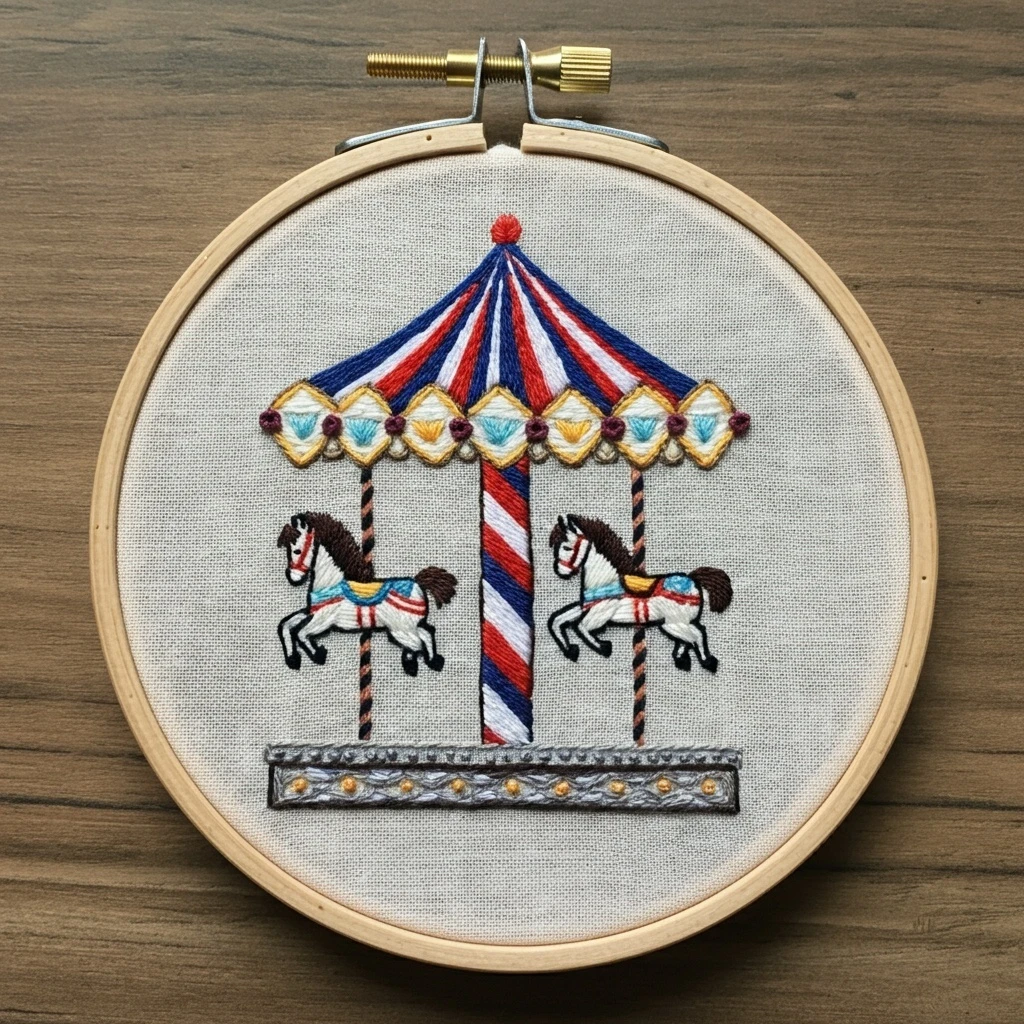
A nostalgic carousel design calls for soft fairground pastels, antique gold trim, warm wood shadows, and crisp decorative outlines. The stitching plan below keeps the carousel horse graceful, the canopy lively, and the metallic-looking details bright without becoming bulky.
Suggested DMC Color Palette
Stitch Type Suggestions
| Area | Recommended stitches | Practical notes |
|---|---|---|
| Horse body | Long and short stitch, split stitch outline | Use 1 strand for shading and 2 strands for the clean outer contour. Angle stitches with the body curves. |
| Mane and tail | Stem stitch, split stitch, loose satin accents | Vary brown lengths so the hair looks carved rather than flat. |
| Canopy panels | Satin stitch, brick stitch, backstitch dividers | Alternate rose and blue sections; keep panel stitches parallel for a tidy fairground stripe effect. |
| Gold pole and trim | Couching, whipped backstitch, chain stitch | Use 783 over a darker 680 shadow line for an antique metallic look. |
| Florals and rosettes | Lazy daisy, woven wheel, French knots | Small flowers can be 2-strand lazy daisies with 1-strand dark centers. |
| Fine outlines | Backstitch or split backstitch | Use 3371 sparingly; too much dark thread can overpower the pastel carousel mood. |
Thread Count & Blending
- 1 strand: facial details, horse body shading, tiny gold shadow marks, and narrow harness lines.
- 2 strands: most outlines, canopy fills, saddle motifs, flower petals, and decorative borders.
- 3 strands: only for bold lower-base outlines or raised trim where the pattern needs extra presence.
- Blend 3865 + 842: gentle horse-body shadow that still reads as white.
- Blend 783 + 3823: bright gold highlight for pole edges and small ornament tips.
- Blend 819 + 335: soft-to-medium rose transition on ribbons, canopy curves, and saddle flowers.
Optional sparkle
For a more theatrical carousel feel, replace a few 3823 highlight stitches with a single strand of pale gold metallic thread, but use it only as an accent so the hand embroidery remains soft.
Suggested Stitching Order
Shading & Texture Guidance
For the carousel horse, avoid heavy shading. Place the darkest beige only under the belly, behind the front leg, around the muzzle, and beneath the saddle. The result should feel porcelain-like, not brown.
For the canopy, treat each stripe as a curved fabric panel. Start with the darker edge color, fill toward the center with the lighter shade, and add a fine backstitch seam only after the fill is complete.
For metalwork, use directional stitches: vertical on the pole, curved around scrolls, and tiny diagonal highlights on knobs or finials. This makes regular cotton floss mimic brass without needing full metallic thread.
Beginner-Friendly Tips
- Use a 6-inch hoop and keep the fabric drum-tight; carousel lines look best when stitches are even.
- Short satin stitches are safer than long ones on the saddle and canopy. Divide large shapes into smaller sections.
- When stitching pale areas, wash hands often and keep dark thread tails away from the back of the horse body.
- Outline after filling. If you outline first, satin stitches can cover or distort the line.
- Step back every few minutes to check symmetry in the pole, canopy scallops, and horse legs.