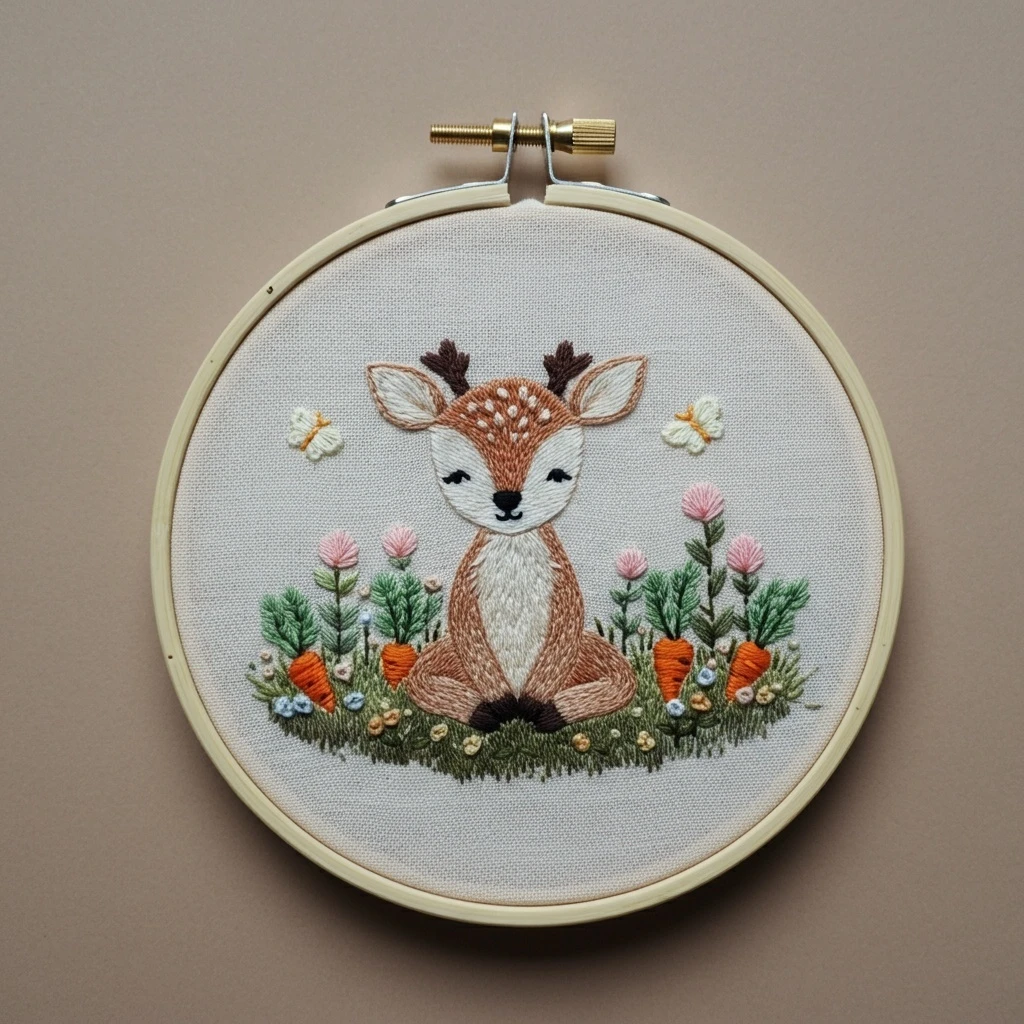

DMC floss palette & hand embroidery notes
Fawn In A Carrot Patch
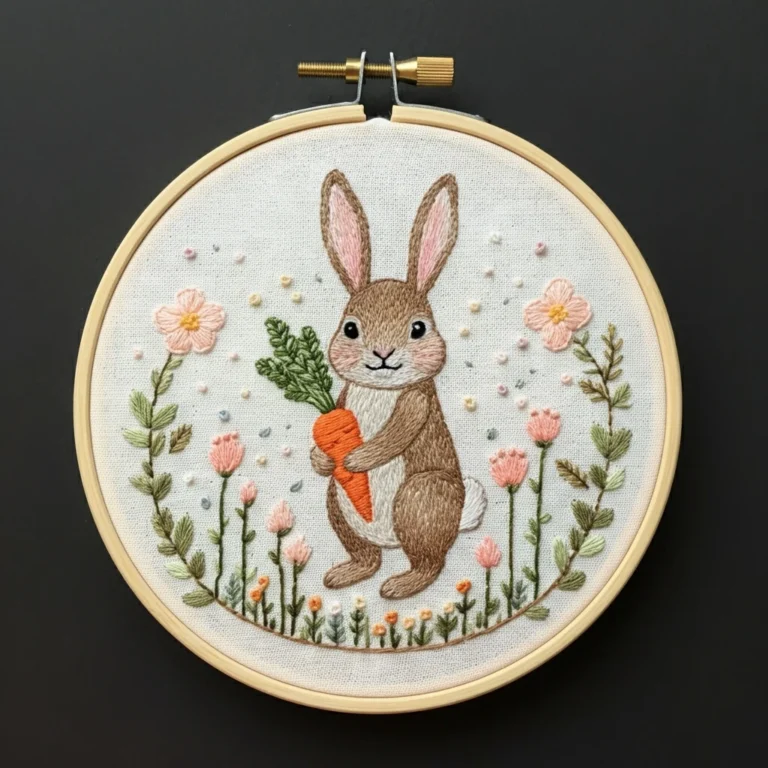
A soft woodland-hoop design with a warm tawny fawn, creamy face and belly, dark stitched antlers, feathery carrot greens, orange roots, pink clover-style flowers, tiny blue blossoms, and a textured grassy base.
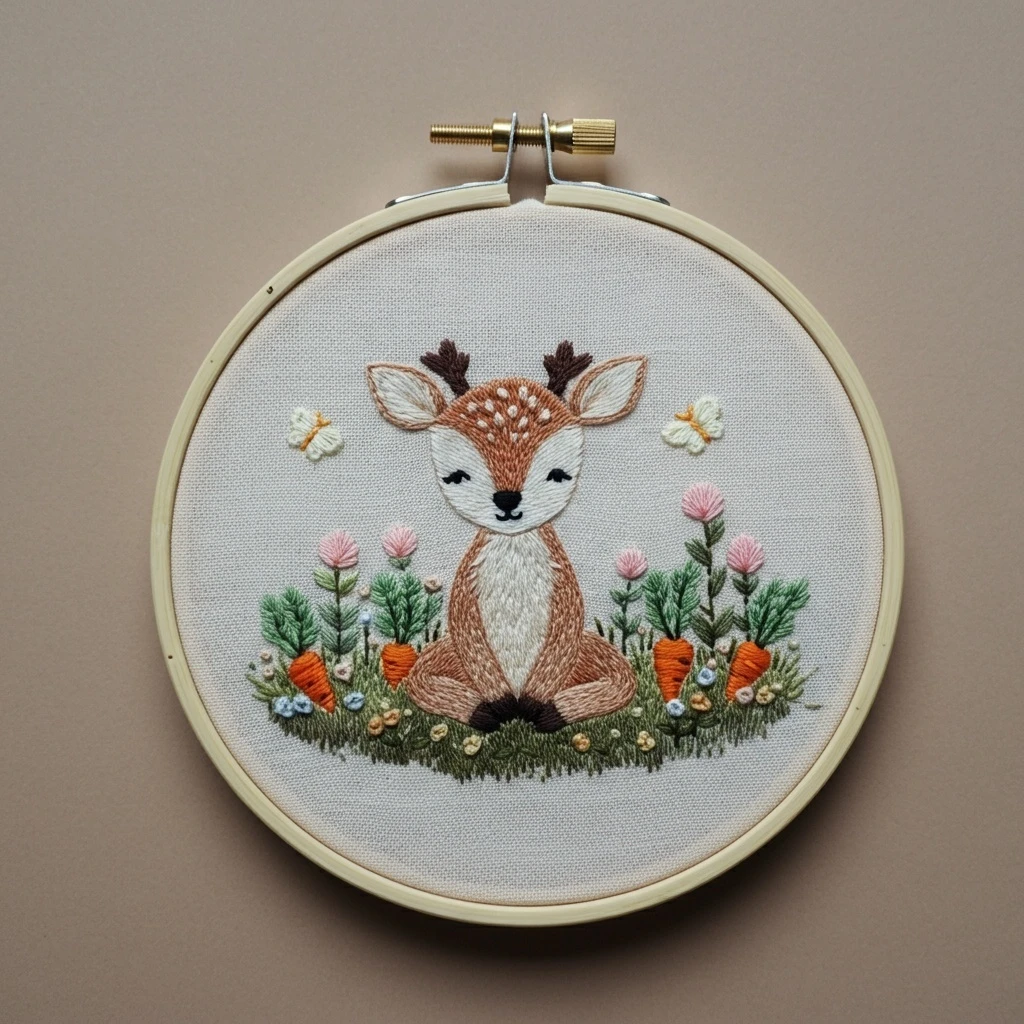
Polished DMC color palette
Use the palette below as a practical embroidery translation of the photo. Keep most fill areas to 1–2 strands so the fawn stays delicate and the garden remains detailed.
DMC 434
Light Brown
Main fawn head, body sides, ear outlines, and warm fur direction lines.
DMC 435
Very Light Brown
Mid-tone fawn blending, forehead transitions, legs, and soft cheek shading.
DMC 436
Tan
Light fur strokes on the fawn's face, chest edges, and inner ear warmth.
DMC 437
Light Tan
Soft highlights on muzzle edges, legs, and the lighter tail/ear transitions.
DMC 3865
Winter White
Fawn belly, face panels, inner ears, white spots, and tiny floral highlights.
DMC 712
Cream
Warmer cream shadows in the belly and ears; blend with 3865 for soft fur.
DMC 938
Ultra Dark Coffee Brown
Antlers, hooves, dark ear bases, and deepest brown accent strokes.
DMC 310
Black
Eyes, lashes, nose, mouth line, and tiny definition dots.
DMC 920
Medium Copper
Carrot root shading and darker ridges; also useful for warm fawn accents.
DMC 740
Tangerine
Bright carrot centers and the most saturated orange stitches.
DMC 741
Medium Tangerine
Carrot highlights, small light bands, and sunny garden accents.
DMC 3011
Dark Khaki Green
Deep grass base, shadowy stems, and undergrowth behind the fawn.
DMC 3012
Medium Khaki Green
Main carrot tops and fern-like garden leaves.
DMC 469
Avocado Green
Leaf mid-tones, lower meadow tufts, and natural green variation.
DMC 470
Light Avocado
Leaf tips, fresh spring-green highlights, and small sprigs around flowers.
DMC 335
Rose
Pink round blossoms, lower petal bases, and slightly deeper flower centers.
DMC 151
Very Light Dusty Rose
Upper petals and gentle blending on the pink pom-pom flowers.
DMC 745
Light Pale Yellow
Butterfly wings, tiny yellow buds, and light centers on small daisies.
DMC 676
Light Old Gold
Butterfly bodies, golden knot flowers, and warm garden specks.
DMC 3756
Ultra Very Light Baby Blue
Tiny blue flowers and pale cool highlights among the greenery.
DMC 931
Medium Antique Blue
Blue blossom shadows or centers; use sparingly for depth.
DMC 317
Pewter Gray
Subtle shadow under the nose, soft outline help, and cool fabric-tone corrections.
Stitch map by design area
| Area | Recommended stitches | Strands & notes |
|---|---|---|
| Fawn face and body | Long-and-short stitch, split stitch outline, tiny straight stitches for fur direction. | Use 1 strand for facial fur and 2 strands for larger body sections. Work from the outline inward so the fur follows the head shape. |
| White belly, muzzle, and inner ears | Long-and-short stitch with gentle split-stitch borders. | Blend 1 strand 3865 + 1 strand 712 for creamy shadow, then add a few single-strand 3865 strokes on top. |
| Eyes, nose, mouth | Satin stitch for nose, back stitch for mouth, tiny straight stitches for lashes. | Use 1 strand black for clean details. A single couching stitch can secure the nose edge if it looks bulky. |
| Antlers and hooves | Satin stitch or closely packed straight stitches. | Use 2 strands of 938 for antlers; add a few 3371 or 310 accents only at the base if extra depth is needed. |
| Carrots | Satin stitch or brick stitch with short angled ridges. | Fill with 2 strands 740/741. Add 1-strand 920 curved ridges after filling for a realistic carrot texture. |
| Leafy carrot tops | Fishbone stitch, fern stitch, and detached straight stitches. | Use 1 strand for thin fern tips; use 2 strands for central stems. Vary 3011, 3012, 469, and 470. |
| Pink flowers | Woven wheel, satin fan, or radiating straight stitches. | Use 2 strands. Place darker rose at the flower base and lighter dusty rose toward the petal tips. |
| Small blossoms and dots | French knots, colonial knots, lazy daisy, and tiny straight stitches. | Use 1 or 2 wraps for knots. Keep blue and yellow flowers scattered so the border feels natural. |
| Grass base | Seed stitch, straight stitch tufts, turkey-work accents if desired. | Use mostly 1 strand. Layer dark green first, then add lighter tips and a few cream/yellow knots. |
Blending & shading plan
- Fawn forehead: alternate 434 and 435 in vertical fur strokes, then add 436 only where the forehead catches light.
- Cheeks: keep the face panels pale; blend 3865 + 712 for the first layer and finish with single-strand 3865 highlights.
- Body sides: shade the outer edges with 434, transition to 435, and let 437 appear on the inner legs.
- Carrots: use 740 as the main fill, 741 on raised centers, and 920 on lower-left shadow ridges.
- Garden greens: mix greens randomly rather than in blocks; real carrot tops look best with uneven color placement.
Outlining details
- Use split stitch in 434 for the fawn outline; it gives a softer edge than black.
- Outline ears with 435, then add inner ear lines with 712 and 437.
- Keep the eyes and nose crisp with 1 strand 310; avoid heavy black around the fawn's face.
- Outline carrots selectively with 920 only on the shadow side so they remain rounded.
- Use a few vertical dark-green stitches under the fawn to anchor it into the grass.
Beginner-friendly stitching sequence
- Transfer lightly. Use a fine washable pen or heat-erasable pen. Mark only the important facial lines, carrot shapes, and flower positions.
- Stabilize the fabric. Hoop natural linen/cotton drum-tight. If the fabric is loose-weave, add a light backing fabric to prevent puckering.
- Outline the fawn. Split stitch the body and face with 1 strand before filling; this creates a neat boundary for long-and-short stitches.
- Fill the fawn in layers. Work from darkest outer fur to lighter inner fur. Keep stitches tapered and slightly irregular for a natural coat.
- Add facial features last. Stitch nose, eyes, lashes, mouth, and spots after the fur fill so the expression stays clean and visible.
- Build the garden from back to front. Start with dark grass and stems, then carrots, pink flowers, blue/yellow knots, and final leaf highlights.
- Finish with texture checks. Add only a few extra knots or grass stitches at a time; stop before the lower border looks crowded.
Practical tip: For the fawn's white spots, use 1 strand 3865 and make small satin dashes or padded seed stitches. Perfect circles are not necessary; slightly varied spots look more natural.
Thread-count guidance
- 1 strand: face fur, eyelashes, mouth, tiny grass, small blue flowers, fine leaf tips.
- 2 strands: body fill, carrots, pink blossoms, antlers, larger leaves, main grass clumps.
- 3 strands: optional only for raised flower centers or very bold carrot ridges; avoid on the fawn face.
- Blended needle: combine one strand each of two nearby colors for smooth transitions, especially 3865/712 and 434/435.
Texture suggestions
- Use short, downward fur strokes under the fawn's chin to suggest softness without overfilling.
- Make carrot tops with uneven fern-stitch arms so the leaves look fluffy and organic.
- Scatter French knots in cream, gold, blue, and pale yellow to imitate small meadow flowers.
- Add grass stitches in different lengths; avoid a perfectly straight lower edge.
- Use a final needle-combing motion with your fingertip to settle long-and-short stitches before framing.
Quick troubleshooting
| Issue | Fix |
|---|---|
| Fawn face looks too flat | Add a few single-strand 435 strokes beside the white face panels and 3865 highlights at the muzzle. |
| Carrot greens look messy | Trim visual clutter by using darker green for stems and lighter green only at the tips. |
| Flowers overpower the fawn | Use fewer wraps on French knots and switch some blossoms to pale 151 or cream. |
| Outline appears harsh | Replace black outlines with 434, 435, or 3011 depending on the area. Save black for eyes and nose. |