
Toxic Bloom
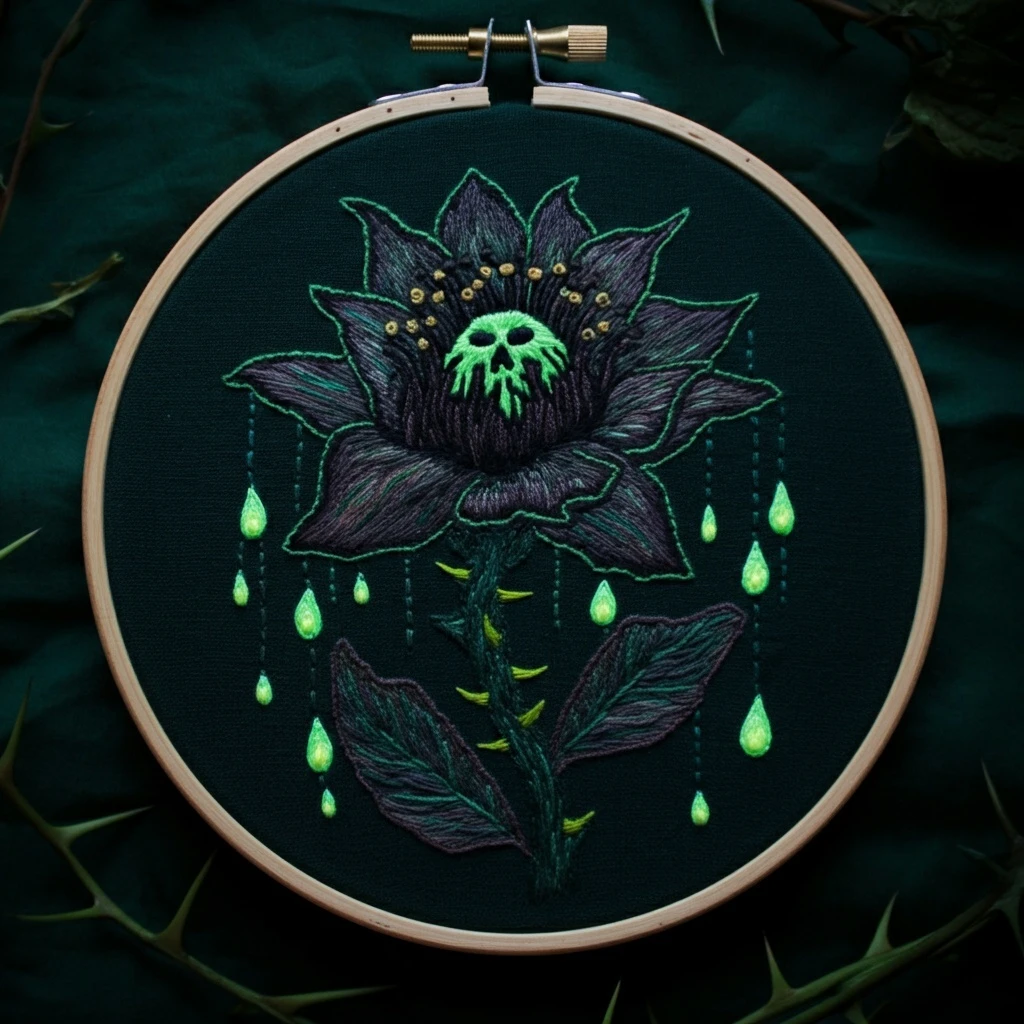
Colors estimated from the visible embroidery hoop preview and matched to close DMC embroidery floss shades. This design reads as a dramatic near-black flower with eerie acid-green glow, cool teal shadows, and dark violet petals on a black ground.
For the strongest result, lean into contrast: keep the petals moody and layered, make the center luminous, and reserve the brightest green for the skull motif, dripping drops, and select edge highlights.
Preview
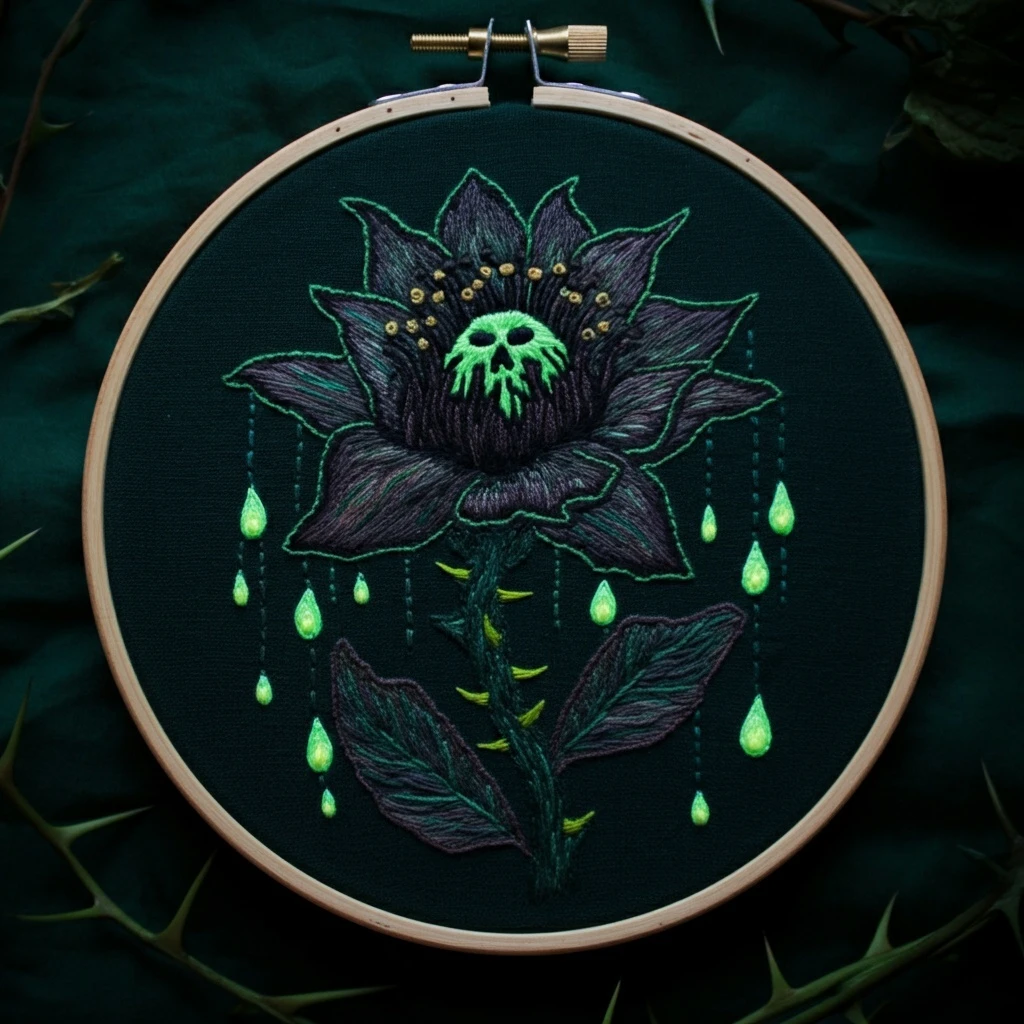
Reference image from the linked sample file. The design features a sinister flower with a glowing skull center, dotted stamens, trailing luminous drops, thorny stem, and two shaded leaves.
Likely DMC Color Palette
Palette based on the dark bloom, cool iridescent stitching, glowing green center and droplets, thorn accents, and tiny warm-gold pollen dots.
| DMC | Thread Name | Use Notes |
|---|---|---|
| 310 | Black | Deepest shadow accents, petal undersides, eye socket depth, and any tiny corrective outline on black fabric. |
| 154 | Grape Very Dark | Main petal shadow color; ideal for the bulk of the flower where it reads as black-violet instead of plain black. |
| 327 | Violet Dark | Midtone petal layering, leaf shadows, and transitions between the darkest petal fill and cooler highlights. |
| 3746 | Blue Violet Dark | Subtle cool highlights on petal ridges and leaf veins; use sparingly so the bloom keeps its moody look. |
| 500 | Blue Green Very Dark | Stem base color, dark leaf contours, and the cooler cast that gives the design its underwater-toxic undertone. |
| 501 | Blue Green Dark | Stem modeling, leaf transitions, and feathered highlights over the dark blue-green base. |
| 3810 | Turquoise Dark | Bright edge flickers within leaves and petals, plus the hanging stitched guide lines behind the flower. |
| 907 | Parrot Green Light | Main glow color for the skull center, bright droplet edges, and the luminous outline around the petals. |
| 704 | Bright Chartreuse | High-energy highlight on the skull center, thorn accents, and the lightest internal glow in the drops. |
| 471 | Avocado Green Very Light | Secondary green for blending the toxic glow into the darker stem and for softening transitions around thorns. |
| 680 | Old Gold Dark | Tiny pollen dots or seed-head accents around the center; gives a subtle warm contrast against the cold palette. |
| 3799 | Pewter Gray Very Dark | Optional tiny highlights on the skull forehead and selected droplet tips if you want a faint spectral sheen. |
Stitching Suggestions
The design benefits from layered direction changes so each petal, leaf, and droplet feels dimensional rather than flat.
| Element | Stitch Type | Notes |
|---|---|---|
| Main petals | Long and short stitch | Work from petal base outward, using 154 for the body and 327/3746 to sculpt ridges and folds. |
| Petal outlines | Split stitch or backstitch | Outline with 907 or a blend of 907 + 3810 to create a glowing edge instead of a harsh cartoon line. |
| Skull center | Satin stitch, split stitch | Pad lightly first if desired, then stitch the forehead and cheek shapes in 907 and 704. Keep the eye sockets darker so the center reads clearly. |
| Pollen dots | French knots | Use one or two wraps in 680. Scatter them evenly but not mechanically around the upper center. |
| Trailing drops | Satin stitch, detached chain | Outline or fill the droplets with 907, then add a lighter 704 highlight at the center or tip to make them feel wet and luminous. |
| Drip guide lines | Running stitch or backstitch | Use 1 strand of 3810 or 500 and keep the lines slightly broken so they fade into the background. |
| Stem | Stem stitch plus long and short stitch | Build the stem with dark blue-greens first, then feather in lighter teal stitches for organic twist and depth. |
| Thorns | Straight stitch or satin stitch | Small sharp stitches in 704 or 471 make the thorns pop without overpowering the stem. |
| Leaves | Fishbone stitch or long and short stitch | Use directional stitches radiating from the center vein. Introduce violet and teal together for an oily, eerie texture. |
Outlining, Texture & Order of Work
Working in a sensible order helps you keep the bloom clean and avoids crushing raised details later.
- Start with the flower body Stitch the main petals first so the design gains its silhouette and overall volume.
- Add center details next Complete the skull motif and pollen dots before moving into the hanging droplets.
- Build the stem and leaves This anchors the bloom and lets you echo the same cool shadows used in the petals.
- Finish with glows Save the brightest green outlines, thorn highlights, and final droplet highlights for the last pass.
- Outline lightly Use split stitch rather than thick backstitch wherever possible. A soft line blends better with filled stitching.
- Create petal texture Slightly vary stitch direction within each petal lobe to suggest folds and velvety surface texture.
- Make drops glossy Leave a narrow darker edge on one side and place the lightest highlight off-center, not directly in the middle.
- Keep empty space dark The black background is part of the drama. Do not overfill the negative space around the bloom.