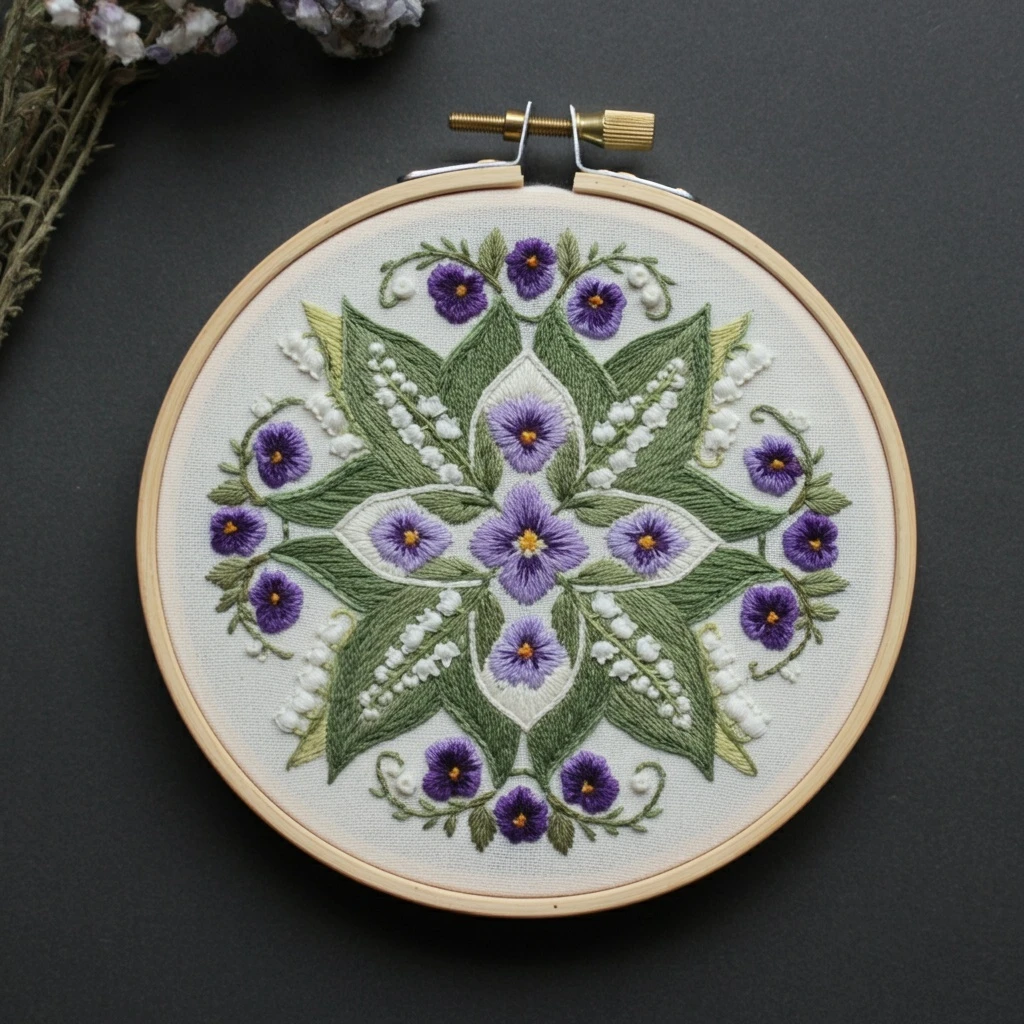

Violet and Lily of the Valley Mandala
A refined floral mandala guide built around velvety violet petals, pearl-white lily bells, fresh spring greens, and soft antique-gold accents for a balanced, heirloom-style hoop.
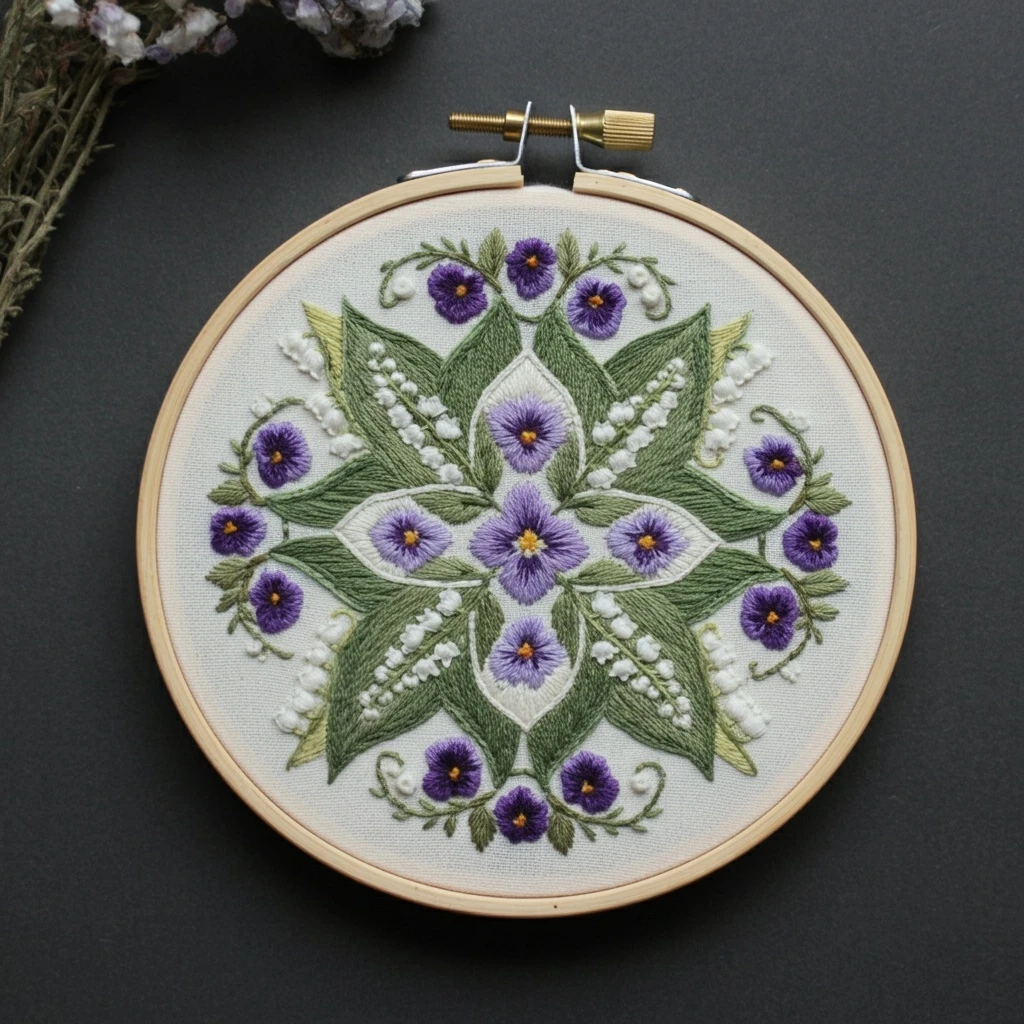
Color story
Use contrast rather than many similar shades: dark violet for petal depth, medium lavender for petal faces, pale lilac for lifted edges, creamy whites for the bell flowers, and two greens to separate soft stems from darker leaf shadows.
Overall mood
Elegant spring woodland, slightly vintage, with enough purple saturation to feel vibrant without overpowering the white bells.
Best fabric
Natural linen, warm white cotton, or pale oatmeal fabric. Avoid bright white fabric if using many lily-of-the-valley stitches, so the bells remain visible.
Hoop approach
Mark the vertical, horizontal, and diagonal axes first. In a mandala, symmetry is more important than dense filling.
Suggested DMC palette
Stitch plan
- Violet petals: long-and-short stitch with 2 strands. Start with DMC 333 at the petal base, blend into 552, then add 554 or 211 at the outer edge.
- Lily bells: padded satin stitch or small detached chain stitches with 1-2 strands. Use 746 for the face and 712 under the rim for shadow.
- Curved stems: stem stitch with 2 strands in 3012. For very fine stems, use 1 strand and keep tension relaxed.
- Leaves: fishbone stitch for larger leaves; straight stitch or fly stitch for smaller mandala repeats. Add 3051 to one side only for depth.
- Mandala dots: French knots in 3820, 746, or 554. Keep wraps consistent so the ring looks intentional.
- Outlines: split stitch with 1 strand of 333 for violet details; use 3051 for leaf outlines only where the shape needs definition.
Thread-count guidance
| Area | Strands | Why it works |
|---|---|---|
| Fine outlines and bell rims | 1 strand | Keeps the lily-of-the-valley delicate and prevents heavy cartoon lines. |
| Violet petal fills | 2 strands | Enough coverage for saturated color while still allowing smooth shading. |
| Leaf and stem structure | 1-2 strands | Use 2 strands on main arcs, 1 strand on tiny repeats near the center. |
| French knot accents | 2 strands | Creates visible decorative dots without bulky knots. |
| Padded centers or focal blooms | 3 strands max | Use only in the central motif or main violets for raised texture. |
Blending, shading & texture suggestions
Beginner sequence
Transfer the design, stitch the stems first, add leaves, fill violets, then stitch lily bells and finish with knots and outlines. This prevents white stitches from catching darker fibers.
Needle choice
A size 7-9 embroidery needle suits most areas. Use a sharper needle for dense satin sections and a slightly larger eye for blended two-color strands.
Tension tip
Keep the fabric drum-tight but do not pull satin stitches hard. Mandalas show puckering quickly, especially around the center.
Texture balance
Use smooth satin and long-and-short stitches for flowers, rope-like stem stitch for vines, and French knots only as accents so the design remains refined.
Substitutions
For a cooler palette, swap DMC 712 with 3865. For deeper violets, add DMC 550 to the darkest petal bases.
Finishing
Steam from the back over a towel, then mount with the vertical axis straight. A mandala looks best when the center is visibly aligned in the hoop.
Practical stitching notes
For the most polished result, keep the lily-of-the-valley bells airy and the violets rich. Let the greens form the circular skeleton of the design, then use purple and white as alternating focal points. When in doubt, reduce strand count rather than adding bulk; this design depends on crisp symmetry, graceful curves, and small repeated details.