
DMC palette & hand embroidery notes
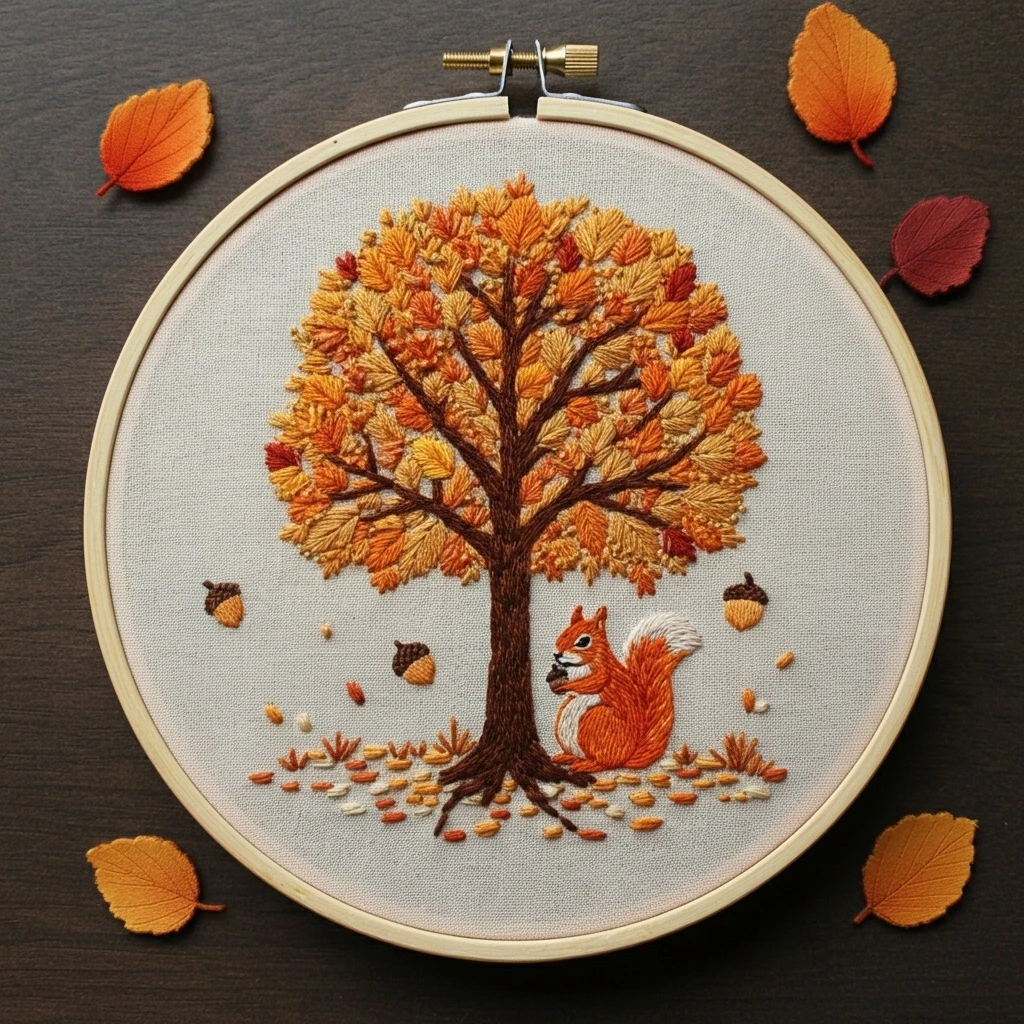
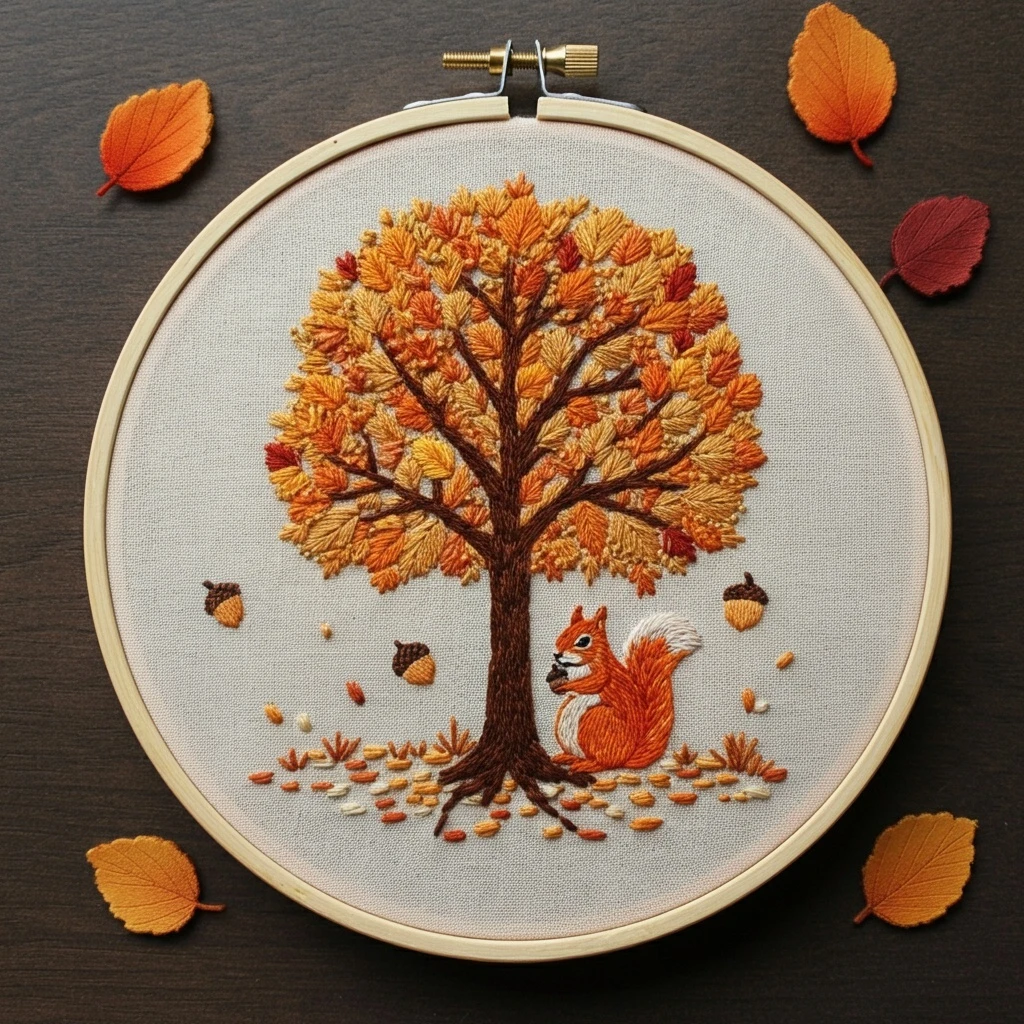
Autumn Squirrel And Maple Tree
A warm woodland guide for stitching a russet squirrel beneath a glowing maple tree, with practical DMC color choices, soft fur texture, bark definition, golden foliage, and beginner-friendly finishing advice.
Design read
This design is built around a sweet woodland subject: a squirrel posed near or beneath a maple tree, surrounded by fallen leaves and autumn warmth. The main visual story depends on contrast between soft animal texture, structured tree limbs, and bright leaf clusters.
Use the richest oranges and reds sparingly as focal pops in the maple leaves. Keep the squirrel slightly softer with layered browns, taupes, and cream highlights so it does not compete with the foliage.
Suggested DMC palette
A practical palette of warm browns, maple oranges, golden yellows, and shadow neutrals for a balanced autumn hoop.
Stitch map
| Area | Recommended stitches | Working notes |
|---|---|---|
| Squirrel body | Long and short stitch, split stitch, tiny straight stitches | Follow the body curve. Use 2 strands for the base and 1 strand for fur flicks around the tail and chest. |
| Tail | Layered long and short stitch, feather stitch | Curve the stitches outward from the spine of the tail. Blend 975, 976, 977, and small touches of 918. |
| Maple leaves | Satin stitch, fishbone stitch, detached chain | Work each leaf lobe separately so the maple shape remains crisp. Add one darker center vein. |
| Tree trunk | Stem stitch, split stitch, couching, seed stitch | Alternate 938, 975, and 976 in uneven vertical rows for rough bark texture. |
| Ground details | Straight stitch, lazy daisy, seed stitch | Scatter small leaf strokes in 783, 921, 922, and 3820; avoid overfilling the lower edge. |
| Face & paws | Back stitch, French knots, satin stitch | Use one strand for the eye, nose, whisker hints, toes, and mouth so the expression stays delicate. |
Thread-count guidance
- 1 strand: face, eye shine, whiskers, fine claws, thin leaf veins, final bark cracks, and delicate fur flicks.
- 2 strands: most squirrel fill, maple leaf fill, branches, and medium outlines. This gives good coverage without bulk.
- 3 strands: only for heavier trunk lines, bold outer tail curves, or large leaves on a 6 inch hoop or larger.
- Needle: size 7 or 8 embroidery needle for 2 strands; size 9 for single-strand detail.
Blending ideas
- Blend 975 + 977 for soft golden squirrel fur.
- Blend 918 + 921 for deep red-orange leaf shadows.
- Blend 976 + 938 for bark grooves and underside branches.
- Blend 3820 + 783 for glowing leaf tips without harsh yellow.
Outlining details
Use split stitch for the squirrel silhouette because it produces a soft edge that can be feathered into the fur. Use back stitch for leaf veins and small claws where crisp lines are useful.
Outline the tree with broken, uneven stem stitch instead of one continuous heavy line; this keeps the bark natural.
Texture suggestions
Add tiny seed stitches around the base of the tree for fallen leaves and woodland speckles. Use short directional stitches on the squirrel tail so it looks fluffy rather than flat.
A few French knots in dark brown can suggest acorns, bark knots, or seed pods.
Shading strategy
Start with the middle value first: DMC 975 or 976 for squirrel and bark, then add shadows with 938 and 918. Highlights should be small and purposeful, especially on the squirrel cheek, belly, top of the tail, and sun-facing leaf edges.
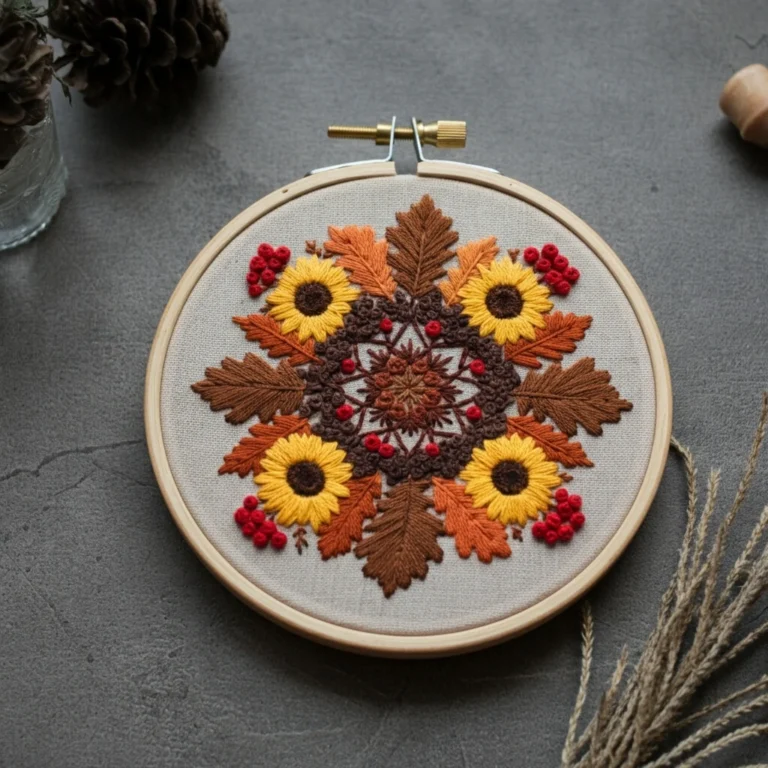
For leaves, use a simple three-step gradient: dark red copper near the base, copper or orange through the center, and topaz or straw on the outer tips. This gives the maple canopy a glowing autumn look while keeping the design readable.
Beginner-friendly tips
- Trace leaf veins lightly so you have a guide before satin stitching.
- Use shorter satin stitches on leaf lobes to prevent snagging.
- Rotate the hoop as you stitch the tail so your stitches follow the fur direction.
- Step back often; autumn pieces look best when the color balance feels lively, not perfectly even.
Practical stitching plan
- Anchor the tree: stitch trunk and branch structure in 975, then deepen grooves with 938 and 976.
- Block the squirrel: fill body and tail with 975/976, leaving tiny spaces for cream highlights on cheek and belly.
- Build fur texture: add 1-strand flicks in 977, 3863, and 918 following the direction of the tail and back.
- Add maple color: stitch leaves in small clusters, alternating 921, 922, 783, 3820, and 918 for natural variation.
- Finish with personality: add eye, nose, paws, whiskers, leaf veins, and scattered ground stitches last.