
Frog on a Toadstool
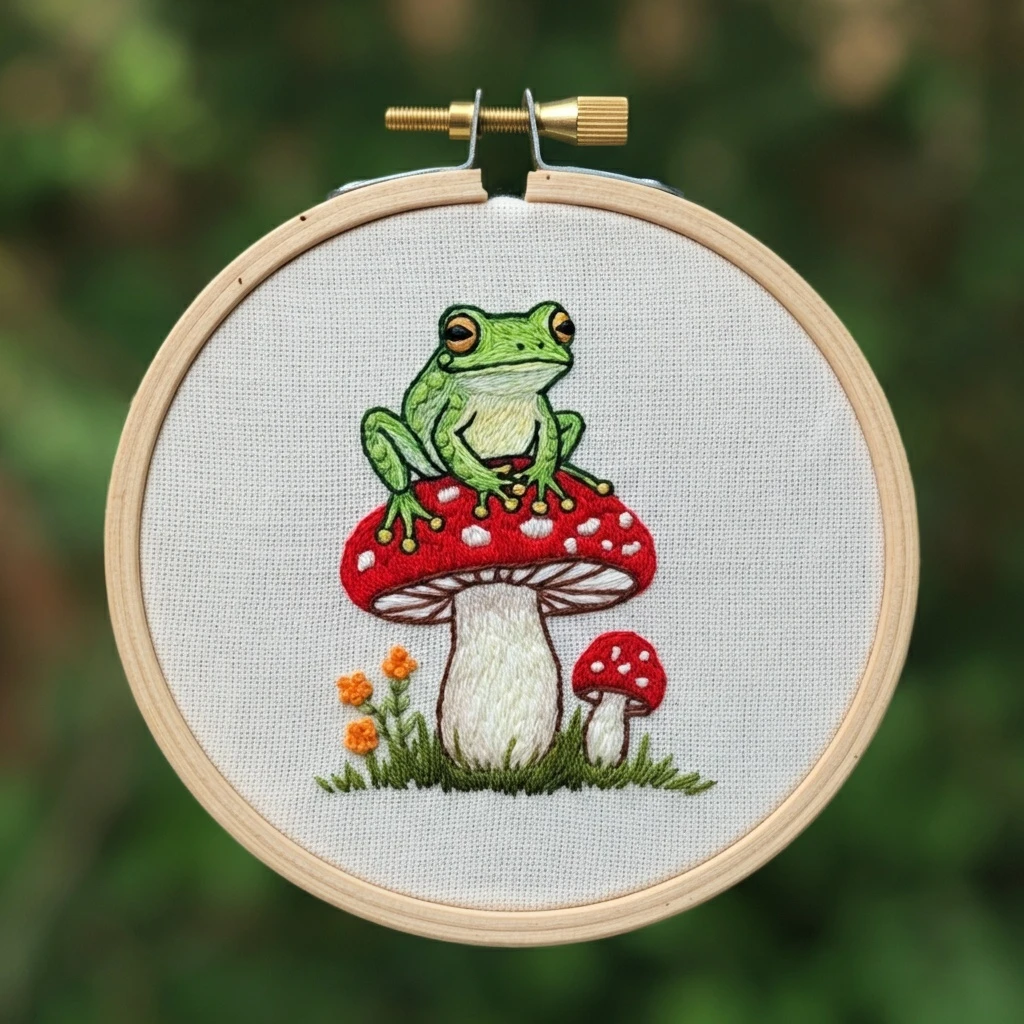
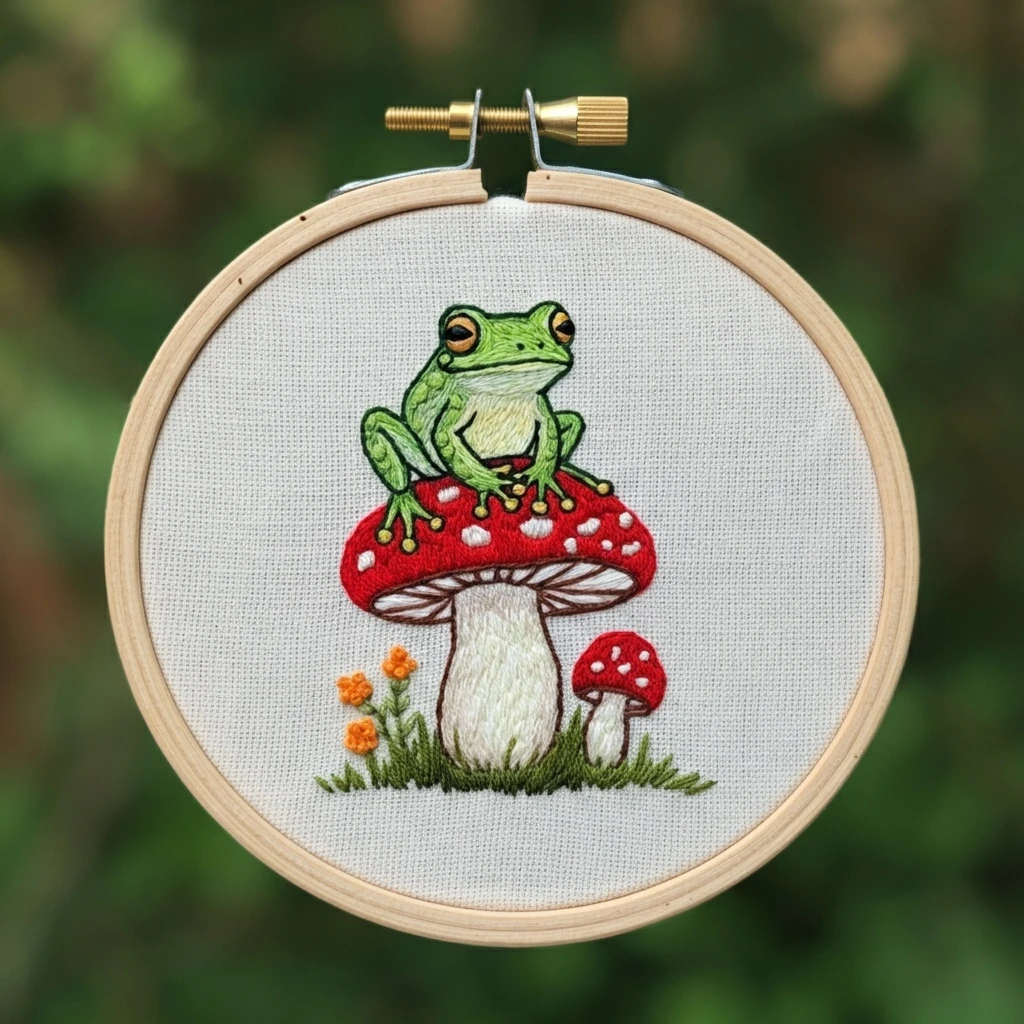
A cheerful woodland hoop with a bright green frog perched on a red-and-white fly agaric mushroom, a smaller side toadstool, fresh grass, and tiny orange wildflowers. The design works best with lively greens, a saturated red cap, creamy mushroom shading, warm golden eyes, and crisp dark outlining.
Suggested DMC Floss Palette
This palette keeps the frog fresh and dimensional while making the toadstool read bold from a distance. Use the darkest colors for narrow outlines only, then soften large fills with blended needles and directional stitches.
DMC 895 — Very Dark Hunter Green
Deep frog contours, crease lines at legs, and darkest grass bases. Use 1 strand for outlines so the face stays expressive, not heavy.
DMC 699 — Green
Main frog shadow and side planes, especially under the belly, behind the arms, and along folded legs.
DMC 704 — Bright Chartreuse
Primary frog body color. Work in short long-and-short stitches that follow the roundness of the head, back, and thighs.
DMC 907 — Light Parrot Green
Highlights on the frog’s crown, eyes, toes, and upper limbs. Mix one strand with 704 for a gentler transition.
DMC 3348 — Light Yellow Green
Pale belly and throat glow, plus small highlights on fingers. Keep coverage soft with 1–2 strands and visible stitch direction.
DMC 3011 — Dark Khaki Green
Muted olive accents for belly shadows, inner leg folds, and natural mottling on the frog’s sides.
DMC 3371 — Black Brown
Strongest outline color for pupils, mouth line, mushroom gill separators, and small facial details. Substitute 310 only for the pupils if desired.
DMC 783 — Medium Topaz
Golden iris rings and toe-tip warmth. A single satin ring around the pupil gives the frog a lively look.
DMC 817 — Very Dark Coral Red
Deepest toadstool cap shadows, especially along the lower rim and the small side mushroom.
DMC 666 — Bright Christmas Red
Main red cap fill. Use long-and-short or padded satin stitches following the mushroom dome curve.
DMC 3705 — Dark Melon
Warm red highlight on the cap’s upper center and side mushroom. Blend with 666 for a rounded cap.
DMC B5200 — Snow White
Bright mushroom spots and the cleanest catchlights in the eyes. Use padded satin or small French knots for raised dots.
DMC 3865 — Winter White
Main mushroom stem and underside highlight. Warmer than B5200, so it keeps the stem natural against linen.
DMC 822 — Light Beige Gray
Soft mushroom stem shading and pale underside shadows. Blend with 3865 for a creamy, rounded stalk.
DMC 801 — Dark Coffee Brown
Mushroom gills, rim lines, and earthy shadow beneath the cap. Best in fine back stitch or split stitch.
DMC 936 — Very Dark Avocado Green
Grass shadows at the base and darker stems behind the mushroom. Use vertical straight stitches of mixed lengths.
DMC 469 — Avocado Green
Main grass blades and flower stems. Combine with 936 and 3346 for a natural cluster instead of one flat green.
DMC 740 — Tangerine
Orange flower petals. French knots, colonial knots, or tiny lazy daisies create compact woodland blossoms.
DMC 741 — Medium Tangerine
Flower highlights and small petal centers. Add last so the blossoms sit brightly over the greenery.
DMC 318 — Light Steel Gray
Subtle shadow on white mushroom spots and cool underside edges. Use only a few tiny stitches to preserve the white areas.
Stitch Map by Design Area
Frog body and face
- Use split stitch for the outer contour, then fill with long-and-short stitch that follows the rounded head, back, and thighs.
- Blend 704 + 907 for sunlit areas and 699 + 3011 for side shadows.
- Keep the mouth and nostrils in 1 strand of 3371; tiny details make the expression read clearly.
Eyes and toes
- Work the iris with satin stitch in 783, outline lightly with 3371, and add a single B5200 catchlight.
- Use small satin stitches or colonial knots for rounded toe tips.
- Leave a hairline of dark green between toes so they do not merge visually.
Main toadstool cap
- Pad the red dome lightly with under-stitches, then cover with satin or long-and-short stitches following the curve.
- Shade the lower rim with 817, fill the center with 666, and brighten the top with 3705.
- Stitch white spots after the red fill so they sit cleanly on top.
Mushroom stem and gills
- Use vertical split stitch in 3865 and 822 for the stem, tapering toward the top.
- Back stitch gill spokes with 801, then soften with a few 822 stitches between lines.
- Outline the cap underside with 3371 or 801 depending on how bold you want the rim.
Grass and ground
- Use straight stitch and fly stitch in 936, 469, and 3346/3348 tones.
- Vary blade height to avoid a comb-like edge.
- Let some blades overlap the mushroom stem slightly for a planted, dimensional look.
Orange flowers
- Use small French knots or colonial knots in 740 with 741 highlights.
- For petal shapes, make five tiny detached chain stitches around a knot center.
- Stitch stems first, then petals, then a final bright knot on top.
Thread Counts, Blending & Texture
| Area | Recommended strands | Practical guidance |
|---|---|---|
| Fine outlines | 1 strand | Use 3371, 895, or 801 for facial details, gills, toes, and cap edges. One strand keeps the illustration delicate. |
| Frog fill | 2 strands | Use long-and-short stitch with blended needles: 704 + 907 for highlights, 699 + 3011 for shaded folds. |
| Red mushroom cap | 2 strands, optional padding | For a plump cap, add loose under-stitches in 817/666, then cover with smooth curved satin rows. |
| White spots | 2 strands or knots | Small spots work as French knots; larger spots look clean in padded satin with a tiny 318 shadow on the lower edge. |
| Grass and stems | 1–2 strands | Use 1 strand for skinny blades in the front and 2 strands for heavier clumps behind the mushrooms. |
| Flowers | 2–3 strands | Use 2 strands for lazy-daisy petals, 3 strands for raised knots if you want the flowers to pop from the hoop. |
Beginner-Friendly Stitching Sequence
Transfer only essential lines
Mark the frog outline, eyes, limbs, mushroom cap edge, stem, major spots, grass base, and flower positions. Avoid drawing every grass blade; stitched variation looks more natural.
Stitch the mushroom foundation
Work the stem and underside first, then the red cap. Keep cap stitches curved from the center top toward the rim so the dome feels rounded.
Build the frog from shadow to highlight
Place dark green crease lines and body shadows first. Fill mid-greens, then add light yellow-green highlights on the crown, cheeks, knees, and toes.
Add eyes and expression carefully
Use tiny satin stitches for irises and a single white catchlight. Stitch the mouth line slowly in one strand so it stays smooth and friendly.
Finish with texture
Add mushroom spots, grass blades, orange blossoms, and any final pale highlights last. These top stitches should remain crisp and raised.
Shading & Finishing Tips
Soft shading
- Use short staggered stitches instead of hard color blocks on the frog belly.
- Blend one light and one mid green in the needle where the frog turns toward the light.
- Reserve 907 and B5200 for the smallest highlights so they stay special.
Clean presentation
- Trim red thread tails before stitching white spots so the red does not show through pale areas.
- Press from the back on a folded towel to protect knots and padded spots.
- Keep the fabric taut but not stretched; the round mushroom and frog face distort easily if over-tightened.
The strongest visual contrast is the bright frog sitting on the red cap, so keep those areas smooth and deliberate. Let the grass and flowers stay a little looser: irregular lengths, tiny knots, and mixed greens make the woodland base feel lively without competing with the central character.