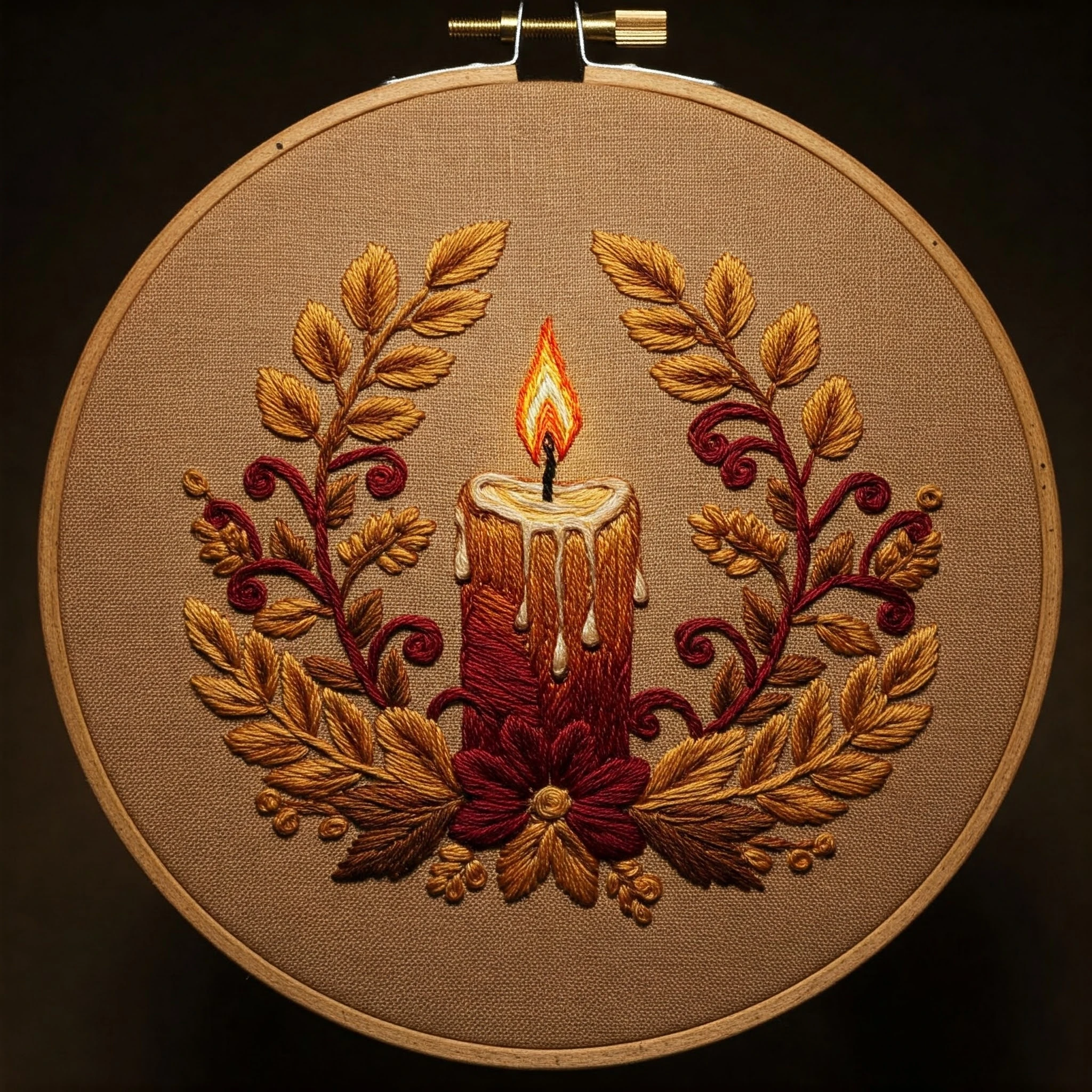

DMC palette & hand embroidery notes
Autumnal Candle Wreath
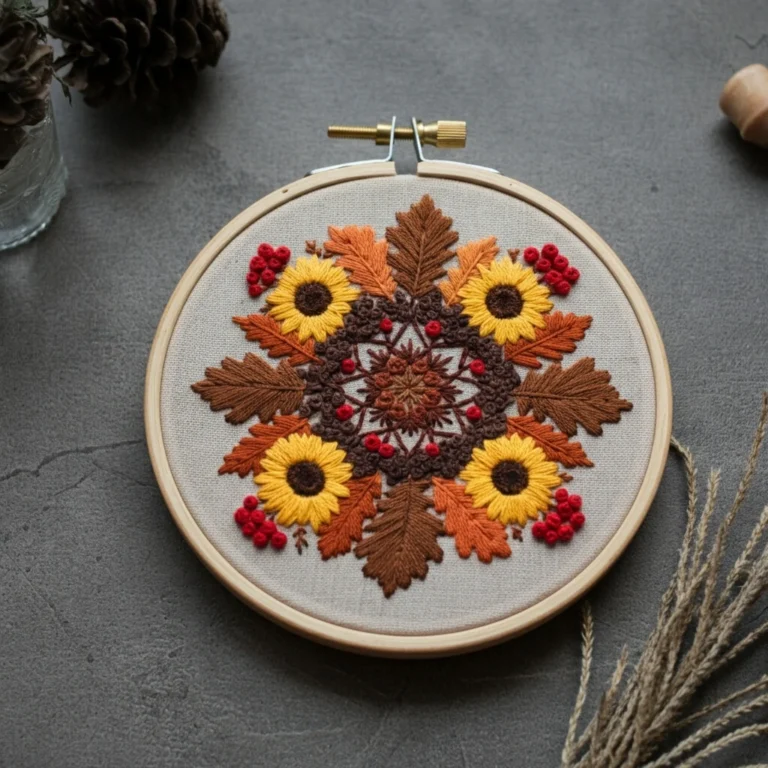
A warm, polished guide for stitching an autumn candle surrounded by a seasonal wreath of leaves, berries, sprigs, and harvest foliage. The palette balances creamy candlelight, honey-gold flame, copper and russet leaves, cranberry berries, muted olive greenery, and dark walnut stems for a cozy hoop with a soft glowing center.
Design read
This design works best when the candle feels calm and luminous while the wreath provides motion and texture. Keep the candle body smooth, vertical, and softly shaded, then let the surrounding leaves curve around it in a loose oval or circular frame.
Use the brightest yellows sparingly in the flame and candle glow. Copper, rust, and golden-brown shades should carry the autumn leaves, while olive and walnut threads keep the wreath structure grounded. Cranberry berries add small, polished points of contrast.
Suggested DMC palette
Use this palette to capture the soft candle center and the rich autumn wreath around it. The use notes help place each shade in a practical, stitch-friendly way.
Stitch map
| Area | Recommended stitches | Working notes |
|---|---|---|
| Candle body | Satin stitch, split stitch outline, long-and-short stitch | Use 3865 for the lightest wax and 739 for side shading. Keep stitches vertical and smooth so the candle reads as calm and polished. |
| Flame and glow | Long-and-short stitch, satin stitch, tiny straight stitch | Place 726 at the flame center, 783 around it, and a few 921 touches at the base for warmth. Use short stitches to keep the flame delicate. |
| Wreath stems | Stem stitch, split stitch, couching | Work the main wreath ring in 801 with 2 strands. Add 3371 only in tucked-under shadow areas. |
| Autumn leaves | Fishbone stitch, satin stitch, detached chain, fly stitch | Blend 921, 922, 918, 920, and 783. Angle the stitches outward from the central vein to give each leaf a natural fold. |
| Berries | French knots, colonial knots, padded satin dots | Use 815 for deeper dots and 816 for visible highlights. Keep berry clusters uneven for a natural wreath look. |
| Seed sprigs | Straight stitch, fly stitch, seed stitch | Use 783, 739, and 3012 for light harvest sprigs that frame the candle without crowding it. |
Thread-count guidance
- Candle outline: 1 strand in 739 or a very light brown keeps the wax edge soft and avoids a cartoon outline.
- Candle fill: 2 strands for satin or long-and-short areas; use shorter stitches near curved top and base edges.
- Flame: 1 strand for fine blended stitches, or 2 strands only if the flame is large in the hoop.
- Main wreath stems: 2 strands in 801; add 1-strand tendrils after the leaves are finished.
- Leaves: 2 strands for large fishbone or satin leaves; 1 strand for veins, tiny edges, and color corrections.
- Berries: 2 strands for French knots; wrap twice for small berries and three times for a fuller focal cluster.
Blending ideas
- Blend one strand 3865 with one strand 739 for creamy candle side shading.
- Blend one strand 726 with one strand 783 for a rich flame halo.
- Blend one strand 921 with one strand 783 for glowing orange-gold leaves.
- Blend one strand 918 with one strand 920 for russet leaves tucked behind the candle.
- Blend 3012 with 739 for dry sage-gold filler sprigs.
Outlining details
- Use 1-strand split stitch around the candle so the edge stays refined.
- Outline only selected leaves; broken outlines look softer than tracing every leaf completely.
- Use 801 for warm twig outlines and reserve 3371 for the wick and deepest overlaps only.
- Whip a few back-stitched stems with 975 or 783 if you want a golden vine effect.
Texture suggestions
- Contrast the smooth candle with textured French-knot berries and seed stitches.
- Alternate filled leaves with lazy-daisy leaves so the wreath feels light rather than heavy.
- Add tiny straight-stitch sparks around the flame in 739 or 783, but keep them sparse.
- Use small gaps between wreath elements to preserve the candle’s peaceful negative space.
Shading plan & practical stitching tips
| Step | What to do | Why it helps |
|---|---|---|
| 1. Mark the center | Lightly mark the candle, wick, flame, and wreath curve before stitching. | The design depends on symmetry; a clear center line keeps the candle upright and the wreath balanced. |
| 2. Stitch the stems | Work the main wreath stems in 801 with small stem stitches, turning gradually around the candle. | A clean stem framework gives the leaves and berries a natural path to follow. |
| 3. Build candlelight | Fill the candle with 3865, shade the sides with 739, then stitch the flame with 726 and 783. | Doing the candle before crowded foliage keeps the central shape smooth and easy to control. |
| 4. Layer the leaves | Add large copper leaves first, then smaller olive and golden leaves to fill gaps. | Large shapes set the rhythm, while muted greenery prevents the palette from becoming too orange. |
| 5. Add berries and final detail | Place cranberry French knots, seed sprigs, one-strand veins, and a dark wick last. | Final details sharpen the design without flattening the earlier soft shading. |