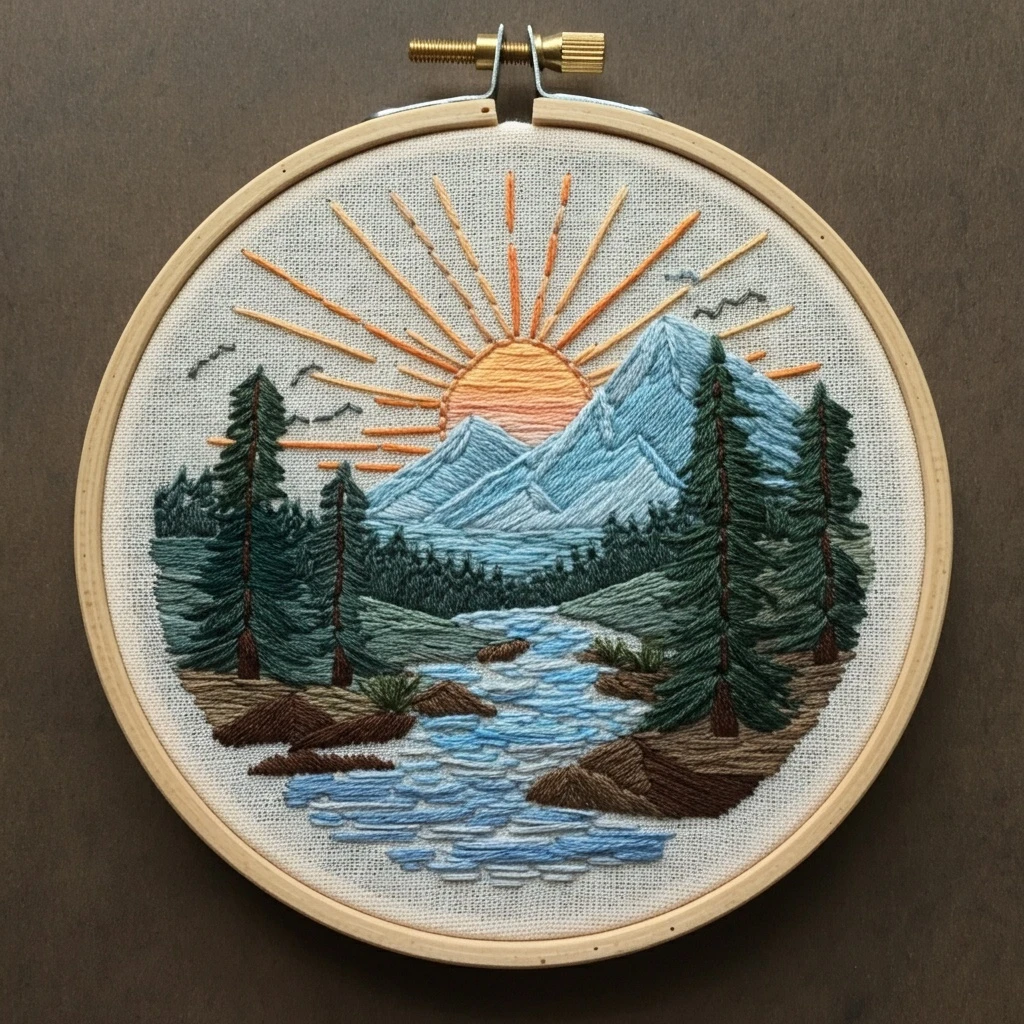

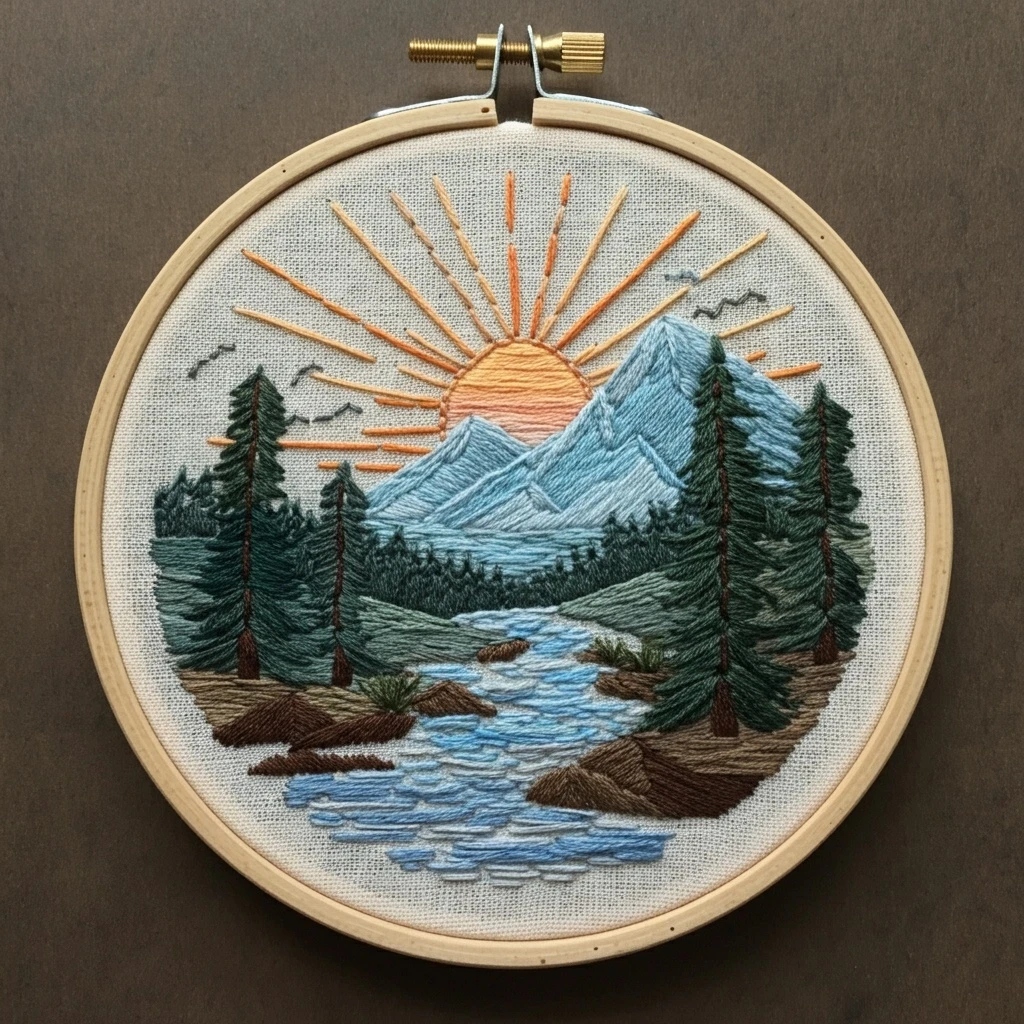

Forest River Sunrise
A calm woodland landscape built around cool blue mountains, layered evergreen silhouettes, a reflective river, warm sunrise rays, and earthy banks. The stitching should feel painterly: long directional fills for the slopes, loose ripples for the water, crisp pine outlines, and glowing orange accents around the sun.
Suggested DMC Floss Palette
Use the cooler blues and blue-greens as the visual anchor, then reserve the oranges for the sun so the sunrise stays bright. Dark pine colors should be used sparingly in foreground outlines and trunks to keep the river from feeling heavy.
Stitch Map & Texture Plan
| Area | Best stitches | Thread guidance | Practical notes |
|---|---|---|---|
| Sun disk & rays | Satin stitch, straight stitch, split stitch outline | 2 strands for rays; 1 strand for the circular outline; blend 3825 + 758 for soft fill. | Stitch rays from the sun outward so the ends taper naturally. Keep the disk slightly textured with horizontal satin or long-and-short rows rather than perfectly flat satin. |
| Mountains | Long and short stitch, stem stitch ridge lines, split stitch borders | 1 strand for ridge detail; 2 strands for filled slopes. Blend 928/927 for highlight planes and 926/932 for shadow planes. | Follow the direction of each slope. Change stitch angle at ridge breaks so the mountains read as folded planes rather than one flat blue shape. |
| River | Loose horizontal straight stitches, seed stitch, whipped running stitch | 2 strands for main ripples; 1 strand of 3753 for sparkling highlights. | Leave tiny linen gaps between ripple rows. Stagger blue values so the water looks reflective, with darkest 931 near bank edges and under foreground stones. |
| Pine trees | Stem stitch trunks, fly stitch or angled straight stitch boughs, couching for heavy limbs | 2 strands for foreground boughs; 1 strand for distant tree silhouettes. | Start with trunk lines in 938, then add boughs from top to bottom. Alternate 500, 501, and 502 to create depth without overfilling. |
| Riverbanks & rocks | Long and short stitch, split stitch, satin stitch for small rocks | 2 strands for soil blocks; 1 strand for rock cracks and contour lines. | Angle stitches diagonally along the bank. Add a few dark 938 stitches under rocks to make them sit on the ground. |
| Birds & tiny details | Back stitch, tiny detached chain, single straight stitches | 1 strand only. | Keep the birds simple and slightly irregular. A few dark gray-green stitches are enough; over-detailing can distract from the landscape. |
Blending, Shading & Outlining
Mountain gradients
Thread-paint the slopes with short overlapping rows. A clean blend is 928 → 927 → 926, with small touches of 932 where the mountain color leans blue. Keep the highest ridge lines pale and stitch shadows on the downward-facing planes.
Water reflection
Mix one strand 932 with one strand 3753 for bright water, then shift to 931 near the banks. Use broken, uneven stitches rather than continuous lines; the gaps make the river sparkle against the fabric.
Evergreen depth
Use 934 or 500 for the inside of foreground pines, 501 for most boughs, and 502 only on outer tips. The darkest values should sit close to the trunk and under overlapping branches.
Warm sunrise glow
Blend 3825 with 758 inside the sun, then use 722 for the rays and strongest rim. Keep the rays raised and clean by using straight stitch with even tension rather than wrapping or overworking them.
Outlining tip: Use split stitch for the mountain edges and riverbanks because it creates a soft embroidered line. Use back stitch only where you need sharper definition, such as tree trunks, tiny birds, and the darkest rock edges.
Beginner-Friendly Working Order
- Transfer lightly: Mark the sun circle, mountain ridges, main river edges, tree trunks, and large bank shapes. Do not draw every ripple; stitch those freehand.
- Work back to front: Stitch sun and rays first, then mountains, distant tree line, river, banks, foreground pines, rocks, and final birds.
- Control thread bulk: Use 1 strand for outlines, distant trees, birds, and ridge details; use 2 strands for most fills; use 3 strands only for bold foreground pine tips if you want extra texture.
- Mind the hoop tension: The long directional stitches in the mountains and river look best on taut fabric. Re-tighten before large satin or long-and-short areas.
- Test colors first: Make a small row of river blues and pine greens on scrap linen. Cool colors can darken visually once densely stitched.
- Finish with highlights: Add 3753 water glints and 928 mountain ridges last so they stay clean and bright.
Thread Count Quick Guide
1 strand
Fine outlines, birds, ridge lines, delicate water highlights, distant tree suggestions, and tiny grass clumps.
2 strands
Main fill for mountains, river, pine boughs, sun disk, rocks, and riverbanks. This should be the default for the design.
3 strands
Optional only for foreground pine texture or heavy dark accents. Use sparingly so the hoop remains clean and detailed.