
DMC Palette & Stitching Notes
Enchanted Bioluminescent Mushroom Forest
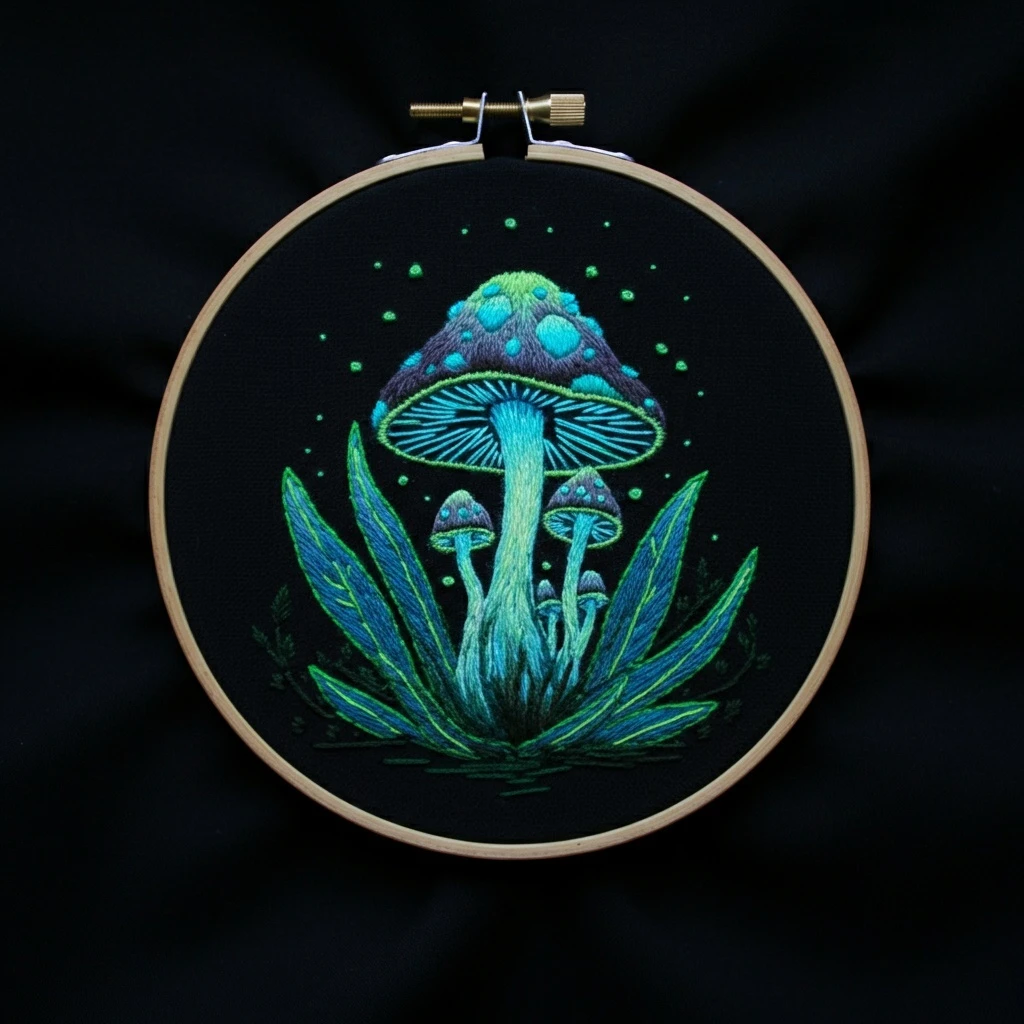
A dramatic black-fabric hoop with glowing teal mushroom gills, aqua stems, lime-green spores, blue-green leaves, and deep violet cap shadows. The palette below is estimated from the visible preview and matched to practical DMC embroidery floss choices for a luminous woodland finish.
Likely DMC Color Palette
Choose luminous blue-greens for the mushroom light, reserve lime for the glowing spores and cap highlights, and use blue-violet sparingly to deepen the mushroom caps. Coverage percentages are visual estimates, not exact thread usage.
Stitching Suggestions
This design depends on contrast: keep the darkest fabric visible, then layer glowing stitches only where the mushrooms and spores should appear lit from within.
| Element | Recommended stitch | Practical notes |
|---|---|---|
| Main mushroom cap | Long and short stitch | Begin with 333 along the shaded lower cap, work 3746 through the middle, then feather in 906 and 907 near the glowing top. Keep stitches curved to follow the dome shape. |
| Cap spots | Satin stitch, padded satin, or tiny long and short | Use 3846 for the brightest turquoise spots, 3845 for shadowed spots, and a dot of 964 on the upper edge to make them look wet and luminous. |
| Underside gills | Straight stitch and backstitch | Radiate 1-strand 3846 and 964 from the central underside. Leave small black gaps between gill rays so the light effect stays crisp. |
| Central stem | Split stitch filling or long and short stitch | Use 959 as the body, 958 for raised ridges, and 964 down the brightest center line. Add a few 3818 strokes at the base for depth. |
| Small mushrooms | Satin stitch caps, split stitch stems | Scale down the stitch length. Use violet on the cap sides, turquoise dots on the tops, and pale sea green on the stems so they echo the main mushroom without competing. |
| Large leaves | Fishbone stitch, stem stitch, and straight stitch | Outline leaves in 699 or 906, fill with directional 3818 and 959, then add thin 995 or 3845 streaks for the blue veins seen in the preview. |
| Forest floor grasses | Straight stitch, fly stitch, and seed stitch | Layer 890 and 500 first, then add brighter 906 strokes in front. Keep lower stitches uneven and wispy for a natural, mossy base. |
| Floating spores | French knots, colonial knots, seed stitch | Use 907 for most dots, with 964 for a few icy highlights. Vary one-wrap and two-wrap knots so the glowing particles feel organic. |
| Cap rim glow | Whipped backstitch or stem stitch | Work a fine 906 line around the cap edge, then whip selected sections with 907 or 964 to create a clean neon rim. |
| Background fern silhouettes | Single-strand straight stitch | Use 890 or 500 and keep these stitches sparse. They should support the scene, not distract from the glowing central mushrooms. |
Thread Count & Blending Plan
- 1 strand: gill rays, spore dots, thin blue leaf streaks, cap rim outline, and background fern silhouettes.
- 2 strands: most stem filling, leaf bodies, mushroom cap shading, and large turquoise cap spots.
- 3 strands: padded satin spots or extra-raised French knots where you want the glow to feel tactile.
- Blended needle idea: combine one strand 959 + one strand 958 for glowing stems, or one strand 333 + one strand 3746 for a smoother violet cap shadow.
- Glow blend: use one strand 907 + one strand 964 for the brightest spore knots and the cap rim, but only in a few places so it stays magical rather than flat.
Outlining & Shading Guidance
- Preserve dark gaps: the black fabric is part of the artwork. Do not overfill the gills, leaf spaces, or cap shadows.
- Curve with the form: cap stitches should arc over the dome; stem stitches should run vertically with slight waviness.
- Make light directional: place the brightest 964 and 907 on raised centers, dots, and upper edges, then let 500 and 3818 recede at the base.
- Outline selectively: use 906 or 699 for leaf edges, but avoid heavy outlines around every tiny spore; loose dots look more natural.
- Layer after filling: stitch cap spots and glowing rim after the cap base is complete so the highlights sit cleanly on top.
Texture Suggestions
Use contrast in stitch height as well as color. Smooth fills make the mushrooms feel solid, while raised knots make the spores and cap spots sparkle against the dark fabric.
| Texture goal | How to create it |
|---|---|
| Glowing cap spots | Add a small base stitch in 3845, cover with satin stitch in 3846, then place a short 964 highlight on the top-left edge. |
| Ribbed stem | Fill the stem with split stitch, then add a few long vertical 958 and 964 strokes over the top to imitate ridges. |
| Sharp gills | Use single-strand straight stitches and anchor each ray carefully. A tiny backstitch line at the outer rim helps the gills read clearly. |
| Mossy base | Scatter short straight stitches in 500, 890, 3818, and 906. Mix lengths so the base feels like uneven woodland growth. |
| Magic spores | Place French knots after all major stitching is finished. Keep some dots tiny with seed stitch and make only a few larger knots. |
Beginner-Friendly Practical Tips
- Use a sharp needle on black fabric: it helps split stitch and long-and-short shading sit neatly without tugging the weave.
- Work with strong light: a lamp or white cloth on your lap makes dark fabric much easier to stitch on.
- Shorten your thread: use 12–15 inch lengths for turquoise and lime shades so they stay smooth and bright.
- Start from the center: stitch the large mushroom stem and underside first, then add caps, leaves, smaller mushrooms, and floating dots.
- Test knots on scrap fabric: one-wrap knots are best for distant spores; two-wrap knots are better for foreground light dots.
Suggested Stitching Order
- 1. Transfer lightly: use a white water-soluble pencil or stabilizer so the lines remain visible on black fabric.
- 2. Anchor the main shapes: stitch central stem, cap outline, and underside gill guide lines.
- 3. Fill the cap and stems: build violet shadows first, then add teal and pale sea-green highlights.
- 4. Add leaves and forest floor: work from dark greens to brighter blue-green streaks.
- 5. Finish with magic: add cap spots, rim glow, French-knot spores, and a final pass of bright highlight stitches.
Encouraging Finish
This hoop will look most enchanting when the stitches feel like they are glowing out of the dark fabric. Let the black background remain visible, keep the gill rays fine, and save the brightest lime and pale aqua for the final pass. A few careful highlights will make the entire mushroom forest feel bioluminescent.
Tip: before framing, view the hoop from arm’s length. If the center mushroom glows clearly and the leaves frame it without crowding it, the balance is right.