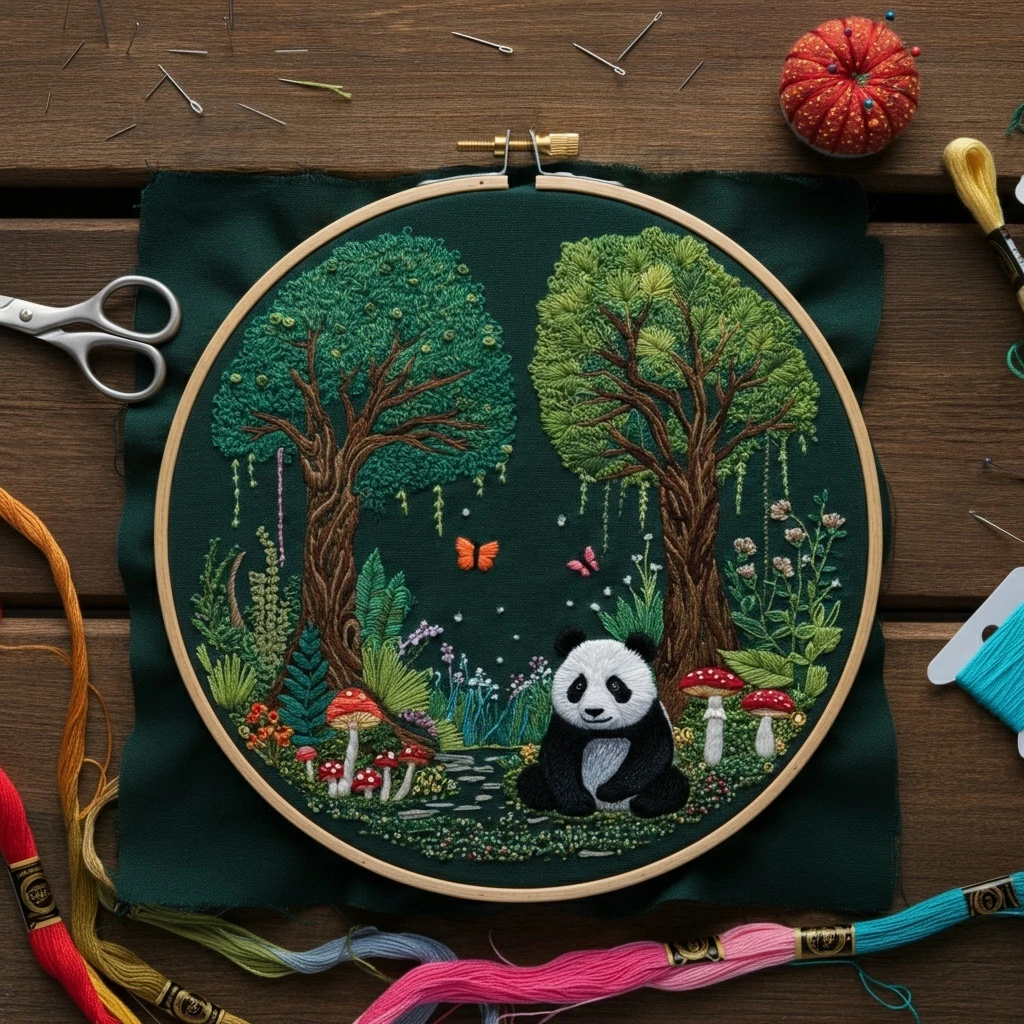

Enchanted Forest Panda
A gentle woodland embroidery guide for a panda framed by enchanted forest greenery: high-contrast black and ivory fur, bamboo-like leaves, mossy textures, warm bark, and small golden or floral accents that keep the hoop soft, storybook, and dimensional.
Design read
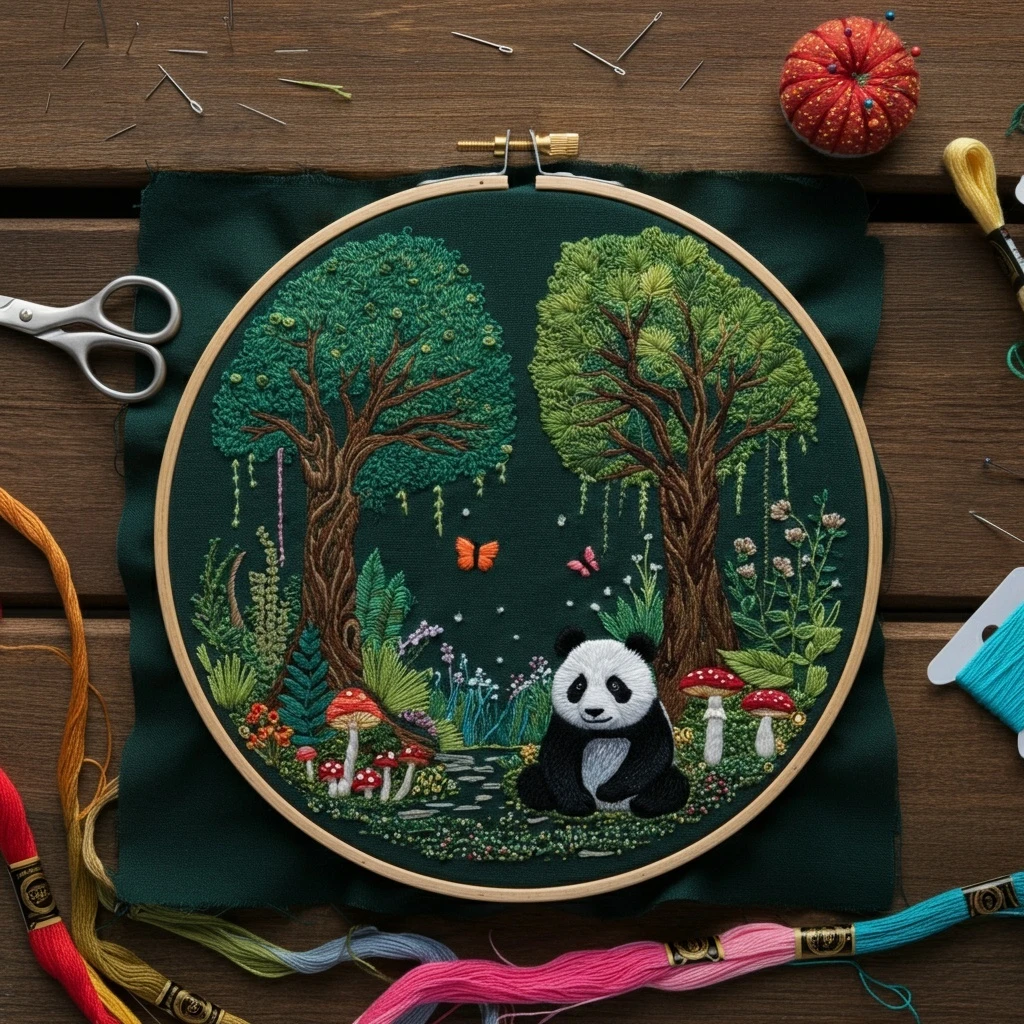
The main contrast is the panda itself: soft ivory fur against charcoal-black ears, eye patches, legs, and arm shapes. Around it, layered greens suggest bamboo leaves, forest foliage, moss, and a natural woodland setting.
For a polished finish, keep the panda smooth and plush while letting the surrounding forest become more textured with knots, detached chains, fly stitches, and fine stems.
Likely DMC Color Palette
These DMC matches are chosen for the visible panda-and-forest theme: clean panda neutrals, deep outlines, bamboo greens, earthy bark, moss, and tiny warm accent notes.
Stitching Suggestions
| Element | Stitch Type | Notes |
|---|---|---|
| Panda white fur | Long-and-short stitch, split stitch, soft satin stitch | Use 822 as the main fill, shade gently with 642, and add a few 3865 stitches on the forehead, cheek, and belly highlights. |
| Panda black patches | Long-and-short stitch, satin stitch, split stitch | Build dark areas with 3799 first, then add 310 where the eye patch, ears, nose, and paws need crisp contrast. |
| Facial details | One-strand backstitch, tiny satin stitch, single straight stitch | Use one strand for the nose, mouth, eye shape, and eye shine. Small details look cleaner when stitched after all fur fills are complete. |
| Bamboo leaves | Fishbone stitch, detached chain, straight stitch | Work leaves from the base outward. Mix 3364, 3052, and 734 so the bamboo has natural light and shade. |
| Forest foliage | Fly stitch, seed stitch, detached chain | Place darker greens behind the panda and lighter greens around the edges for depth. Keep the foliage airy near the face. |
| Moss and ground | French knots, colonial knots, short straight stitches | Cluster knots in 3363 and 3052 around the panda’s base; add a few lighter knots in 3051 for cushiony moss texture. |
| Branches and bark | Stem stitch, whipped backstitch, split stitch | Use 801 for structure, 975 for warm ridges, and a touch of 3371 or 310 only in the deepest bark cracks if needed. |
| Tiny flowers or magical accents | French knots, lazy daisy, seed stitch | Add 725 as small final dots or flower centers. These should support the forest atmosphere rather than compete with the panda. |
| Final outlines | Fine backstitch or split stitch | Outline the panda selectively: dark around ears and paws, softer gray-beige around white fur so the edge stays plush. |
Thread Count, Blending & Shading Guidance
Fur strand count
Use 2 strands for most panda fur fills. Switch to 1 strand for face details, eye shine, fur wisps, and tiny contour corrections around the muzzle.
Black fur softness
Do not fill every dark patch with solid 310. Use 3799 as a base and reserve 310 for the darkest centers and outlines; this keeps the fur dimensional.
White fur shading
Blend 822 with 642 in shadowed lower areas, then add 3865 only at the end for small lifted highlights.
Bamboo blends
Try one strand of 3364 plus one strand of 3052 for natural mid-green leaves, or one strand 3051 plus one strand 734 for light tips.
Texture contrast
Keep the panda smooth and the forest textured. Knotted moss and leafy stitches will make the animal look softer by comparison.
Color balance
Warm browns and small topaz accents help offset the cool black-white panda palette. Use them in bark, seed pods, and tiny flower centers.
Outlining, Shading & Texture Suggestions
Outlining details
- Use 310 for the nose, ears, paws, and strongest eye patch edges.
- Use 317 or 642 around white fur so the outline does not look harsh.
- Break outlines into short stitches for a furrier edge.
Shading guidance
- Place shadows under the chin, belly, and lower paws.
- Keep the face brighter than the body to draw attention to the expression.
- Use darker greens behind the panda to make the light fur stand out.
Texture ideas
- Use French knots for moss, berries, and tiny flowers.
- Use detached chains for bamboo leaves and small foliage.
- Add a few single-strand fur wisps around cheeks and ears.
Beginner-friendly shortcuts
- Use satin stitch for the smaller black patches if long-and-short feels difficult.
- Limit the forest to three greens for a simpler palette.
- Stitch the face details last so they stay crisp.
Where to Start
Encouraging finish
This design will look best when the panda stays smooth, rounded, and expressive while the enchanted forest around it becomes layered and tactile. Work with short thread lengths for the black and white fur, re-tighten the hoop before adding tiny facial details, and press only from the back over a towel to protect raised moss and knot texture.