
DMC floss palette & hand embroidery notes
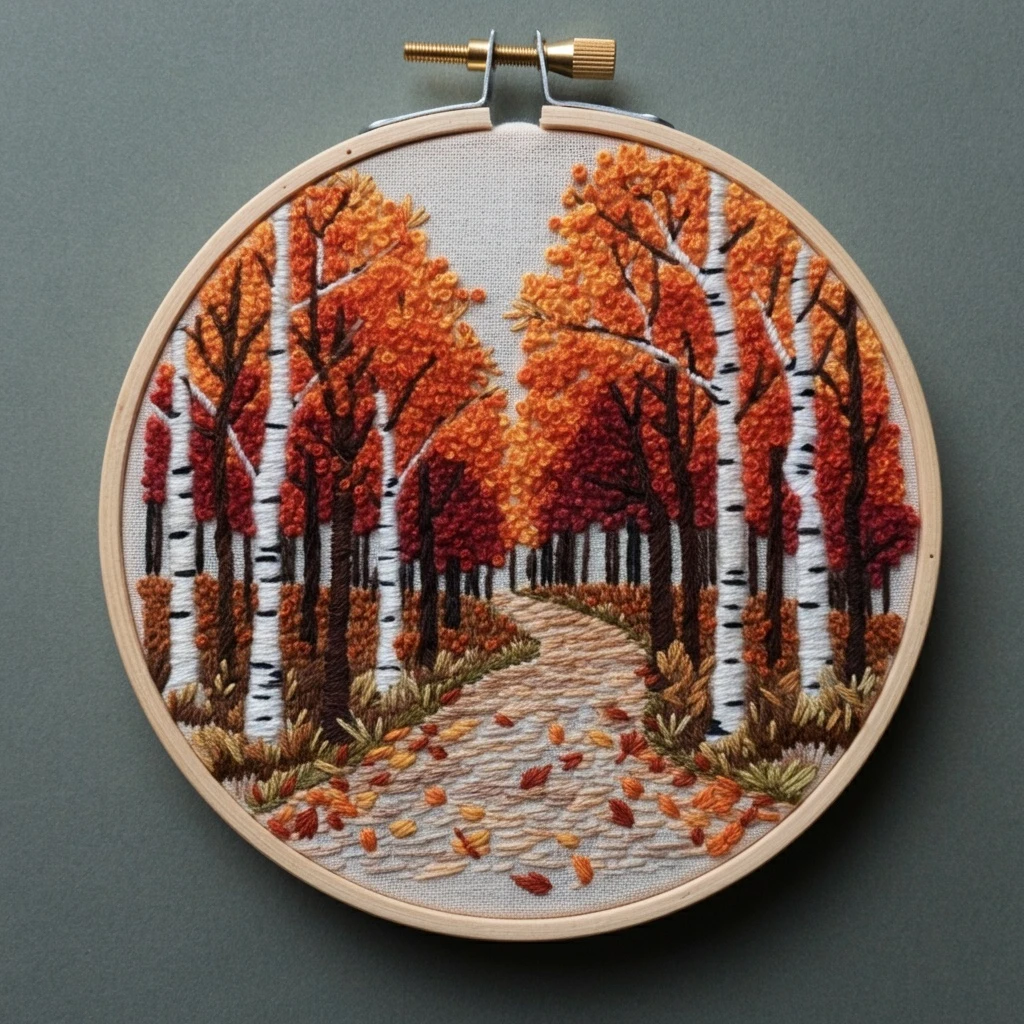
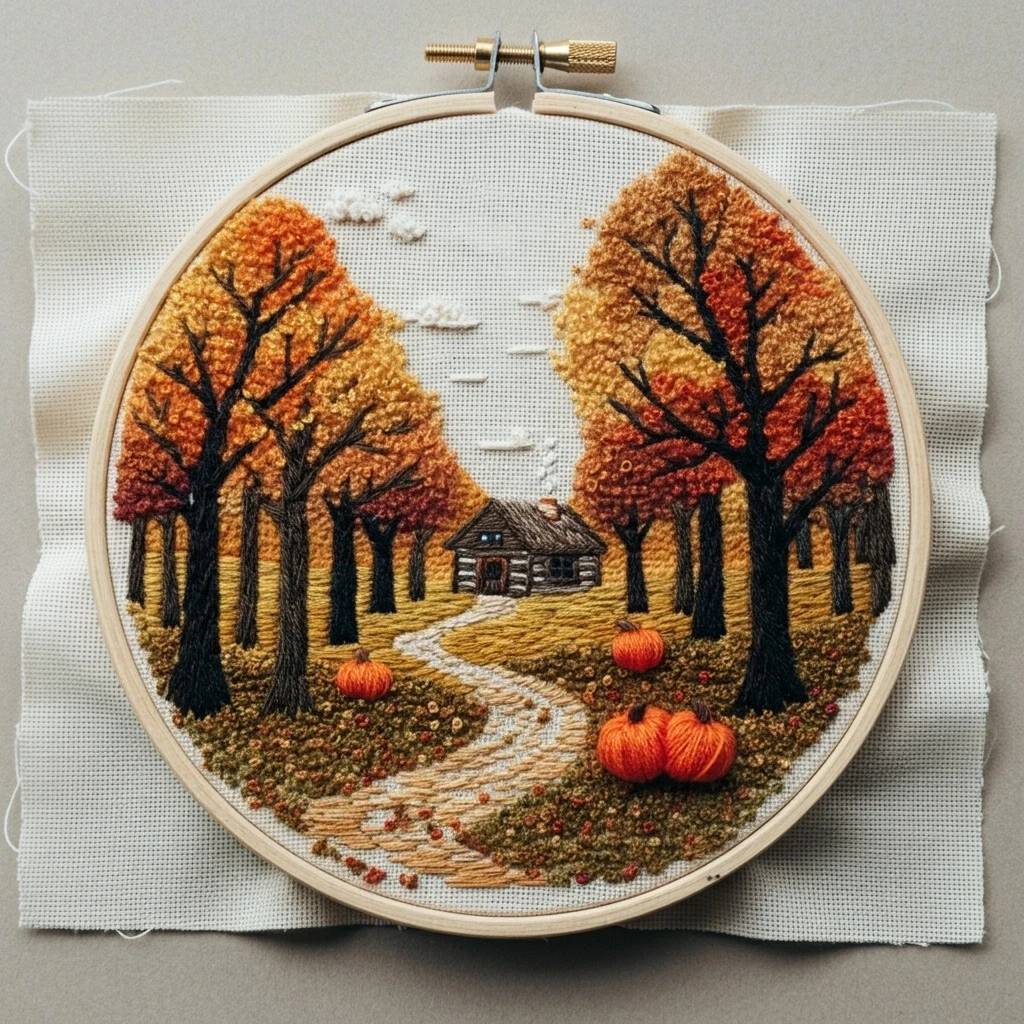
Winding Autumn Path In The Forest
A warm woodland scene with a curving path, layered autumn trees, dark trunks, and glowing gold-orange foliage. The embroidery should feel atmospheric: crisp enough to show the path direction, but softly blended so the forest recedes into depth.
Design Color Read
This design is driven by contrast between a light winding path and richer forest edges. Expect creamy beige highlights on the path, ochre and amber leaves in the canopy, rust-brown leaf litter, olive shadows in the undergrowth, and deep bark browns for vertical tree structure. Keep the center path slightly lighter than the surrounding woods so the eye travels naturally into the scene.
The path
Use pale tan and beige stitches in the middle, then shade the path edges with warmer browns. Curved directional stitches help create the feeling of a trail turning through the trees.
Autumn canopy
Scatter gold, orange, russet, and muted yellow in irregular clusters. Avoid solid blocks; broken stitches create leaf sparkle and distance.
Forest depth
Dark trunks and olive shadow stitches should sit behind the bright leaves. Thin verticals in deep brown anchor the whole composition.
Suggested DMC Palette
The palette below balances warm autumn light with grounded forest shadows. Use the yellows and oranges for leaf clusters, beige tones for the path, and dark browns/greens only where you need definition and depth.
Stitch Plan
| Area | Best stitches | Thread guidance | Practical notes |
|---|---|---|---|
| Winding path | Long and short stitch, split stitch, satin stitch for small bends | 1-2 strands; blend 739 + 841 for soft mid-light | Follow the curve of the path with stitch direction. Keep the center pale and soften the edges with broken brown stitches. |
| Leaf canopy | Seed stitch, detached chain, tiny straight stitch, French knots | 2 strands for foreground leaves; 1 strand for distant speckles | Mix 3822, 783, 976, and 921 randomly. Dense clusters at the top and edges will frame the trail. |
| Tree trunks | Stem stitch, split stitch, whipped back stitch, long and short fill | 1 strand for distant trunks; 2 strands for foreground trunks | Use 840 as the base, 838 for one shaded edge, and a few 3371 details only in the deepest cuts. |
| Forest floor | Seed stitch, fly stitch, straight stitch, couching for grasses | 1-2 strands depending on scale | Layer rust, beige, and olive stitches. Let the foreground be more textured than the background. |
| Outlines & detail | Back stitch, split stitch, tiny straight stitch | Mostly 1 strand | Outline only the strongest trunks and the near path edge. Too much outline will flatten the atmospheric forest effect. |
Shading, Blending & Texture
Autumn leaf blends
- Blend one strand DMC 783 with one strand DMC 976 for warm golden-orange leaf clusters.
- Use DMC 3822 on top-facing leaf flecks to suggest sunlight without needing metallic thread.
- Add DMC 921 near the lower canopy and forest floor for coppery autumn depth.
Path perspective
- Use smaller, closer stitches as the path narrows into the distance; use slightly longer stitches in the foreground.
- Shade only the outer edges with DMC 841 and 840 so the path stays readable.
- Angle the stitches with the curve rather than stitching straight across the trail.
Beginner tip: build the forest in layers. Start with the path, add distant trunks, stitch middle foliage, then finish with foreground leaf and bark details. This keeps the scene from becoming muddy.
Beginner-Friendly Workflow
Hoop, Fabric & Strand Suggestions
Fabric
Ivory, oatmeal, warm beige, or natural linen will enhance the golden autumn palette. Avoid stark white if you want a softer forest atmosphere.
Needle
Use a size 7-9 embroidery needle. A finer needle helps with 1-strand distant trees and clean seed stitches.
Strands
Use 1 strand for background details, 2 strands for most leaves and trunks, and 3 strands only for bold foreground accents.
Outlining & Finishing Details
- Outline the near path edge with broken 1-strand DMC 840 instead of a continuous dark line.
- Use DMC 838 for the shaded side of larger trunks; reserve DMC 3371 for tiny notches and root shadows.
- Add final leaf highlights after the main stitching so they sit visibly on top of the canopy.
- Step back often. If the forest feels too busy, add a few pale path stitches rather than more dark outlines.
- Press the finished embroidery face down on a towel to preserve raised knots and seed-stitch texture.