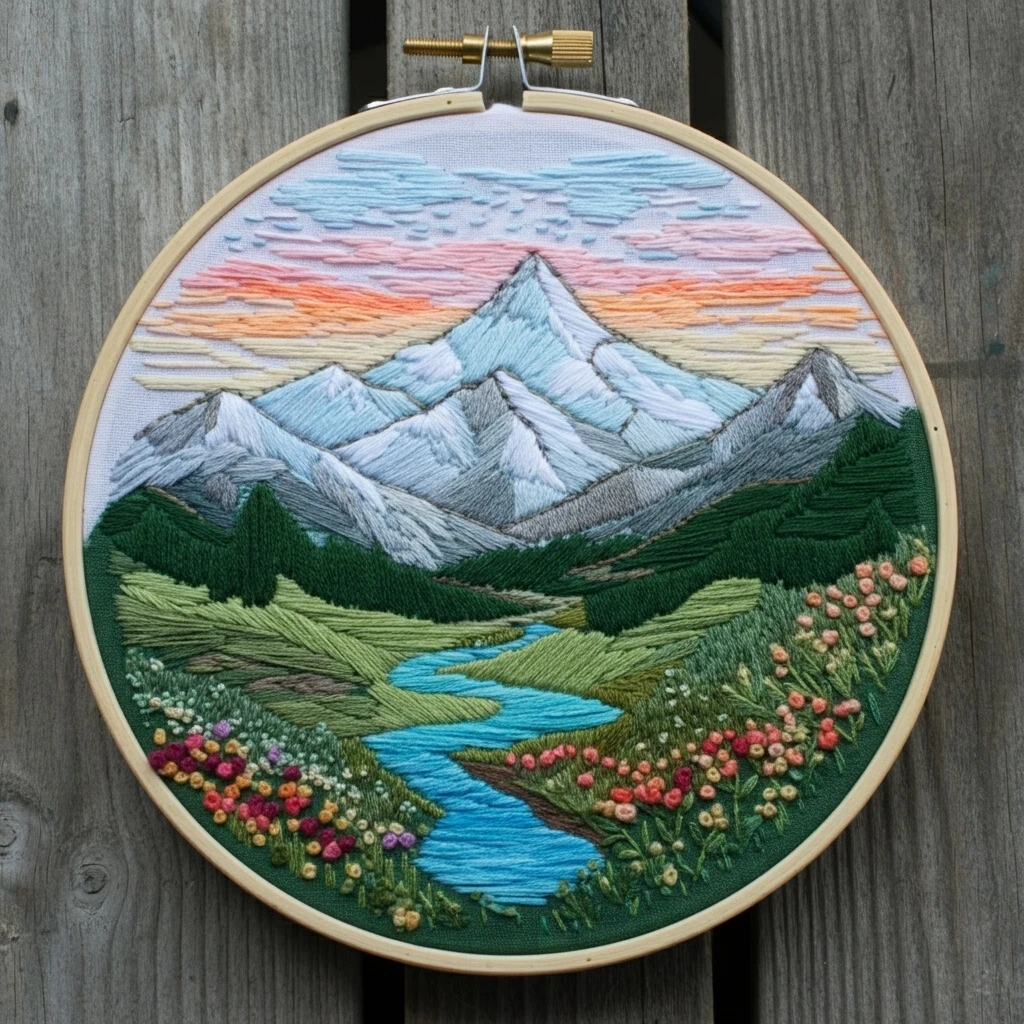

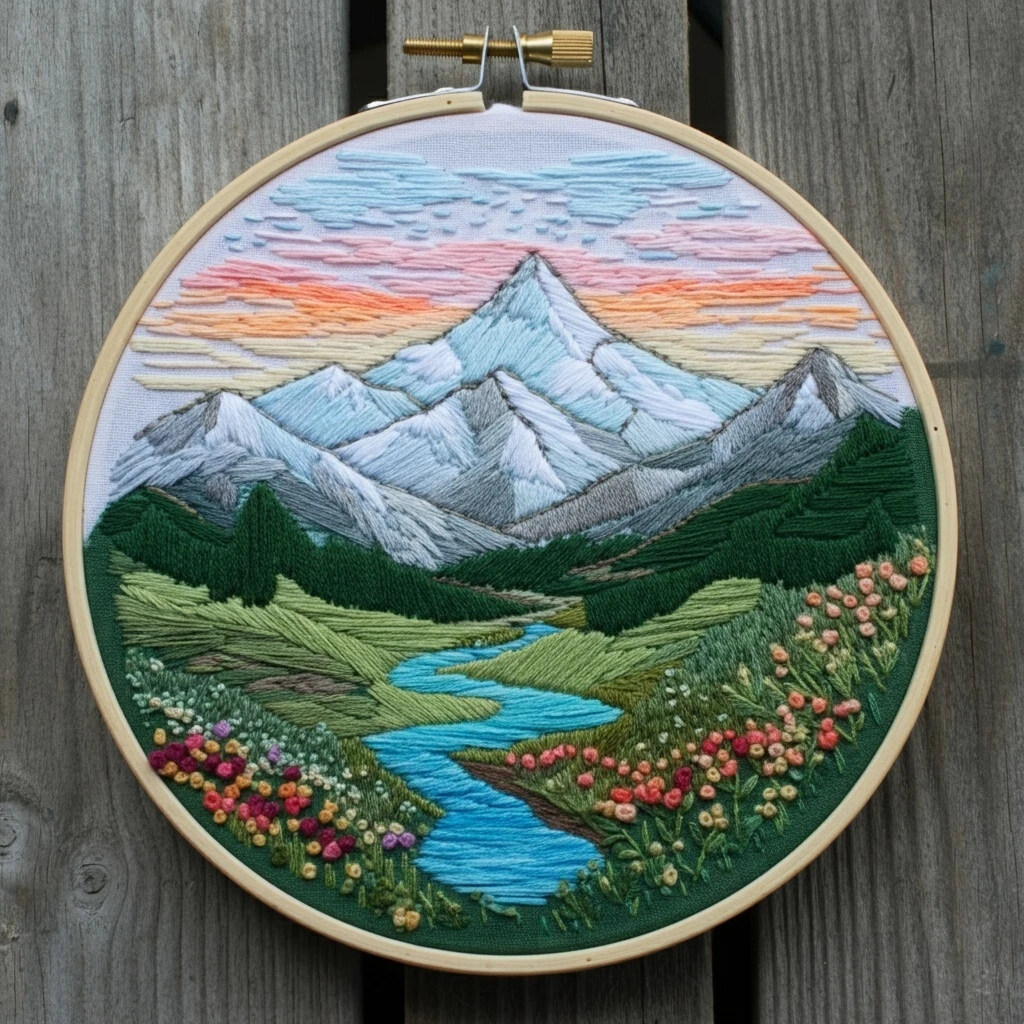
Rustic Cabin And Pumpkin Patch Autumn
A cozy fall landscape guide built around a small log cabin, dark tree trunks, golden fields, rounded pumpkins, warm sunset foliage, and muted woodland greens.
Design read
The design reads as a harvest scene: a small wooden cabin sits in the middle distance, framed by two tall autumn trees and a warm pumpkin patch in front. The palette is dominated by pumpkin orange, burnt sienna foliage, bark brown, golden straw, olive greens, and soft sky neutrals. The key to stitching it well is separating the scene into layers: sky first, trees and distant fields second, cabin third, pumpkins and foreground texture last.
Stitching mood
Keep the piece rustic rather than overly polished. Let field stitches run in broken, directional rows; use slightly uneven pumpkin ribs; keep tree branches dark and wiry; and reserve the brightest orange highlights for pumpkin crowns and sunlit leaf tips.
Polished DMC palette
| Color | DMC | Name | Practical use notes |
|---|---|---|---|
| 740 | Tangerine | Brightest pumpkin ridges, leaf sparks, and tiny sunlit accents. Use sparingly so it stays special. | |
| 741 | Tangerine, Medium | Main pumpkin fill and warm orange foliage. Good mid-tone for satin or long-and-short pumpkin sections. | |
| 920 | Copper, Medium | Deep pumpkin grooves, shaded undersides, and rusty leaves around the tree canopy. | |
| 919 | Red Copper | Darkest orange-red shadows, leaf clusters against trunks, and low pumpkin creases. | |
| 3826 | Golden Brown | Golden field strokes, harvest grasses, and warm highlights on the cabin logs. | |
| 977 | Golden Brown, Light | Soft straw-yellow leaf tips, dry grasses, and path highlights. | |
| 3821 | Straw | Light field glints, far grasses, and fine highlights along the winding path. | |
| 801 | Coffee Brown, Dark | Main log cabin walls, fence-like lines, tree branch structure, and pumpkin stem shadows. | |
| 898 | Coffee Brown, Very Dark | Cabin roof edge, door, window divisions, and strongest bark shadows. | |
| 3371 | Black Brown | Selective final outlining around roof, trunks, pumpkin separations, and the deepest crevices. Avoid overusing it. | |
| 730 | Olive Green, Very Dark | Dark evergreen shapes, shaded field edges, and background shrub masses. | |
| 732 | Olive Green | Main grassy field, pumpkin leaves, and mid-tone woodland ground. | |
| 734 | Olive Green, Light | Sunlit field strokes and grass highlights near pumpkins. | |
| 895 | Hunter Green, Very Dark | Deep pine silhouettes and shaded foliage behind the cabin. | |
| 355 | Terra Cotta, Dark | Brick-red leaves, warm roof reflections, and accents in the autumn canopy. | |
| 356 | Terra Cotta, Medium | Soft transitions between orange leaves and brown branches; also useful for cabin side shadows. | |
| 3864 | Mocha Beige, Light | Path base, distant cabin highlights, and pale dry-grass strokes. | |
| 3863 | Mocha Beige, Medium | Path shadows, muted fence/ground lines, and rustic neutral blending. | |
| 927 | Gray Green, Light | Soft sky or distant haze if the design includes pale blue-gray space above the cabin. | |
| 739 | Tan, Ultra Very Light | Warm window glow, pale path sparkle, and the tiniest highlights on pumpkin tops. |
Palette strategy: use the orange family for pumpkins and leaf clusters, the olive family for ground and trees, the coffee browns for cabin structure, and mocha neutrals for the path and atmospheric details. On darker linen, strengthen the sky/path with 739 and 3864; on white fabric, add more 3863 and 730 to keep the scene grounded.
Layer the landscape
Stitch from back to front: sky and distant haze, far field, trees, cabin, path, pumpkins, then final outlines. This prevents foreground pumpkins from being crowded by later stitches.
Keep the cabin crisp
The cabin is a small focal point, so use neat split-stitch edges, short horizontal log stitches, and a limited number of dark details. Too many heavy lines can make it look muddy.
Make pumpkins dimensional
Shade each pumpkin rib separately: light at the ridge, medium across the curve, dark in the groove. Tiny highlights near the upper left make them look round.
Stitch plan by motif
Thread-count guidance
Needles & fabric
- Use a size 7 or 8 embroidery needle for 2-strand filling, and switch to a size 9 or 10 for single-strand branches and cabin details.
- Natural linen, cream cotton, or oatmeal evenweave complements the cabin and patch without fighting the oranges.
- If the fabric is loose or soft, add a light backing stabilizer; the small cabin and path edges will stay much cleaner.
Blending ideas
- Pumpkin glow Blend one strand 741 with one strand 740 for bright ridges; blend 741 with 920 for curved sides.
- Burnt leaves Blend 355 with 920 for red-orange foliage that feels mature and autumnal.
- Dry field Blend 3826 with 734 for grassy-gold rows; blend 3863 with 977 for dusty path edges.
- Cabin warmth Blend 801 with 3826 for sunlit logs, then reserve 898 for crevices and roof edges.
Outlining & shading
- Outline the cabin more clearly than the trees; this keeps the center focal point readable.
- Use 3371 only at the final pass, and only where two dark forms meet: under the roof, inside the doorway, and along a few tree-trunk edges.
- Shade pumpkins from groove to ridge rather than from left to right. Each rib should have its own light-to-dark curve.
- For distant elements, avoid heavy outlines. Broken stitches and slightly faded colors make the scene feel deeper.
Beginner-friendly practical tips
- Transfer only the major shapes first: tree trunks, cabin, path, and pumpkin outlines. Add tiny grasses and leaf marks freehand as you stitch.
- Work small areas completely before moving across the hoop, but do not finish all outlines first. Filling against a hard outline can make the landscape stiff.
- Shorten your strands to 14–16 inches for orange and brown floss; these colors show fuzz quickly when pulled through dense areas.
- Step back often. Landscape embroidery needs value contrast more than perfect individual stitches.
- Press from the back over a towel when finished so the pumpkin ridges and leaf knots stay raised.
Suggested stitching sequence
| Step | Area | Why this order works |
|---|---|---|
| 1 | Sky, haze, and distant color bands | Light background stitching stays clean and will not snag on raised pumpkins or knots. |
| 2 | Far fields and ground shapes | Directional rows create the landscape base before focal details are added. |
| 3 | Trees and evergreen silhouettes | Trunks and dark greens frame the cabin and establish depth. |
| 4 | Cabin walls, roof, door, windows | The cabin is central; complete it before foreground textures crowd the space. |
| 5 | Path, furrows, and pumpkin patch rows | These guide the viewer's eye into the design and sit beneath the pumpkins. |
| 6 | Pumpkins, grasses, leaf accents | Foreground details should sit on top, with the strongest color and texture saved for last. |
| 7 | Selective final outlines and highlights | A few dark lines and bright glints sharpen the scene without making it cartoonish. |