
Spiral Galaxy and Planets Cosmic Embroidery
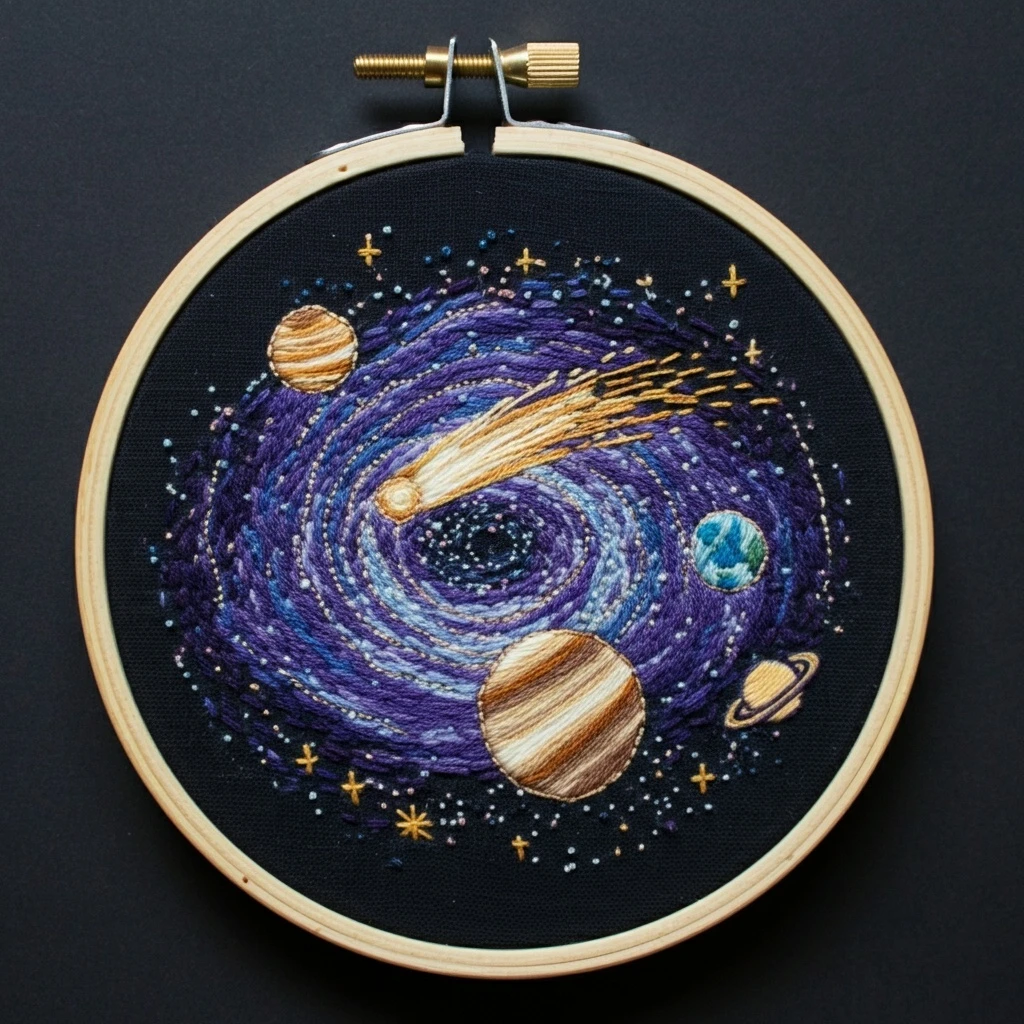
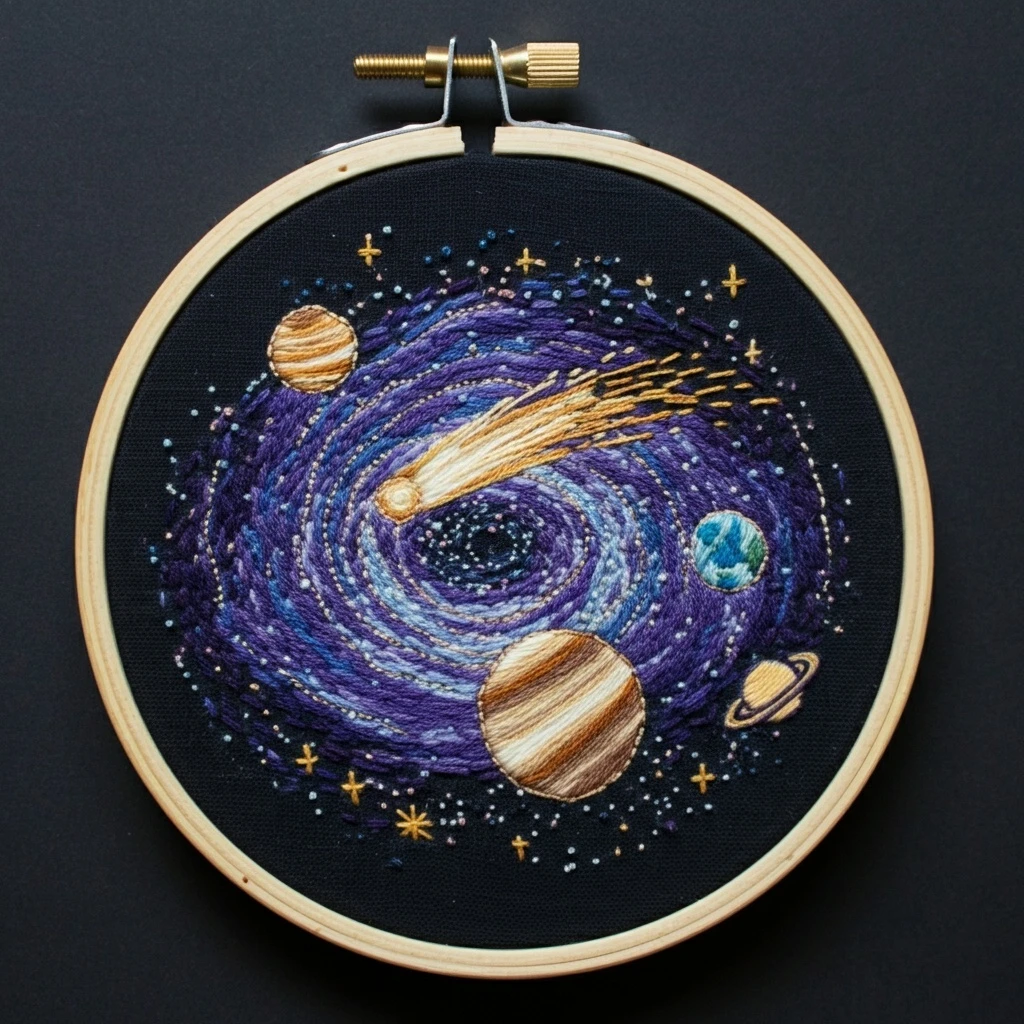
A polished stitching plan for a dramatic black-fabric hoop with a swirling violet-blue galaxy, glowing comet, golden stars, and softly shaded planets. The design benefits from layered directional stitches, sparkling French knots, and controlled thread blending.
Design Color Read
The reference artwork is built around a deep black ground cloth, an oval spiral galaxy in layered indigo, violet, blue, and icy lavender, plus warm golden-yellow starbursts and a comet trail. The planets introduce cream, tan, copper brown, teal, aqua, and pale yellow accents. Keep the background fabric visible between stitches so the galaxy looks airy rather than filled like a patch.
Suggested DMC Floss Palette
These DMC choices match the visible tones in the sample image and are organized by practical embroidery use.
Stitch Map by Design Area
| Area | Recommended stitches | Thread count & notes |
|---|---|---|
| Galaxy spiral | Curved split stitch, stem stitch, long-and-short stitch, and occasional couching for sweeping arcs. | Use 1–2 strands. Keep strokes curved around the center. Alternate DMC 823, 791, 333, 340, 156, 3843, and 3753 in broken bands. |
| Central dark vortex | Tiny seed stitches, short split stitches, and small French knots. | Use 1 strand in 310, 823, and 3753. Leave a small dark open center so the swirl has depth. |
| Comet and tail | Satin stitch for core, straight stitches and couching for tail streaks. | Use 2 strands for the body and 1 strand for thin trailing rays. Blend 746 with 743 at the center, then 743 and 782 outward. |
| Planets | Padded satin stitch, long-and-short shading, curved stem stitch bands. | Use 2 strands for coverage. Follow each planet’s round contour; do not stitch horizontal bands too stiffly. |
| Stars and cosmic dust | French knots, colonial knots, single seed stitches, star crosses, detached chain for small sparkles. | Use 1 strand for tiny dust and 2 strands for featured gold stars. Vary knot size for natural depth. |
| Saturn ring | Back stitch, whipped back stitch, or couched straight thread. | Use 1 strand for a crisp ring line. Add a few 782 shadow stitches below the ring. |
Blending & Shading Guidance
Galaxy depth
Work from the darkest arcs first, then layer mid-violet and pale blue over the top in shorter broken stitches. This prevents the spiral from becoming a flat block of color.
Glow effect
For the brightest inner spiral, blend one strand DMC 3753 with one strand DMC 156. Add a few tiny DMC 746 stitches close to the comet path.
Planet volume
Shade each round planet with curved bands. Put darker brown or navy at one edge and cream highlights slightly off-center to suggest a light source.
Useful two-strand blends
- Deep galaxy: 1 strand DMC 823 + 1 strand DMC 333.
- Electric violet: 1 strand DMC 791 + 1 strand DMC 340.
- Frosty spiral glow: 1 strand DMC 156 + 1 strand DMC 3753.
- Comet warmth: 1 strand DMC 743 + 1 strand DMC 782.
- Striped planet highlight: 1 strand DMC 3823 + 1 strand DMC 3826.
Outlining & Texture Suggestions
Keep outlines selective
Do not outline every galaxy band. Instead, use short dark split stitches along a few outer violet arcs, around planet edges, and at the central vortex. This keeps the design soft and painterly.
Add dimensional sparkle
Use French knots in DMC 746, 3753, 3845, and 743. Make some with a single wrap and others with two wraps. A few metallic gold or silver accents can replace some star knots if desired.
For the long comet trail, try couching: lay a single strand of 743 or 782 along the sweeping flame shape, then tack it down with tiny stitches in matching thread. This creates a smooth, blazing line without fighting the fabric grain.
Beginner-Friendly Stitching Order
Practical Tips for a Clean Finish
Thread management
Use shorter thread lengths on black fabric because fuzz is more visible. Condition metallic thread lightly if you add sparkle, and use a larger needle to reduce shredding.
Hoop tension
Keep the dark fabric drum-tight but not stretched out of shape. Re-tighten before stitching long galaxy arcs so curves remain smooth.
Star placement
Place the biggest stars first, then fill with tiny dots. Avoid making a perfect ring of stars; uneven spacing feels more natural and cosmic.
Back neatness
Because the design uses many small dots, avoid carrying pale threads across open black areas. Start and stop often to prevent show-through.