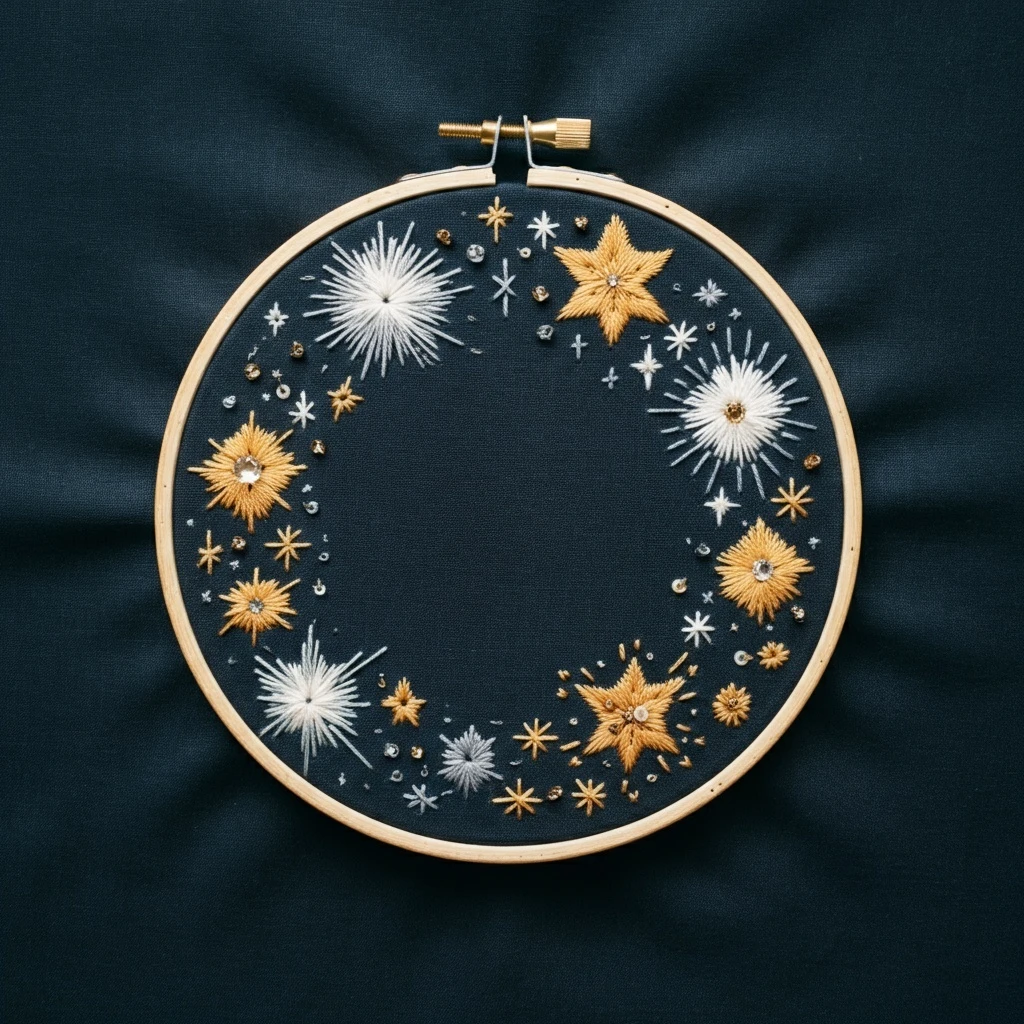

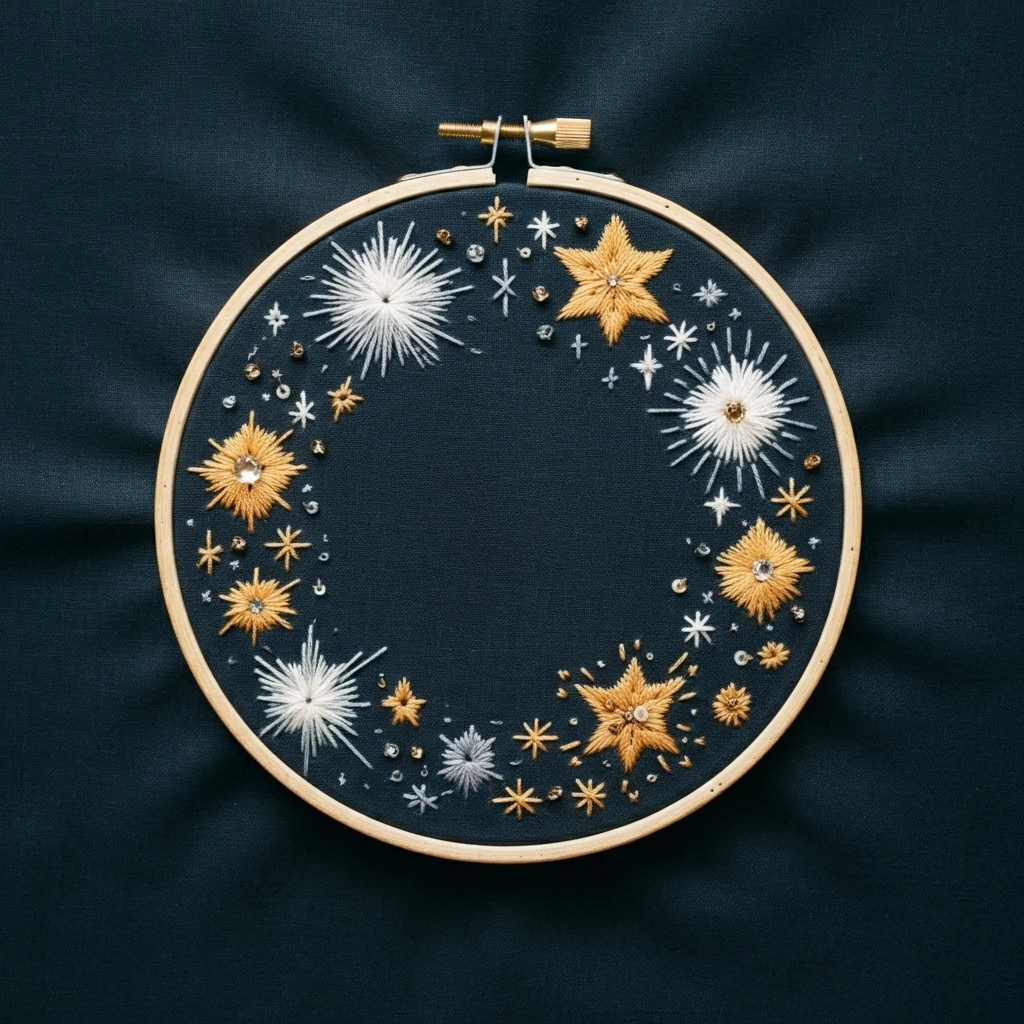
Celestial Star Wreath
This celestial wreath design is built around a graceful circular arrangement of stars, moons, tiny dots, and possibly delicate leafy or botanical accents. The stitched version should feel balanced and luminous: a clean wreath arc, varied star sizes, warm gold sparkle, soft moonlit cream highlights, and enough open space inside the circle to keep the design elegant.
Polished DMC Color Palette
This palette emphasizes warm celestial golds, creamy moonlight, and soft blue-lavender accents. Muted greens are included for optional wreath sprigs or botanical details if the design includes leaves around the star circle.
Stitch Map by Design Element
Thread Count & Blending Guide
Fine details
Use 1 strand for star rays, crescent contours, tiny dots, thin wreath guides, and small leaf veins. One strand keeps the wreath delicate and polished.
Main motifs
Use 2 strands for larger stars, moon fills, leaves, and visible wreath stems. Two strands give clean coverage without making the circular arrangement too heavy.
Raised sparkle
Use 2–3 strands for prominent French knots and focal star centers. Use three strands only on a few important points so the wreath still feels refined.
Shading, Outlining & Texture Suggestions
Balanced wreath shape
- Mark a faint circle before stitching so stars stay evenly arranged.
- Place the largest motifs first at balanced points around the wreath.
- Fill gaps with medium stars, then tiny knots and dots.
- Leave the center open so the wreath feels light and intentional.
Star sparkle
- Use varied star sizes to create movement around the circle.
- Reserve B5200 and 3865 for the brightest pinpoints only.
- Use 977 at the base of larger gold stars for gentle depth.
- Mix knots, crosses, and straight rays rather than repeating one star type everywhere.
Moonlit softness
- Shade crescents with 822 on the inner curve and 3865 on the outer highlight.
- Use pale blue and lavender stitches around moons for a soft glow effect.
- Avoid heavy black outlines; muted gray, gold, or cream is more elegant.
- Keep moon motifs smoother than the surrounding textured star knots.
Greenery control
- Keep sprigs secondary to the celestial motifs by using muted greens.
- Alternate leaf direction so the wreath looks natural, not mechanical.
- Use darker green near stems and lighter green at tips.
- Skip heavy outlines on small leaves; stitch direction defines them well enough.
Beginner-Friendly Stitching Order
- Mark the circle: lightly draw the wreath guide, placing the largest stars and moon motifs first. Keep the guide faint so it disappears under or between stitches.
- Stitch focal motifs: complete the largest stars, moons, or crescent shapes before adding small dots.
- Add sprigs if included: stitch stems and leaves next, tucking them behind the celestial motifs where possible.
- Fill with medium stars: place secondary stars around the circle to even out the visual weight.
- Add tiny dots and knots: scatter small gold, cream, blue, and lavender details along the wreath curve.
- Finish with highlights: add B5200 pinpoints, final star tips, and any small outline corrections last.
Practical Tips for a Clean Finish
Fabric & hoop
Warm cream cotton, linen, or cotton-linen makes gold and moonlit stitches glow. Keep the fabric drum-tight so the circular wreath spacing remains even and the star rays stay crisp.
Needle choice
Use a sharp embroidery needle size 7–9 for one- and two-strand work. For three-strand French knots, use a slightly larger needle so the wraps pull through smoothly.
Spacing tip
Step back after every few motifs. A celestial wreath depends on rhythm and breathing room, so it is better to leave a small gap than to overfill the circle.
Clean sparkle
Use shorter lengths of gold and pale floss, strip and recombine strands before stitching, and save the brightest white stitches for the very end so they stay crisp.